


























Views
Downloads


Essential Grade 9 Vocabulary Worksheet | Printable ELA
Paste this activity's link or code into your existing LMS (Google Classroom, Canvas, Teams, Schoology, Moodle, etc.).
Students can open and work on the activity right away, with no student login required.
You'll still be able to track student progress and results from your teacher account.
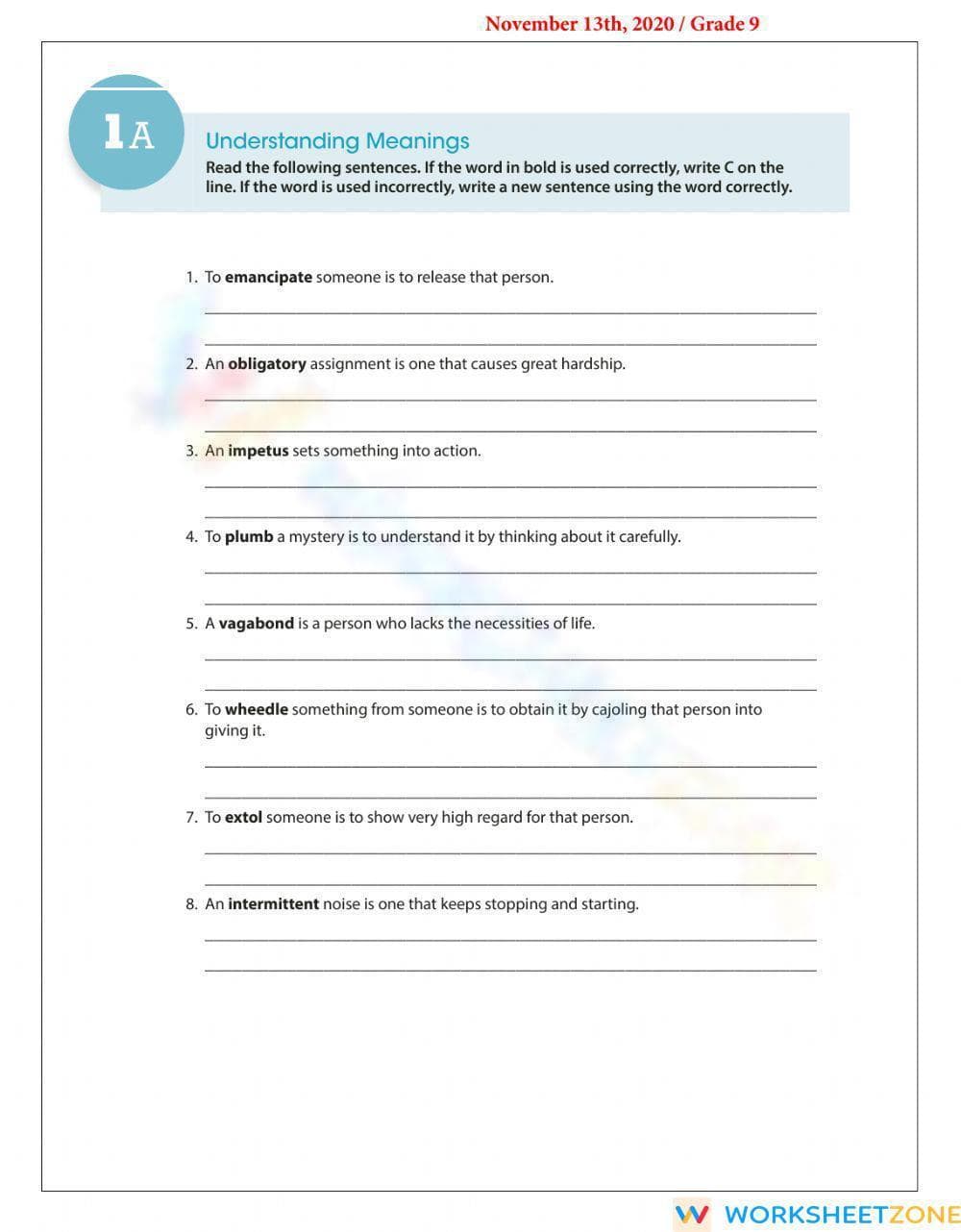
Strengthen student vocabulary acquisition with this targeted Grade 9 English Language Arts worksheet. Designed to bridge the gap between rote memorization and practical application, this resource challenges learners to evaluate the semantic accuracy of complex tier-two words in context. Students must determine if words are used correctly and synthesize their understanding by composing original, contextually rich sentences for any identified errors.
At a Glance
- Grade: 9 · Subject: English Language Arts (ELA)
- Standard:
CCSS.ELA-LITERACY.L.9-10.4— Determine or clarify the meaning of unknown and multiple-meaning words and phrases- Skill Focus: Contextual word analysis and sentence construction
- Format: 2 pages · 15 problems · Answer key included · PDF
- Best For: Independent practice or bell-ringer activities
- Time: 20–30 minutes
What's Inside
This comprehensive two-page PDF features 15 rigorous vocabulary exercises focusing on high-level academic terms such as emancipate, insuperable, and visage. Each task presents a sentence where a bolded word is used; students must evaluate its validity. If incorrect, students draft a new, correct sentence in dedicated workspace. A consolidated word bank is located at the conclusion of the second page for reference.
Zero-Prep Workflow
Implementing this resource in the classroom is efficient and straightforward. Print and distribute the two-page document as a self-contained warm-up or homework assignment; clear instructions require zero teacher introduction. Review responses using the included answer key for immediate feedback. Total teacher preparation time for this high-impact literacy activity is under two minutes.
Standards Alignment
This resource is strictly aligned to CCSS.ELA-LITERACY.L.9-10.4: "Determine or clarify the meaning of unknown and multiple-meaning words and phrases based on 9th-10th grade level reading and content, choosing flexibly from a range of strategies." Specifically, it addresses sub-standard 4.a by requiring students to use context clues. This standard code can be copied into lesson plans, IEP goals, or curriculum mapping tools to ensure instructional alignment.
How to Use It
This worksheet is ideal for use during the independent practice phase of a vocabulary unit. It functions exceptionally well as a formative assessment tool to gauge student mastery of lesson-specific vocabulary before a summative exam. For a collaborative twist, have students work in pairs to debate the "C" (correct) or "I" (incorrect) status of each sentence before writing their corrections. Teachers should observe whether students can explain *why* a word is used incorrectly, as this demonstrates a deeper level of semantic processing.
Who It's For
While specifically designed for 9th-grade ELA students, this resource is highly effective for advanced 8th graders or 10th-grade students requiring additional literacy support. It is particularly beneficial for English Language Learners (ELL) at an advanced proficiency level who are working to master academic English. This worksheet pairs naturally with a vocabulary anchor chart or a short literary passage that utilizes these specific tier-two academic terms in a narrative or expository setting.
This instructional resource directly addresses the critical need for Tier 2 vocabulary instruction, promoting the deep encoding of language necessary for high-school-level reading comprehension. The worksheet provides fifteen structured opportunities for students to practice essential L.9-10.4 skills, moving beyond simple recognition toward active production. Sentence-writing tasks ensure students integrate new words into their active mental lexicon. This systematic approach aligns with the gradual release of responsibility model, providing a stable platform for demonstrating mastery of academic language and supporting evidence-based literacy outcomes.


