


























Views
Downloads

Writing the Letter O Worksheet | Essential Kindergarten
Paste this activity's link or code into your existing LMS (Google Classroom, Canvas, Teams, Schoology, Moodle, etc.).
Students can open and work on the activity right away, with no student login required.
You'll still be able to track student progress and results from your teacher account.
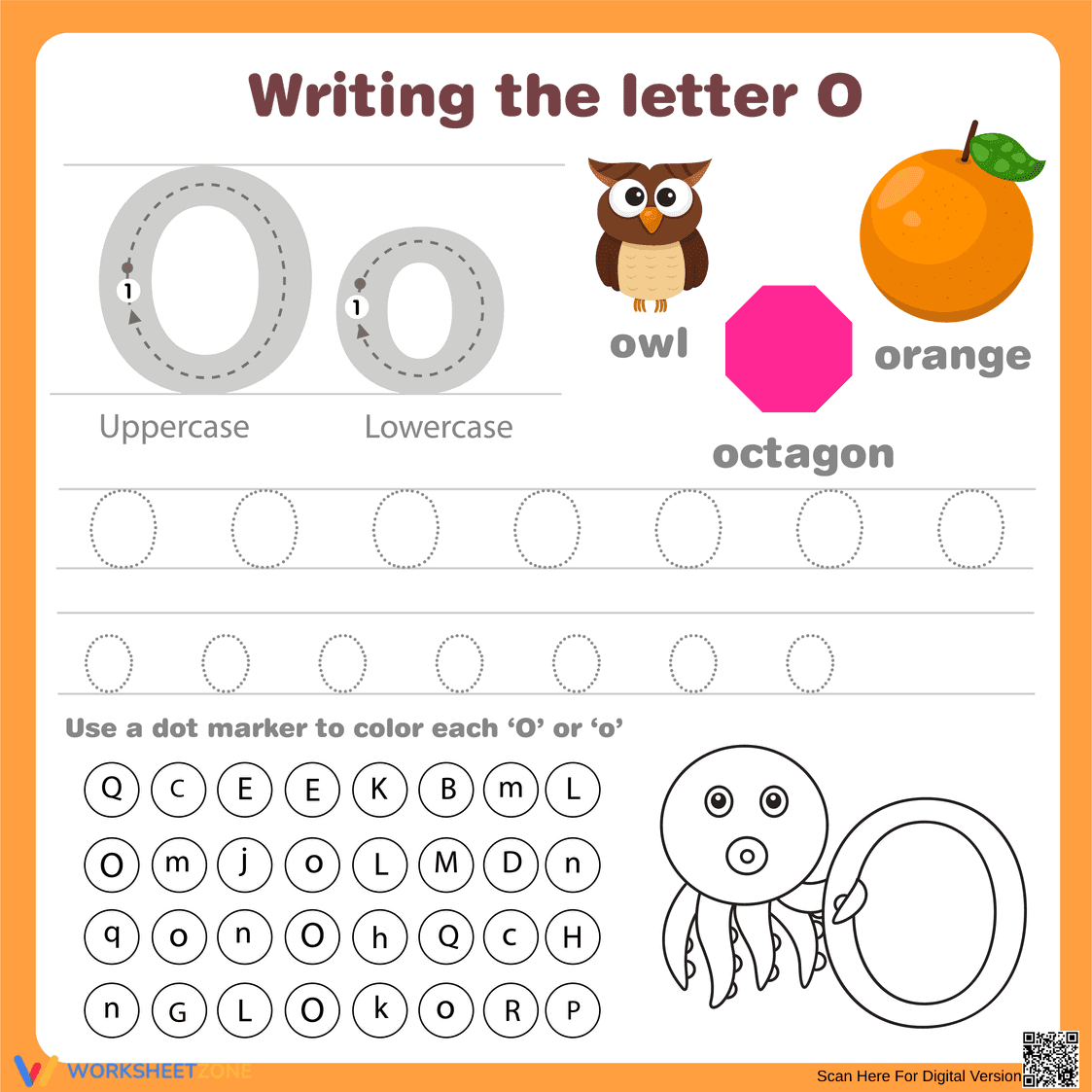
This Kindergarten handwriting worksheet provides a comprehensive approach to mastering the letter O. Students engage in multi-sensory activities including directional tracing, visual discrimination, and coloring to build foundational literacy skills. By focusing on both uppercase and lowercase forms, learners develop the fine motor control necessary for legible writing and early reading success.
At a Glance
- Grade: Kindergarten · Subject: English Handwriting
- Standard:
CCSS.ELA-LITERACY.L.K.1.A— Print many upper- and lowercase letters correctly- Skill Focus: Letter O formation and recognition
- Format: 1 page · 49 tasks · Answer key included · PDF
- Best For: Morning work or literacy centers
- Time: 15–20 minutes
The worksheet features a structured layout starting with large, numbered directional arrows for the letter O. It includes 14 individual tracing opportunities for both cases, a "dot marker" letter search containing 32 distinct characters for visual discrimination, and thematic vocabulary images like an owl and octopus. A full-page PDF format ensures high-quality printing for classroom use.
This resource is designed for immediate classroom implementation with a three-step workflow. First, print the single-page PDF (30 seconds). Second, distribute to students with crayons or dot markers (1 minute). Third, conduct a quick visual review of the letter search section to check for accuracy (1 minute). Total teacher preparation time is under three minutes, making it an ideal sub-plan.
This resource aligns with CCSS.ELA-LITERACY.L.K.1.A, which requires students to print many upper- and lowercase letters. It also supports phonological awareness by connecting the letter shape to initial sounds in words like "orange" and "octagon." This standard code can be copied directly into lesson plans, IEP goals, or district curriculum mapping tools.
Use this worksheet during the independent practice phase of a gradual release lesson on the alphabet. It serves as an excellent formative assessment tool; observe students as they trace to ensure they follow the numbered directional arrows rather than drawing circles from the bottom up. Expected completion time ranges from 15 to 20 minutes depending on fine motor speed.
This activity is tailored for Preschool and Kindergarten students beginning their handwriting journey. It is particularly effective for English Language Learners (ELLs) who benefit from the visual cues and vocabulary associations. Pair this with a physical alphabet manipulative or a letter-sound anchor chart for a complete instructional block.
According to the RAND AIRS 2024 report, early handwriting instruction is a critical predictor of later reading fluency and spelling accuracy. This worksheet addresses the specific mechanical needs of early learners by providing 49 distinct opportunities for letter interaction, ranging from tracing to identification. By isolating the letter O, the resource reduces cognitive load, allowing students to focus entirely on the circular stroke and visual discrimination between similar characters like 'Q' and 'C'. Research from Fisher & Frey (2014) emphasizes that repetitive, scaffolded practice in letter formation builds the muscle memory required for automaticity in writing. This worksheet's inclusion of both uppercase and lowercase forms ensures that students meet the CCSS.ELA-LITERACY.L.K.1.A standard through varied, engaging tasks. Educators can use this tool to bridge the gap between letter recognition and production, providing a stable foundation for the Kindergarten literacy curriculum.


