




























Views
Downloads

Writing Interest Inventory | Essential Grade 3-6 Guide

Paste this activity's link or code into your existing LMS (Google Classroom, Canvas, Teams, Schoology, Moodle, etc.).
Students can open and work on the activity right away, with no student login required.
You'll still be able to track student progress and results from your teacher account.
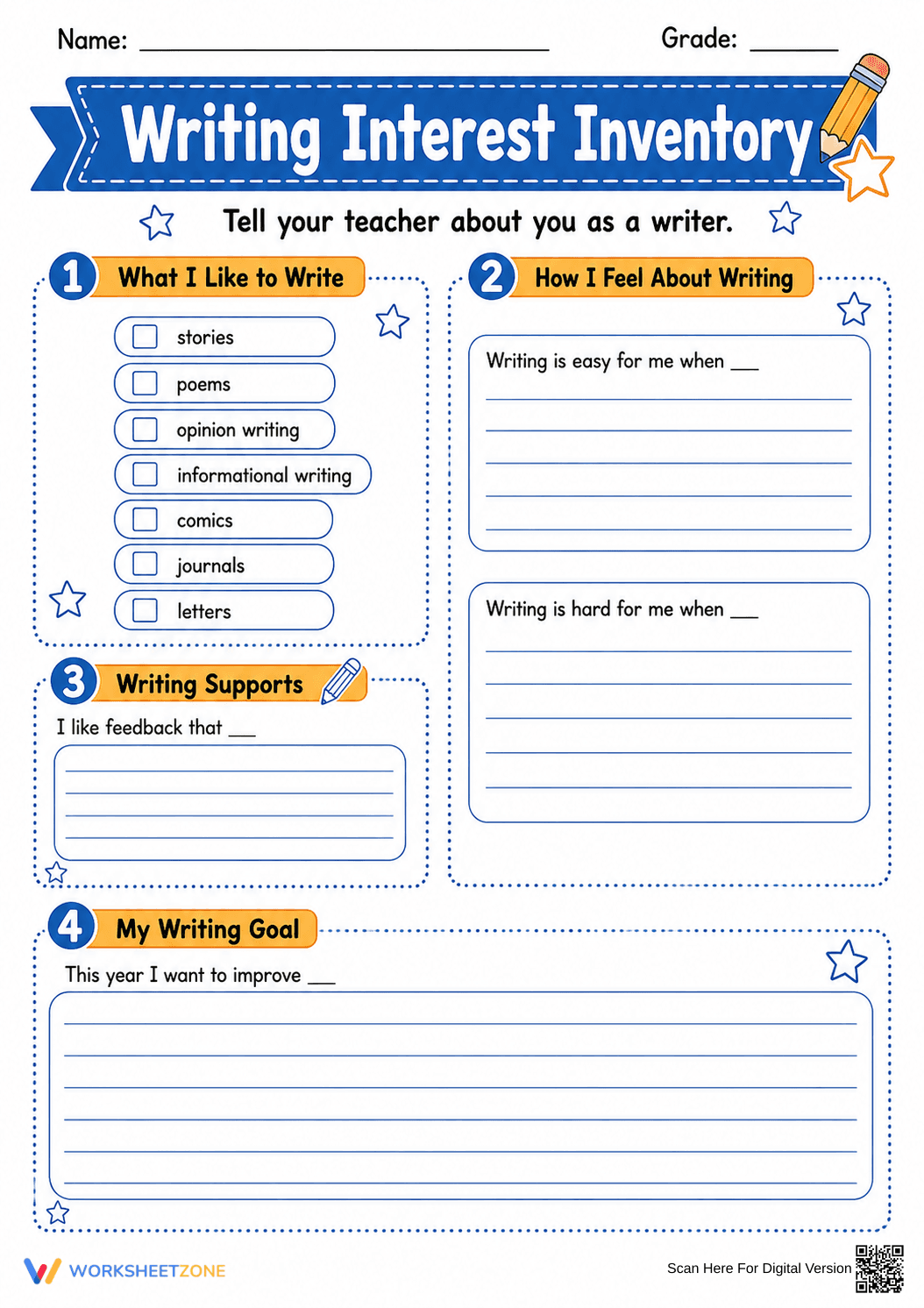
This Grade 3-6 Writing Interest Inventory provides a structured way for students to communicate their preferences, strengths, and challenges as writers. By identifying specific genres and support needs, students develop self-awareness that fuels engagement. This essential tool helps teachers tailor instruction to individual student needs from the very first day of a writing workshop.
At a Glance
- Grade: 3-6 · Subject: ELA / Writing
- Standard:
CCSS.ELA-LITERACY.W.4.10— Write routinely over extended and shorter time frames for various tasks- Skill Focus: Writing Self-Assessment & Goal Setting
- Format: 1 page · 11 tasks · No answer key needed · PDF
- Best For: Back-to-school or new writing units
- Time: 15–20 minutes
The worksheet features four distinct sections designed to capture a holistic view of the student's writing profile. It includes a genre checklist for seven different writing types, two reflective sentence starters regarding ease and difficulty, a dedicated space for feedback preferences, and a ruled section for annual goal setting. The clean layout uses blue and orange accents to maintain a professional yet inviting notebook aesthetic.
- Print: Select the single-page PDF and print enough copies for your class (1 minute).
- Distribute: Hand out the inventory at the start of your writing block or as a morning work activity (1 minute).
- Review: Collect the completed forms to immediately identify which students prefer comics over essays or who requires specific types of feedback (5 minutes). This zero-prep workflow ensures you have actionable data without any teacher-led setup.
This resource aligns with `CCSS.ELA-LITERACY.W.4.10`, which requires students to write routinely for a range of discipline-specific tasks, purposes, and audiences. By reflecting on their own process, students engage in the metacognitive work necessary to sustain writing stamina. This standard code can be copied directly into lesson plans, IEP goals, or district curriculum mapping tools.
Use this inventory during the first week of school to build a classroom writing community. It serves as a formative assessment of student attitudes toward the subject. Alternatively, assign it before starting a new genre unit to see which students already feel confident in that area. Observe how students describe their "hard" moments to identify candidates for small-group strategy instruction.
This worksheet is ideal for general education classrooms in grades 3, 4, 5, and 6. It is particularly helpful for students with IEPs or 504 plans, as it allows them to explicitly state their support needs. Pair this inventory with a "Writer's Notebook" setup lesson or an anchor chart about the different genres of writing.
Research by Fisher & Frey (2014) emphasizes that student agency and choice are critical components of a successful writing workshop. When students are given the opportunity to reflect on their own interests and set personal growth goals, they demonstrate higher levels of persistence and task value. This Writing Interest Inventory facilitates that reflection by mapping student preferences to the requirements of `CCSS.ELA-LITERACY.W.4.10`. By documenting what students find "easy" or "hard," teachers can implement more effective scaffolding strategies that align with the gradual release of responsibility model. Data from the NAEP suggests that students who engage in frequent, varied writing tasks perform better on standardized assessments. This 1-page tool provides the foundational data needed to create those varied opportunities, ensuring that instruction is both standards-aligned and responsive to the unique identities of the young writers in the classroom.


