


























Views
Downloads

Printable First and Last Name Worksheet | Grade 1 ELA
Paste this activity's link or code into your existing LMS (Google Classroom, Canvas, Teams, Schoology, Moodle, etc.).
Students can open and work on the activity right away, with no student login required.
You'll still be able to track student progress and results from your teacher account.
This foundational handwriting worksheet helps first-grade students master writing their first and last names with proper letter formation and spacing. By providing structured repetition and clear guidelines, the resource ensures young learners develop the fine motor control required for daily classroom tasks and personal identification.
At a Glance
- Grade: 1 · Subject: ELA
- Standard:
CCSS.ELA-LITERACY.L.1.1.A— Print all upper- and lowercase letters accurately.- Skill Focus: Writing first and last name
- Format: 3 pages · 5 tasks · No answer key · PDF
- Best For: Morning work and handwriting practice
- Time: 10–15 minutes
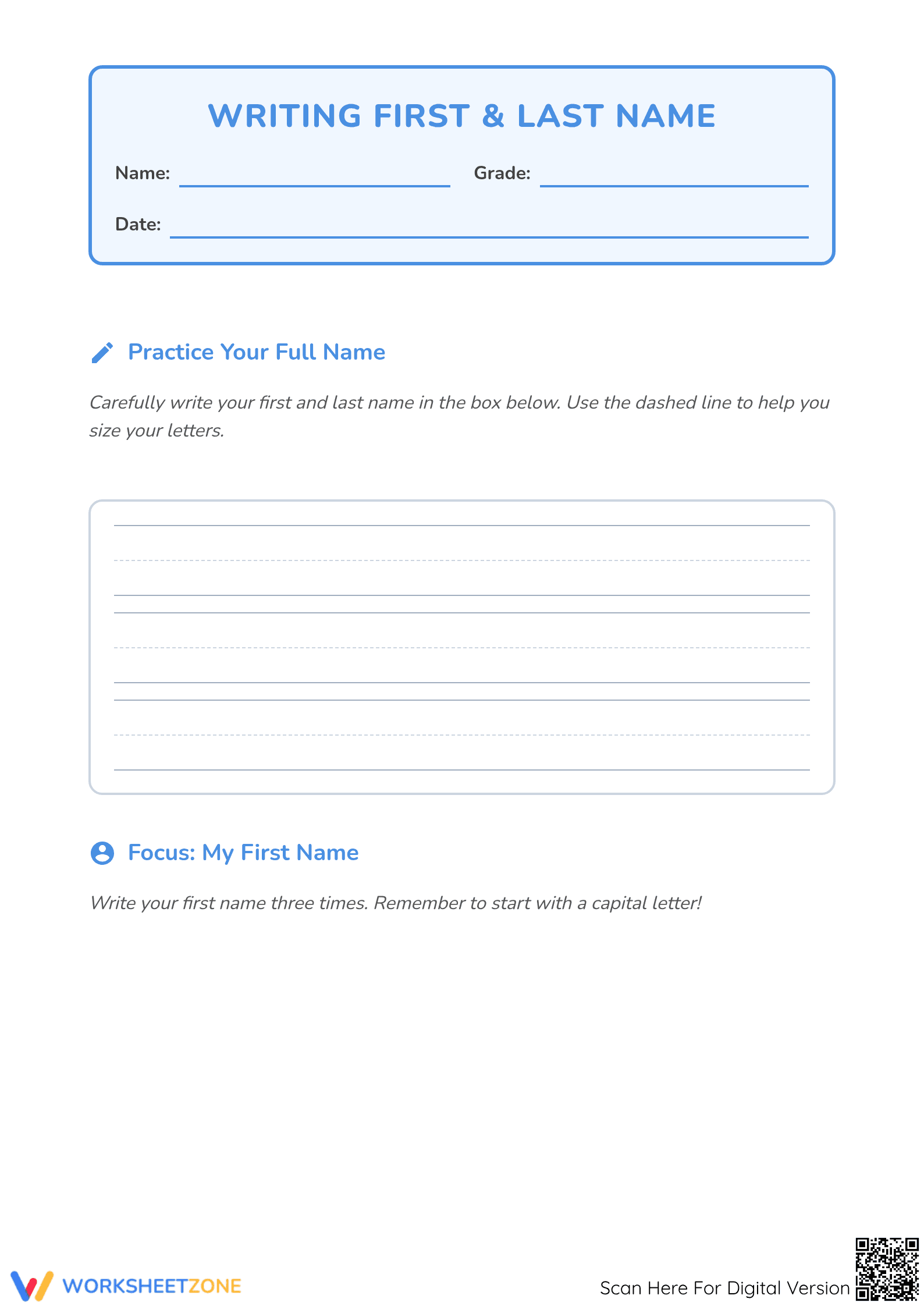
This three-page packet features five distinct handwriting tasks designed to build name-writing stamina. Students will find primary dashed writing lines to guide letter sizing, dedicated sections for isolating their first and last names, and a creative space to design their own special signature. The layout is clean and distraction-free, keeping young learners focused on their letter formation.
Skill Progression
- Guided practice: Students begin by tracing or carefully copying their full name within a structured box using dashed guidelines to establish proper sizing.
- Supported practice: The packet breaks the skill down, asking students to write their first name three times, followed by their last name three times, building muscle memory.
- Independent practice: Finally, learners write their full name as many times as possible on blank dashed lines and create a personal signature without strict guides.
This gradual-release approach ensures students build confidence through the classic I Do, We Do, You Do instructional model.
Standards Alignment
This resource is aligned to CCSS.ELA-LITERACY.L.1.1.A, which requires students to print all upper- and lowercase letters. By practicing their names, students apply this standard to the most meaningful words in their vocabulary. Both standard codes can be copied directly into lesson plans, IEP goals, or district curriculum mapping tools.
How to Use It
Deploy this packet during morning work routines or as a dedicated handwriting center at the beginning of the school year. It serves as an excellent baseline assessment for fine motor skills before direct instruction on letter formation. As a formative assessment tip, observe students while they work to identify incorrect pencil grips or bottom-to-top letter strokes that need correction. The entire packet takes approximately 10 to 15 minutes to complete.
Who It's For
This resource is designed for first-grade students who are transitioning from tracing to independent name writing. It is highly effective for occupational therapy sessions or special education students needing targeted fine motor repetition. Pair this worksheet with personalized desktop nameplates or alphabet anchor charts to provide visual support for students who still reverse certain letters.
Developing automaticity in name writing is a critical early literacy milestone that bridges fine motor development and personal identity. According to a 2024 report by EdReports, foundational handwriting skills directly correlate with later reading fluency and written expression capabilities. When students practice to print all upper- and lowercase letters accurately, as outlined in CCSS.ELA-LITERACY.L.1.1.A, they reduce the cognitive load required for basic transcription. This allows young learners to dedicate more working memory to complex tasks like sentence generation and phonics application. Structured repetition, such as writing the first and last name multiple times on guided lines, builds the necessary muscle memory for efficient letter formation. By mastering this fundamental skill early in the academic year, students gain confidence and independence in completing all subsequent classroom assignments and assessments.


