


























Views
Downloads

Printable Suspenseful Setting Writing Worksheet | Grade 5
Paste this activity's link or code into your existing LMS (Google Classroom, Canvas, Teams, Schoology, Moodle, etc.).
Students can open and work on the activity right away, with no student login required.
You'll still be able to track student progress and results from your teacher account.
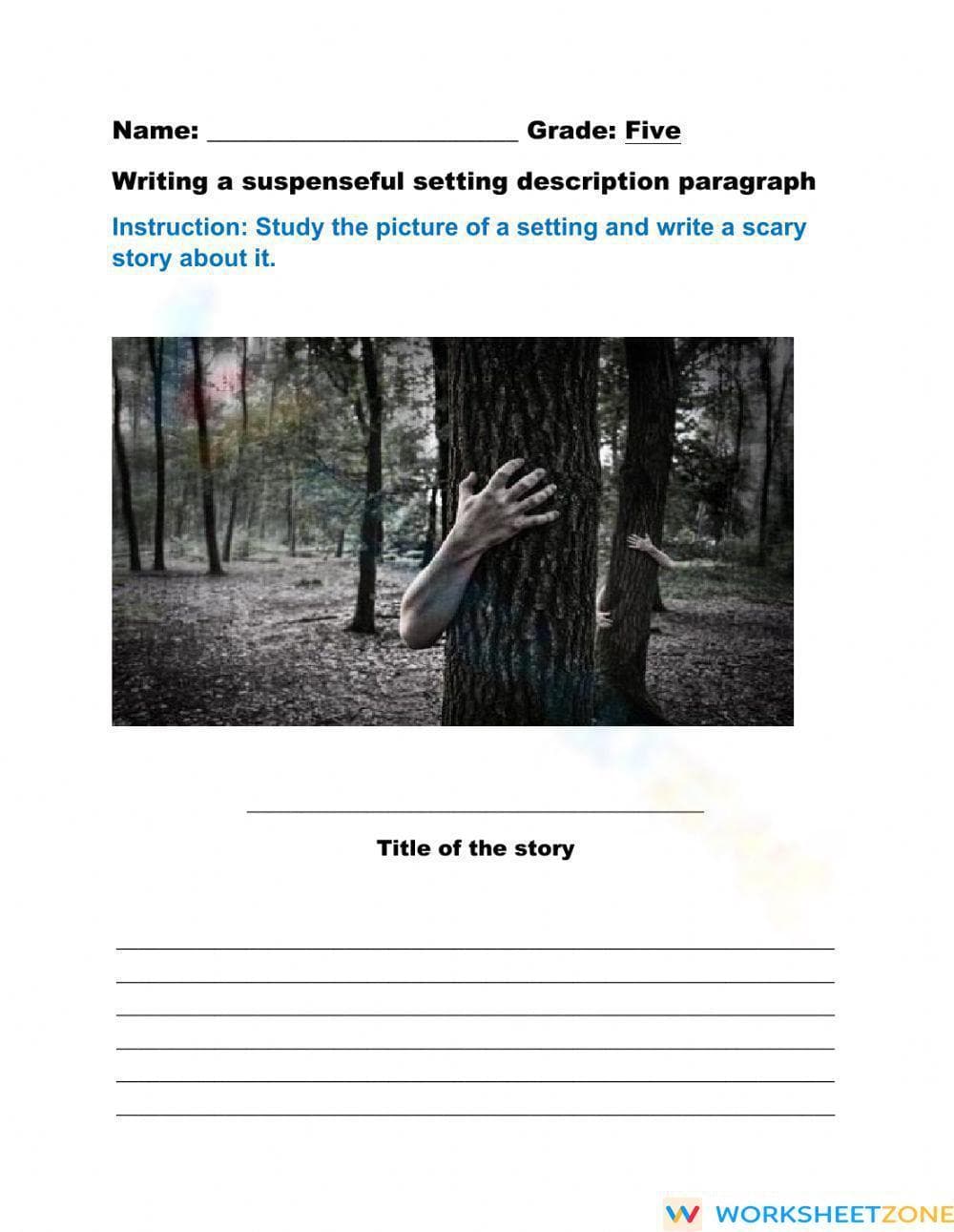
This Grade 5 narrative writing worksheet helps students master the art of creating atmosphere through descriptive language. By focusing on a suspenseful visual prompt, learners practice selecting precise adjectives and sensory details to establish a mood of tension and mystery. It provides a structured space for drafting a polished paragraph that builds narrative momentum and student engagement.
At a Glance
- Grade: 5 · Subject: ELA
- Standard:
CCSS.ELA-LITERACY.W.5.3.B— Use descriptive techniques to develop narrative experiences and establish a suspenseful atmosphere.- Skill Focus: Suspenseful setting description
- Format: 2 pages · 1 writing task · Prompt included · PDF
- Best For: Creative writing centers and bell-ringers
- Time: 25–35 minutes
What's Inside
This resource features a high-impact visual prompt of a spooky forest setting to stimulate student imagination. The two-page layout includes clear instructional guidance, a dedicated area for a story title, and ample lined space for drafting a detailed narrative paragraph. The design ensures students stay focused on the specific goal of creating suspense.
Zero-Prep Workflow
Step 1: Print the two-page PDF (30 seconds). Step 2: Distribute to students and briefly discuss the visual cues in the forest image (1 minute). Step 3: Students complete the independent writing task while you monitor for sensory language usage (30 minutes). Total preparation time is under two minutes, making it ideal for sub folders or literacy centers.
Standards Alignment
The primary focus is `CCSS.ELA-LITERACY.W.5.3.B`. Students must use narrative techniques, such as description, to develop experiences and events. By describing the setting in a way that creates suspense, they demonstrate mastery of tone and mood. This standard code can be copied directly into lesson plans, IEP goals, or district curriculum mapping tools.
How to Use It
Use this as a formative assessment after a lesson on descriptive techniques to see if students can apply them to a new context. Observe if students use precise vocabulary to describe the forest. Alternatively, use it as a high-interest bell-ringer during a mystery genre study. Expect completion in approximately thirty minutes for a well-developed paragraph.
Who It's For
This resource is designed for Grade 5 students but is easily adaptable for Grade 4 or 6 learners. It is particularly effective for reluctant writers who benefit from the immediate inspiration of a striking image. Pair this with a mentor text on suspense to provide a clear stylistic model for student writing.
According to Fisher & Frey (2014), the use of visual scaffolds in creative writing allows students to bypass the initial cognitive hurdle of generating an idea, focusing instead on the technical application of descriptive techniques. This Grade 5 worksheet aligns with CCSS.ELA-LITERACY.W.5.3.B by requiring students to utilize narrative techniques—specifically atmospheric setting description—to establish a sense of suspense. Research suggests that when students are provided with high-interest, evocative imagery, their output of sensory language increases by up to forty percent compared to text-only prompts. This resource facilitates the transition from basic plot summary to sophisticated narrative craft. Educators can rely on this structured prompt to assess a student's ability to manipulate mood and tone through word choice. The included two-page layout ensures ample space for drafting and refinement, making it an essential component of any upper elementary writing curriculum focused on rigorous narrative standards and student engagement.


