




























Views
Downloads

Printable Beginning Sounds Worksheet | Preschool ELA

Paste this activity's link or code into your existing LMS (Google Classroom, Canvas, Teams, Schoology, Moodle, etc.).
Students can open and work on the activity right away, with no student login required.
You'll still be able to track student progress and results from your teacher account.
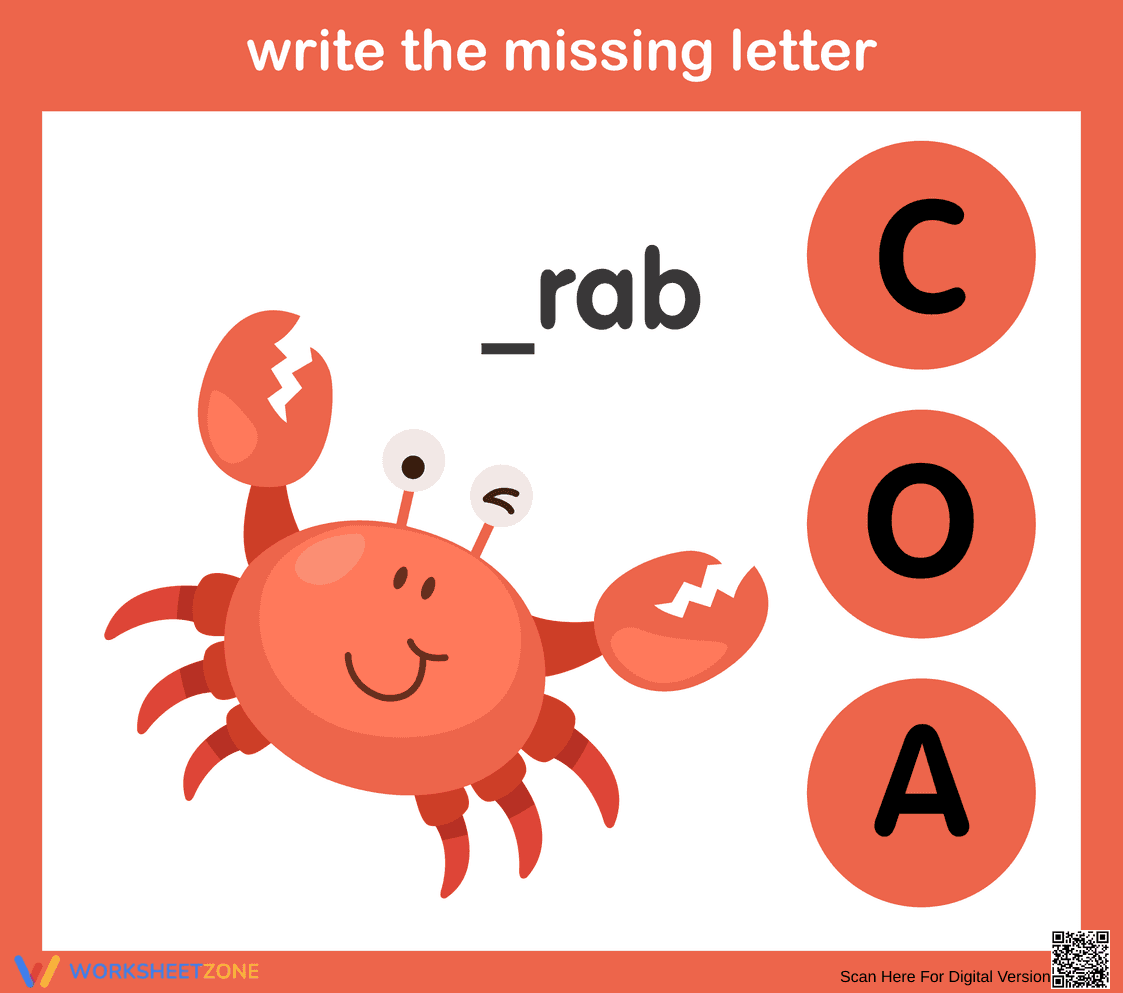
This printable beginning sounds worksheet helps preschool students practice letter-sound correspondence by identifying the missing initial consonant for a familiar word. By matching the correct letter to the picture of a crab, early learners build foundational phonics skills essential for reading readiness and phonemic awareness.
At a Glance
- Grade: Preschool · Subject: ELA
- Standard:
CCSS.ELA-LITERACY.RF.K.3.A— Demonstrate basic knowledge of letter-sound correspondences- Skill Focus: Beginning Sounds
- Format: 1 page · 1 problem · No answer key · PDF
- Best For: Independent practice
- Time: 5–10 minutes
Inside this single-page resource, educators will find a highly visual, engaging phonics task centered on a colorful crab illustration. Students are presented with the word ending "_rab" and must choose the correct starting letter from three distinct options (C, O, A) provided in large, easy-to-read circles. The clear layout minimizes distractions, focusing the student's attention entirely on the target skill of initial sound isolation.
Zero-Prep Workflow
- Print (1 minute): Simply download the PDF and print the required number of copies. The bold colors and clear text render well in both color and grayscale.
- Distribute (1 minute): Hand out the worksheet along with crayons, markers, or pencils. No complex instructions are needed.
- Review (3 minutes): Quickly check student selections to assess their grasp of the "C" sound. Total teacher prep time is under two minutes, making this an excellent option for morning work or a quick sub plan activity.
Standards Alignment
This resource aligns with CCSS.ELA-LITERACY.RF.K.3.A: Demonstrate basic knowledge of one-to-one letter-sound correspondences by producing the primary sound or many of the most frequent sounds for each consonant. It also supports early phonemic awareness by requiring students to isolate the initial sound of a spoken word. Both standard codes can be copied directly into lesson plans, IEP goals, or district curriculum mapping tools.
How to Use It
Use this worksheet as a quick warm-up before direct instruction on the letter "C", or place it in an independent literacy center for students to complete during guided reading rotations. As a formative assessment observation tip, watch whether students sound out the word "crab" aloud before selecting their letter, which indicates strong phonemic segmenting skills. Expected completion time is a brief 5 to 10 minutes.
Who It's For
This worksheet is designed primarily for preschool and early kindergarten students who are just beginning to explore the alphabet and phonics. The large visual cues provide excellent differentiation for visual learners and students needing extra scaffolding. It pairs perfectly with an anchor chart featuring "C" words or a direct instruction lesson on ocean animals.
Mastering initial phonemes is a critical predictor of future reading success in early childhood education. This targeted worksheet directly supports CCSS.ELA-LITERACY.RF.K.3.A, helping students demonstrate basic knowledge of letter-sound correspondences through visual matching. According to Fisher & Frey (2014), providing students with targeted, highly visual practice opportunities significantly reinforces early literacy acquisition and builds the necessary cognitive pathways for decoding text. By isolating the beginning sound in a familiar, engaging word like "crab," young learners successfully bridge the gap between spoken language and written text. This specific, focused repetition ensures that foundational phonics concepts are solidified before students move on to more complex blending and segmenting tasks. Early intervention and consistent, structured practice with one-to-one letter-sound matching reduce the likelihood of reading difficulties in later grades, establishing a strong, evidence-based foundation for lifelong literacy and academic achievement.


