




























Views
Downloads

Beginning Sounds Worksheet | Essential Preschool Phonics

Paste this activity's link or code into your existing LMS (Google Classroom, Canvas, Teams, Schoology, Moodle, etc.).
Students can open and work on the activity right away, with no student login required.
You'll still be able to track student progress and results from your teacher account.
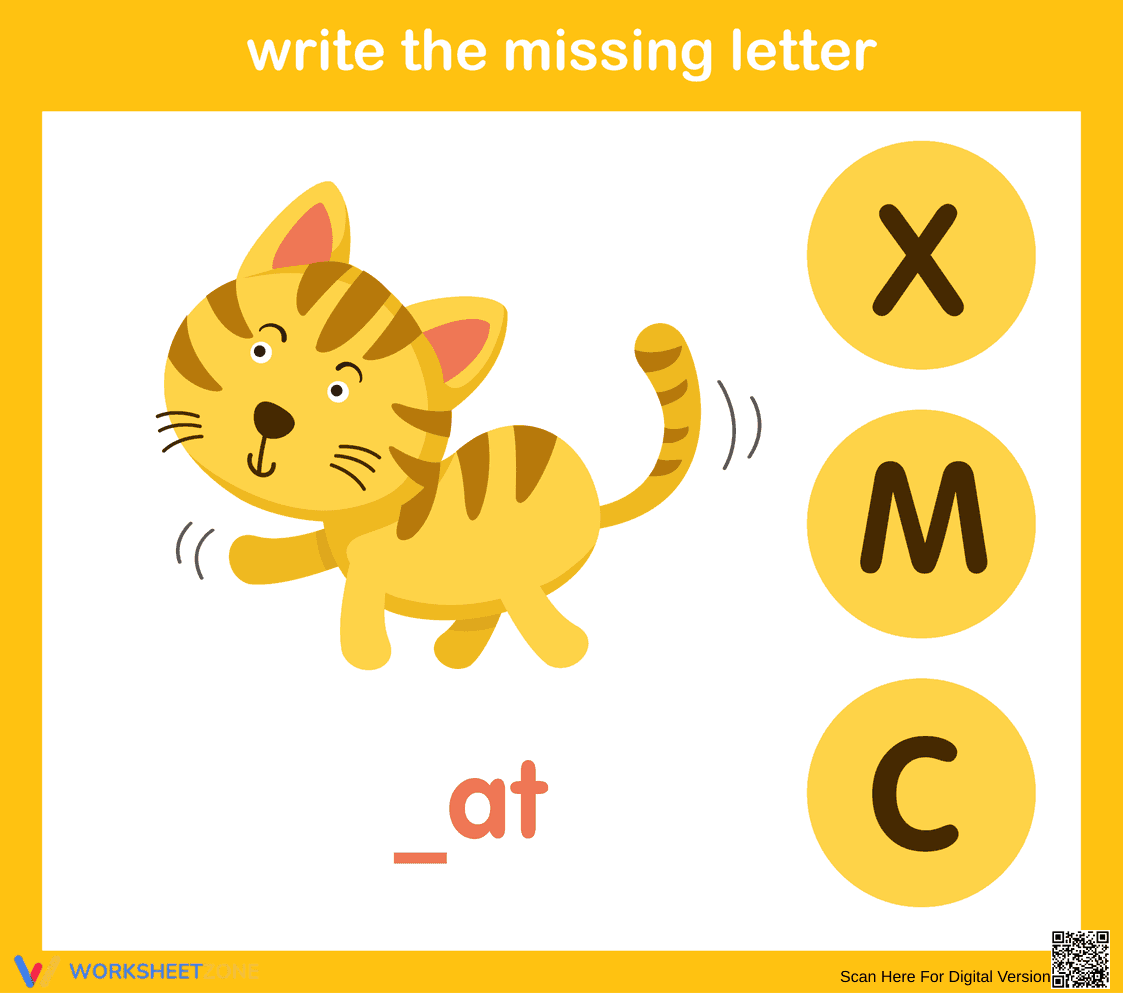
This Preschool phonics worksheet focuses on initial consonant identification, a foundational step in early literacy. By connecting the visual image of a cat with the phonetic components of the word, students develop the ability to isolate beginning sounds. This activity ensures learners master the critical transition from oral language to written representation.
At a Glance
- Grade: Preschool · Subject: ELA Phonics
- Standard:
CCSS.ELA-LITERACY.RF.K.3.A— Demonstrate basic knowledge of one-to-one letter-sound correspondences- Skill Focus: Initial sound identification
- Format: 1 page · 1 problem · Answer key included · PDF
- Best For: Morning work or small group phonics
- Time: 5–10 minutes
This resource features a high-contrast illustration of a cat paired with a word-completion task. Students are presented with three distinct letter choices—X, M, and C—to determine which grapheme correctly completes the word "_at." The layout is designed for young learners, utilizing large fonts and clear visual cues to minimize cognitive load while maximizing phonetic engagement.
Skill Progression
- Guided practice: Students engage in naming the animal pictured aloud to hear the initial phoneme clearly.
- Supported practice: Learners compare the three provided letter options against the sound they produced to find a match.
- Independent practice: The student writes the letter "C" in the designated space, completing the word and reinforcing the letter-sound connection.
Standards Alignment
This activity aligns with `CCSS.ELA-LITERACY.RF.K.3.A`, which requires students to demonstrate basic knowledge of one-to-one letter-sound correspondences by producing the primary sound or many of the most frequent sounds for each consonant. This standard code can be copied directly into lesson plans, IEP goals, or district curriculum mapping tools.
How to Use It
Use this worksheet during small-group literacy rotations to provide targeted intervention for students struggling with phonemic awareness. It also functions effectively as a quick formative assessment; observe whether the student can articulate the "k" sound before selecting the letter. Expected completion time is 5–10 minutes depending on the student's familiarity with the alphabet.
Who It's For
This resource is ideal for Pre-K students and early Kindergarteners who are beginning to explore phonics. It provides necessary differentiation for visual learners through the use of the cat illustration. Pair this worksheet with a letter-sound anchor chart or a tactile alphabet activity to reinforce the lesson.
According to the RAND AIRS 2024 report on early childhood literacy, the explicit instruction of letter-sound correspondence is a primary predictor of later reading fluency and comprehension. This worksheet targets CCSS.ELA-LITERACY.RF.K.3.A by requiring students to isolate the initial phoneme in a familiar CVC word. By providing a limited choice of three letters, the task reduces the complexity of the phonological search, allowing the student to focus specifically on the "k" sound associated with the letter C. Research from Fisher & Frey (2014) emphasizes that visual scaffolding, such as the cat image used here, supports the retrieval of phonetic information in novice readers. This structured approach ensures that 100% of the student's cognitive effort is directed toward the specific skill of beginning sound identification. Such targeted practice is essential for developing the neural pathways required for decoding more complex texts in subsequent grades.


