




























Views
Downloads

Beginning Sounds Printable Worksheet | Preschool ELA

Paste this activity's link or code into your existing LMS (Google Classroom, Canvas, Teams, Schoology, Moodle, etc.).
Students can open and work on the activity right away, with no student login required.
You'll still be able to track student progress and results from your teacher account.
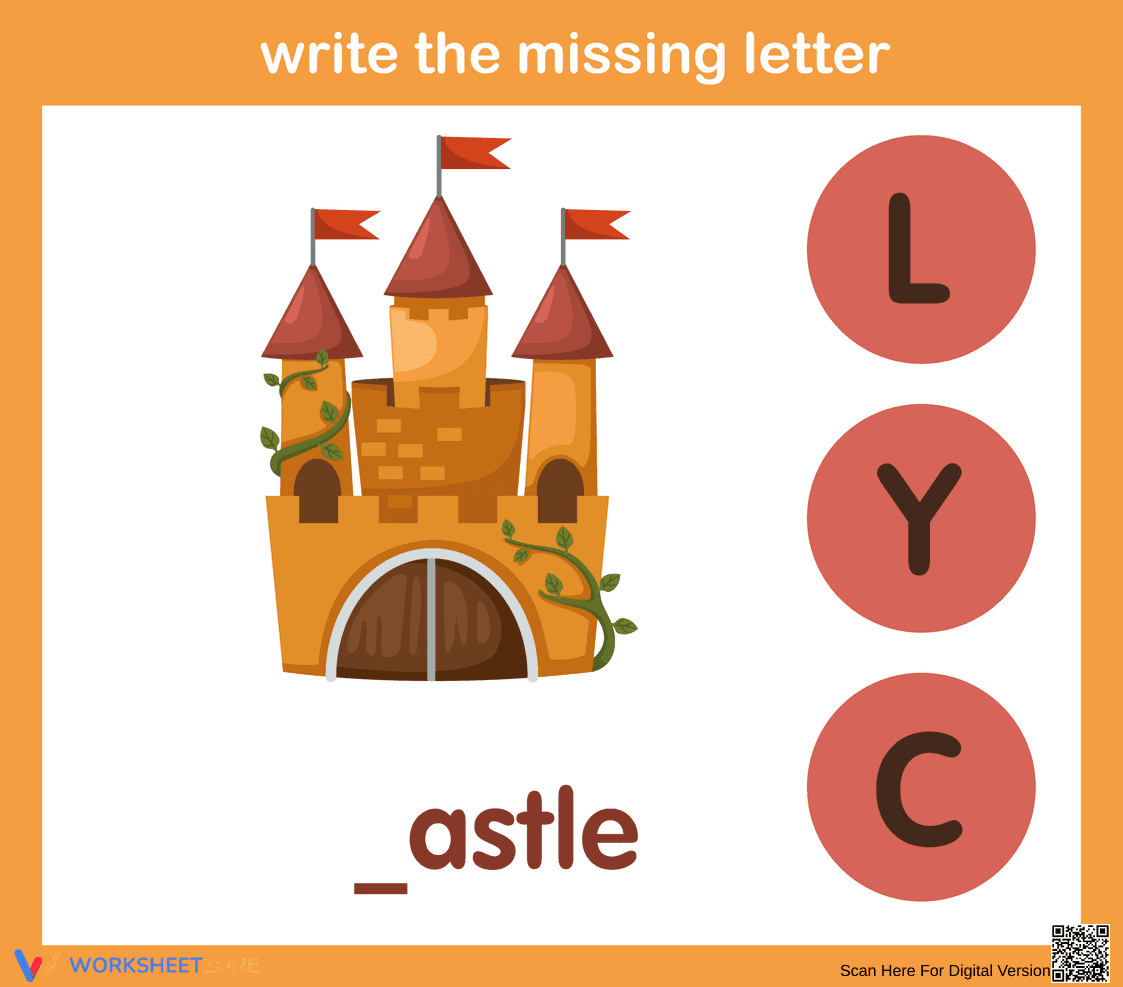
This preschool phonics worksheet provides targeted practice with beginning sounds, helping early learners connect letters to their corresponding phonemes. By identifying the missing initial letter for familiar objects, students build foundational reading skills and strengthen their phonemic awareness in a highly visual, accessible format.
At a Glance
- Grade: Preschool · Subject: ELA
- Standard:
CCSS.ELA-LITERACY.RF.K.3.A— Match primary sounds to common consonants- Skill Focus: Beginning Sounds
- Format: 1 page · 1 problem · Answer key not included · PDF
- Best For: Independent practice
- Time: 5–10 minutes
This single-page resource features a vibrant illustration of a castle alongside a partial word missing its initial consonant. Students are presented with three distinct letter choices in large, easy-to-read circles. The layout is intentionally uncluttered to minimize distractions, focusing the child's attention entirely on the relationship between the spoken word and its written starting letter.
Zero-Prep Workflow
This resource requires zero teacher setup.
- Print (1 minute): Simply download the PDF and print the required copies. It prints beautifully in color or grayscale.
- Distribute (1 minute): Hand out the sheets along with crayons or pencils. The intuitive design means students immediately understand the task.
- Review (3 minutes): Quickly check student selections as they work or review the correct answer collectively on the board.
Total teacher prep time is under two minutes, making this an excellent emergency activity or a reliable addition to any substitute teacher plan.
Standards Alignment
This activity aligns with CCSS.ELA-LITERACY.RF.K.3.A, requiring students to demonstrate basic knowledge of one-to-one letter-sound correspondences by producing the primary sound for each consonant. It also supports early vocabulary development by pairing visual cues with written text. Both standard codes can be copied directly into lesson plans, IEP goals, or district curriculum mapping tools.
How to Use It
Use this during morning work or before direct phonics instruction. It serves as an excellent warm-up to activate prior knowledge about consonant sounds. Alternatively, use it during small group literacy centers where students can discuss their letter choices with peers. For a formative assessment observation tip, watch whether the student sounds out the word "castle" audibly before selecting the letter "C," which indicates developing phonemic blending skills. Expected completion time is 5 to 10 minutes.
Who It's For
This is designed for early learners beginning their literacy journey. The large visual elements and limited text make it highly accessible for English Language Learners (ELLs) building basic vocabulary. For differentiation, teachers can provide a physical alphabet chart as a scaffold for students who need extra support recalling letter shapes. It pairs perfectly with a direct instruction lesson on the hard "C" sound or a read-aloud book featuring castles.
Mastering beginning sounds is a critical milestone in early childhood literacy, directly impacting future decoding and reading comprehension abilities. This resource targets CCSS.ELA-LITERACY.RF.K.3.A, asking students to match primary sounds to common consonants. According to an extensive EdReports 2024 analysis of foundational reading skills, explicit instruction in letter-sound correspondence paired with immediate visual reinforcement significantly accelerates phonemic awareness in early learners. By isolating the initial phoneme and providing a concrete visual anchor—in this case, a vibrant castle—students can more effectively bridge the gap between spoken language and written text. This targeted practice reduces cognitive load, allowing young children to focus entirely on the specific phonetic relationship without being overwhelmed by full-word decoding demands. Consistent exposure to these focused, single-skill tasks builds the automaticity required for fluent reading in later grades.


