


























Views
Downloads


Grade 2 Sentence Structure — Printable No-Prep Worksheet
Paste this activity's link or code into your existing LMS (Google Classroom, Canvas, Teams, Schoology, Moodle, etc.).
Students can open and work on the activity right away, with no student login required.
You'll still be able to track student progress and results from your teacher account.
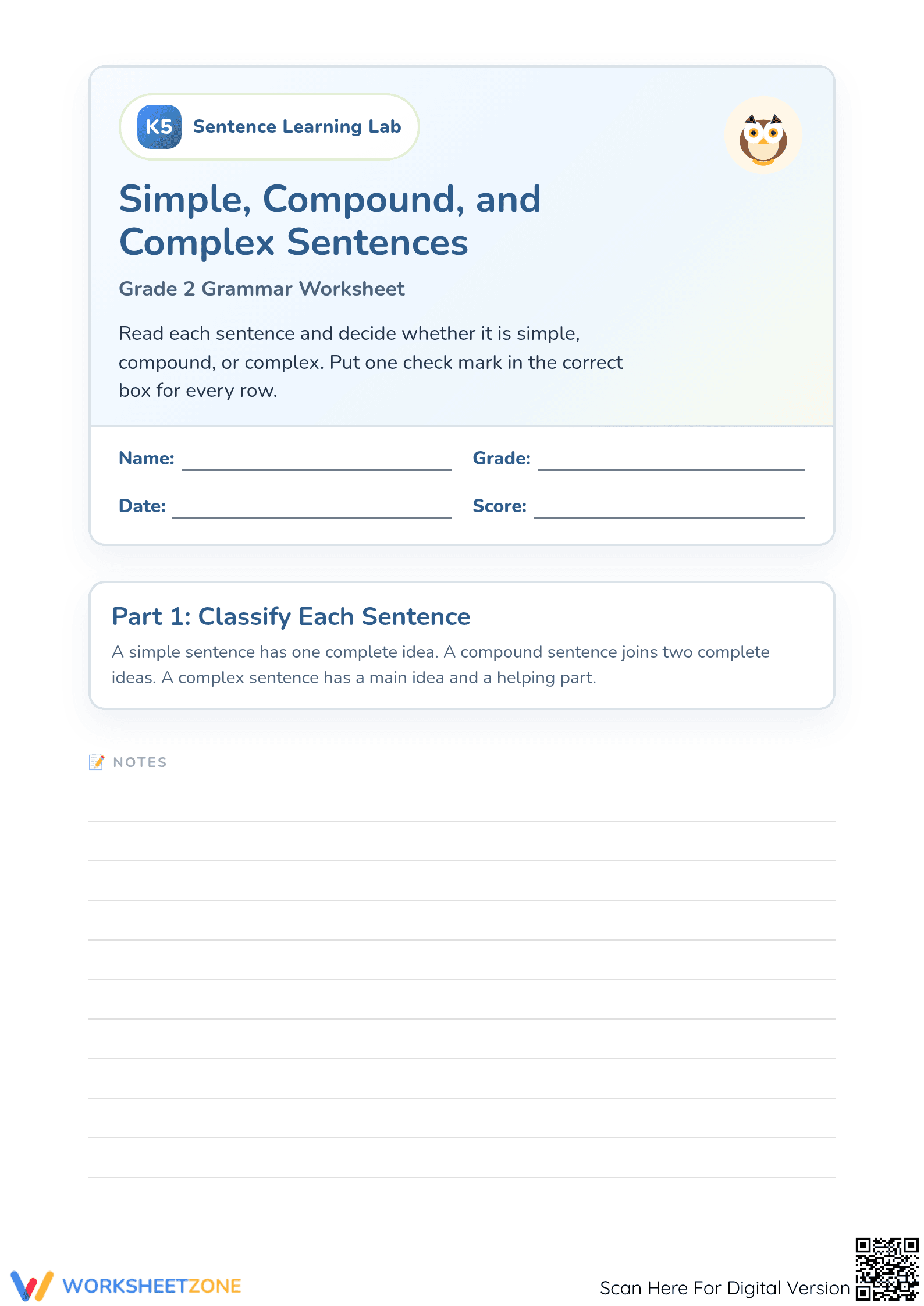
Mastering sentence structure is a foundational step in developing clear and effective writing skills. This Grade 2 grammar worksheet helps students distinguish between simple, compound, and complex sentences through targeted identification practice. By recognizing how ideas connect, young learners build the mechanical awareness necessary for proper punctuation and advanced composition.
At a Glance
- Grade: 2 · Subject: English Language Arts
- Standard:
CCSS.ELA-LITERACY.L.2.1.F— Produce, expand, and rearrange complete simple and compound sentences accurately.- Skill Focus: Sentence Classification (Simple, Compound, Complex)
- Format: 5 pages · 12 problems · Answer key included · PDF
- Best For: Grammar centers and independent practice sessions
- Time: 15–20 minutes
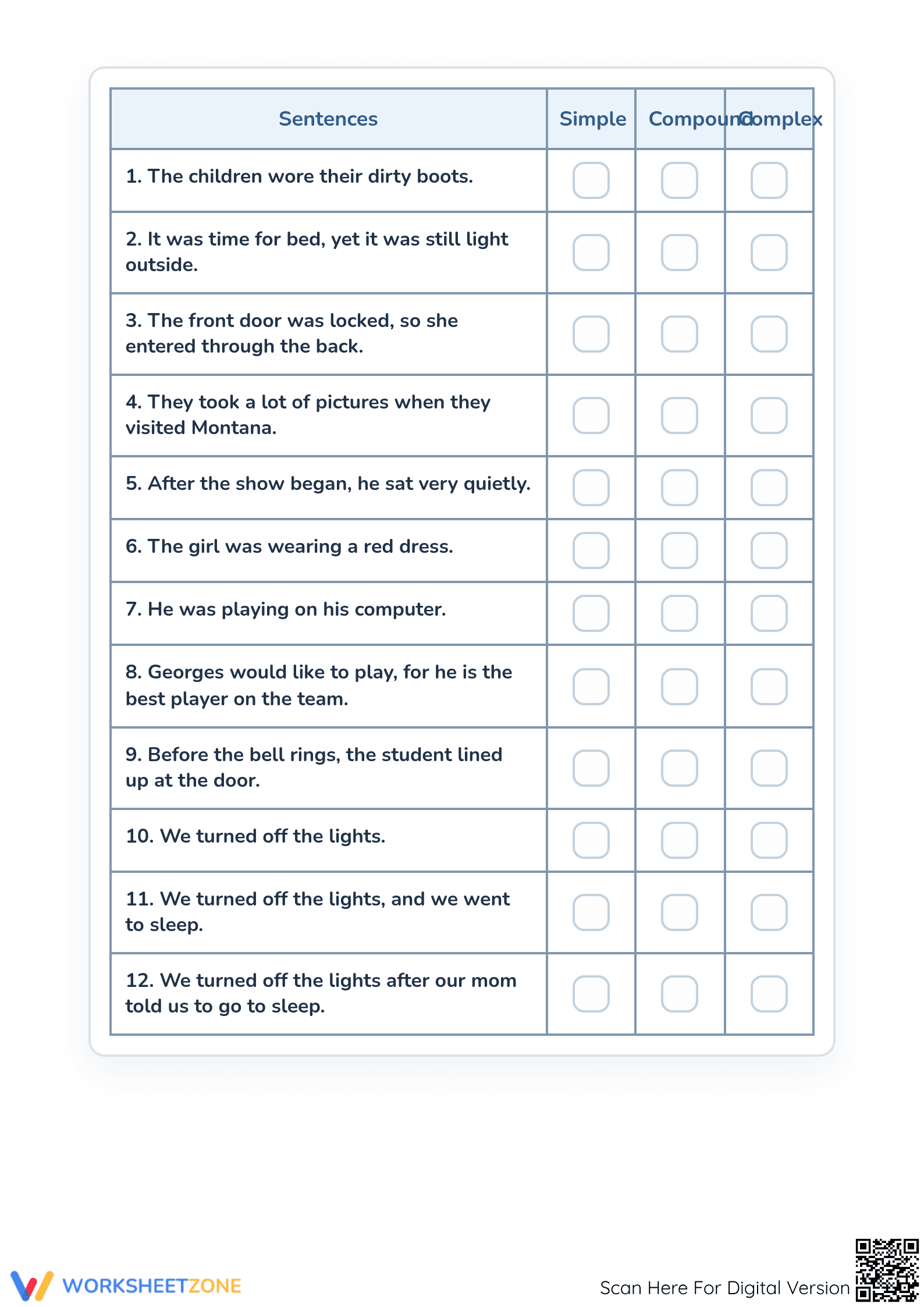
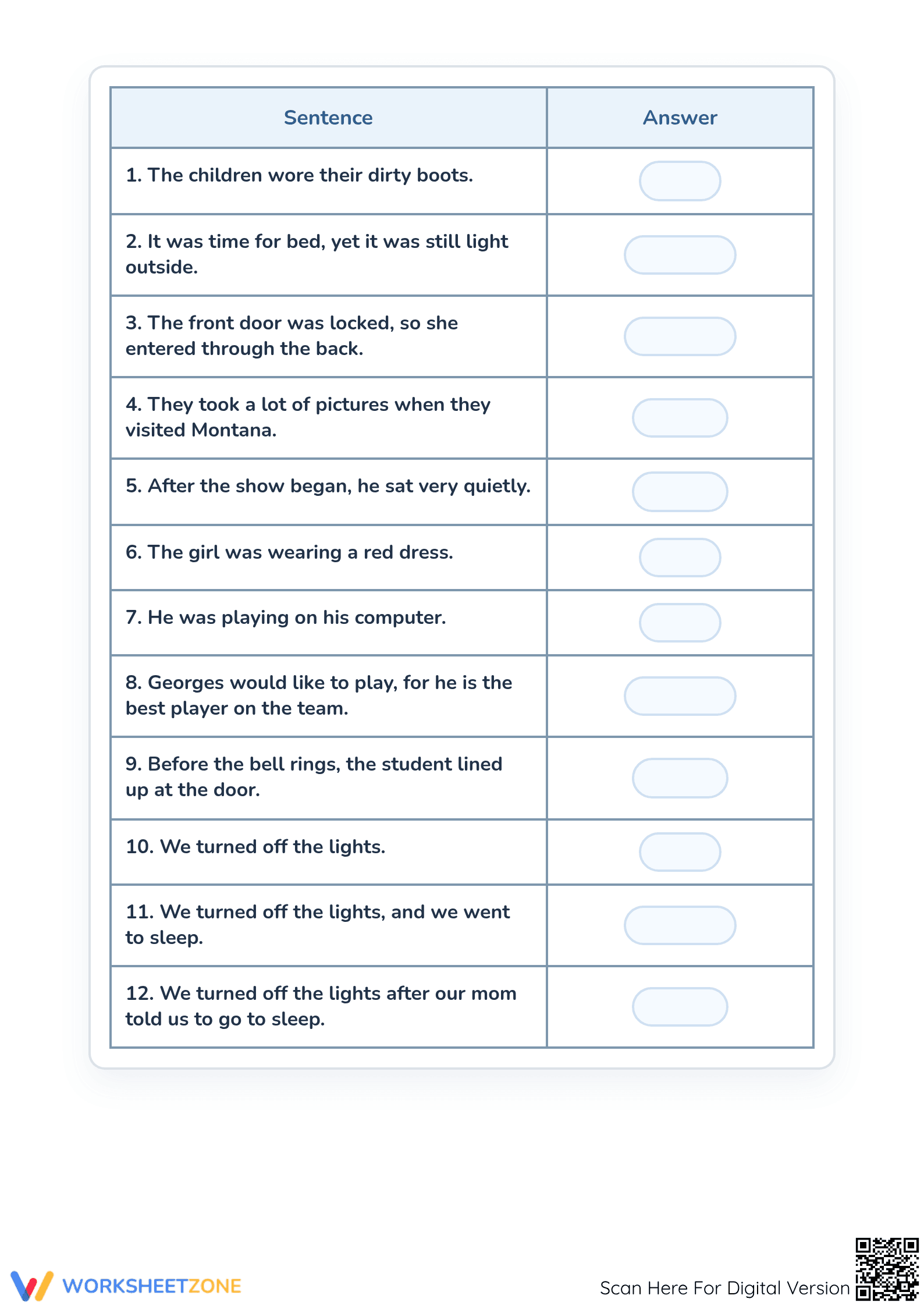
This comprehensive Sentence Learning Lab includes a detailed classification table where students analyze twelve unique sentences. Each item is paired with clear checkboxes to facilitate quick sorting. The packet also features a dedicated "Quick Check" guide that highlights essential clue words like "and," "but," "yet," and "after," alongside a complete answer key for immediate feedback.
The zero-prep workflow for this resource is designed for maximum teacher efficiency. First, print the classification and answer key pages (30 seconds). Next, distribute the student sheets and briefly review the clue word "Quick Check" box (1 minute). Finally, use the provided answer key to facilitate a whole-class review or allow students to self-correct their work (5 minutes).
This resource aligns with `CCSS.ELA-LITERACY.L.2.1.F`, which requires students to produce, expand, and rearrange complete simple and compound sentences. While the standard focuses on production, this identification task provides the critical analytical foundation needed for students to recognize structure before they apply it. This standard code can be copied directly into lesson plans or IEP goals.
Use this worksheet as a formative assessment after introducing conjunctions and dependent clauses. It works exceptionally well in a grammar station where students can use the "Quick Check" box to independently solve problems. Teachers should observe whether students are identifying the "clue words" as their primary sorting strategy, which serves as an excellent indicator of structural understanding.
This activity is perfect for second-grade students who are beginning to move beyond basic sentence construction. It provides necessary scaffolding for English Language Learners through the inclusion of visual clue words. Pair this worksheet with a short reading passage to have students hunt for different sentence types in a real-world text context after completion.
Sentence structure analysis in early elementary grades is a strong predictor of later reading comprehension and writing proficiency. According to the RAND AIRS 2024 report on literacy development, students who receive explicit instruction in syntax and sentence combining demonstrate significantly higher scores in narrative clarity and structural complexity. This worksheet addresses these needs by isolating the skill of sentence classification, allowing students to focus on the logical relationship between ideas without the cognitive load of simultaneous drafting. By utilizing the included clue-word strategy, the resource mirrors proven pedagogical techniques that emphasize the role of conjunctions as structural signals. This standards-aligned tool provides the repetitive, high-frequency practice required to move syntax identification from a conscious effort to an automatic literacy skill, supporting the long-term goal of CCSS.ELA-LITERACY.L.2.1.F mastery in diverse classroom settings.


