




























Views
Downloads



Reflexive Pronouns Worksheet | Grade 1 Essential ELA

Paste this activity's link or code into your existing LMS (Google Classroom, Canvas, Teams, Schoology, Moodle, etc.).
Students can open and work on the activity right away, with no student login required.
You'll still be able to track student progress and results from your teacher account.
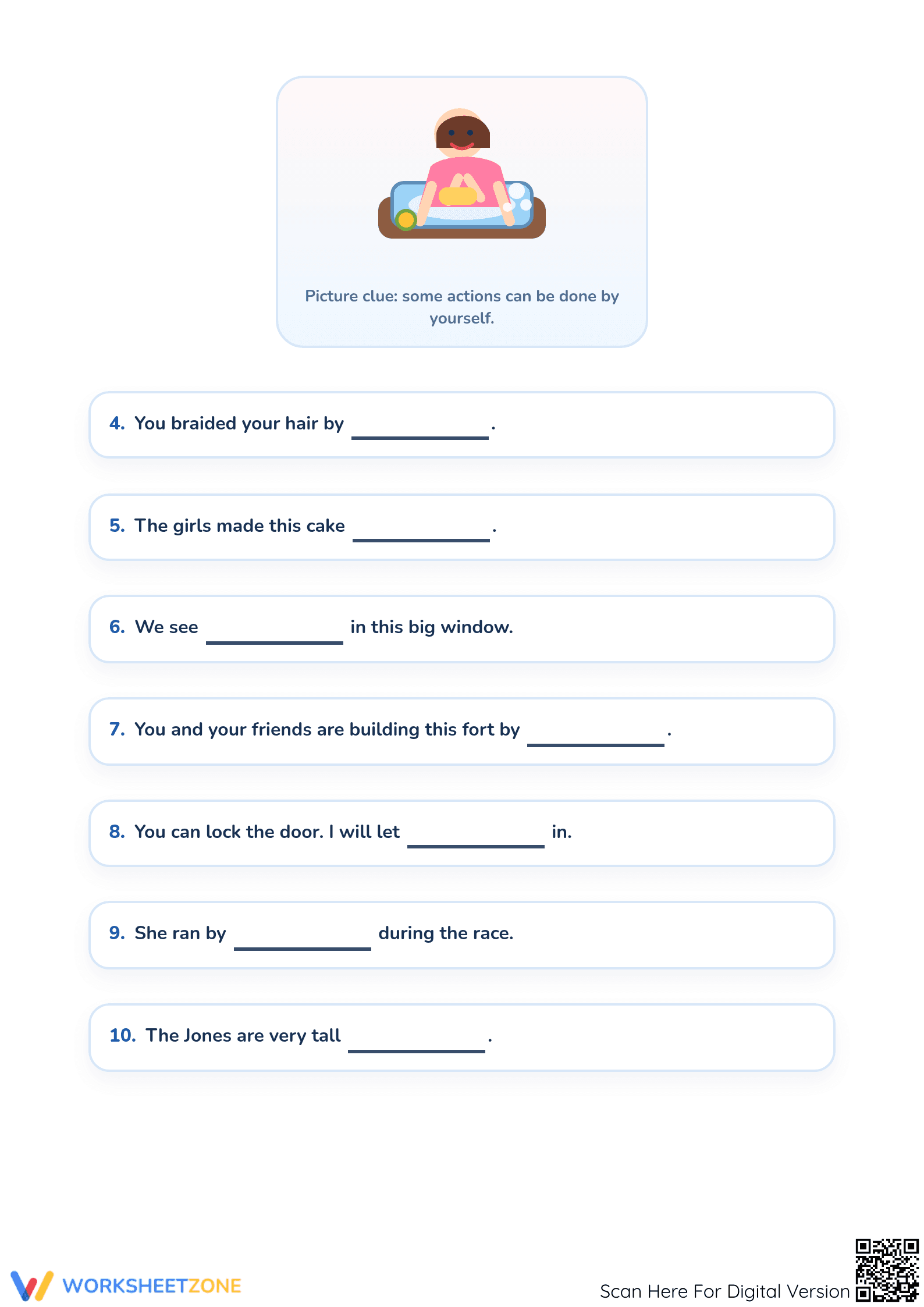
This Grade 1 grammar worksheet helps students master reflexive pronouns by completing 10 context-rich sentences. By identifying the subject and selecting the correct pronoun ending in -self or -selves, learners develop a foundational understanding of sentence structure and pronoun-antecedent agreement. It provides immediate clarity for early writers through structured practice.
At a Glance
- Grade: 1 · Subject: ELA
- Standard:
CCSS.ELA-LITERACY.L.1.1.D— Use personal, possessive, and reflexive pronouns in sentences- Skill Focus: Reflexive pronouns
- Format: 3 pages · 10 problems · Answer key included · PDF
- Best For: Independent practice or morning work
- Time: 15–20 minutes
The resource includes two pages of student work and a dedicated answer check page. A helpful hint box at the top provides a visual example ("She sees herself in the mirror") to anchor student understanding before they begin the tasks. The 10 sentences cover a variety of singular and plural forms, including himself, itself, themselves, ourselves, and yourself, ensuring comprehensive coverage of the topic.
This resource is designed for a zero-prep workflow. Teachers can print the three-page PDF in under 2 minutes. Distribution is instantaneous, and the included answer key allows for a quick whole-class review or a self-checking station. It is an ideal solution for emergency sub plans, homework assignments, or a quiet transition activity between subjects.
Standards Alignment
This worksheet is aligned to `CCSS.ELA-LITERACY.L.1.1.D`, which requires students to "Use personal, possessive, and reflexive pronouns." This specific activity targets the reflexive component, ensuring students can distinguish between singular and plural subjects to apply the correct suffix. Both standard codes can be copied directly into lesson plans, IEP goals, or district curriculum mapping tools.
How to Use It
Use this as a formative assessment after a mini-lesson on pronouns. Observe if students can correctly identify plural subjects like "kids" or "The Jones" to choose the correct plural reflexive form. It also works well as a literacy center activity where students read the completed sentences aloud to a partner to check for natural phrasing. Expected completion time ranges from 15 to 20 minutes depending on reading level.
Who It's For
This is perfect for first-grade students or English Language Learners (ELL) who need structured practice with word classes. It pairs naturally with a pronoun anchor chart or a mentor text that features repetitive reflexive language. The clear layout supports students with executive functioning challenges by providing one distinct task per line with ample writing space.
According to Fisher & Frey (2014), the gradual release of responsibility is most effective when students move from modeled examples to independent application. This worksheet facilitates that transition by providing a clear anchor example before requiring 10 independent responses. Research from the NAEP indicates that early mastery of grammar conventions, such as those found in CCSS.ELA-LITERACY.L.1.1.D, is a strong predictor of later writing fluency. By focusing on the specific function of reflexive pronouns, this resource ensures students understand how to refer back to a subject without redundant noun usage. The structured format reduces cognitive load, allowing Grade 1 learners to focus on the linguistic logic of the -self and -selves suffixes. This evidence-based approach supports long-term retention of grammatical rules in primary education settings.


