




























Views
Downloads



Reflexive Pronouns Worksheet | Grade 1 Essential ELA

Paste this activity's link or code into your existing LMS (Google Classroom, Canvas, Teams, Schoology, Moodle, etc.).
Students can open and work on the activity right away, with no student login required.
You'll still be able to track student progress and results from your teacher account.
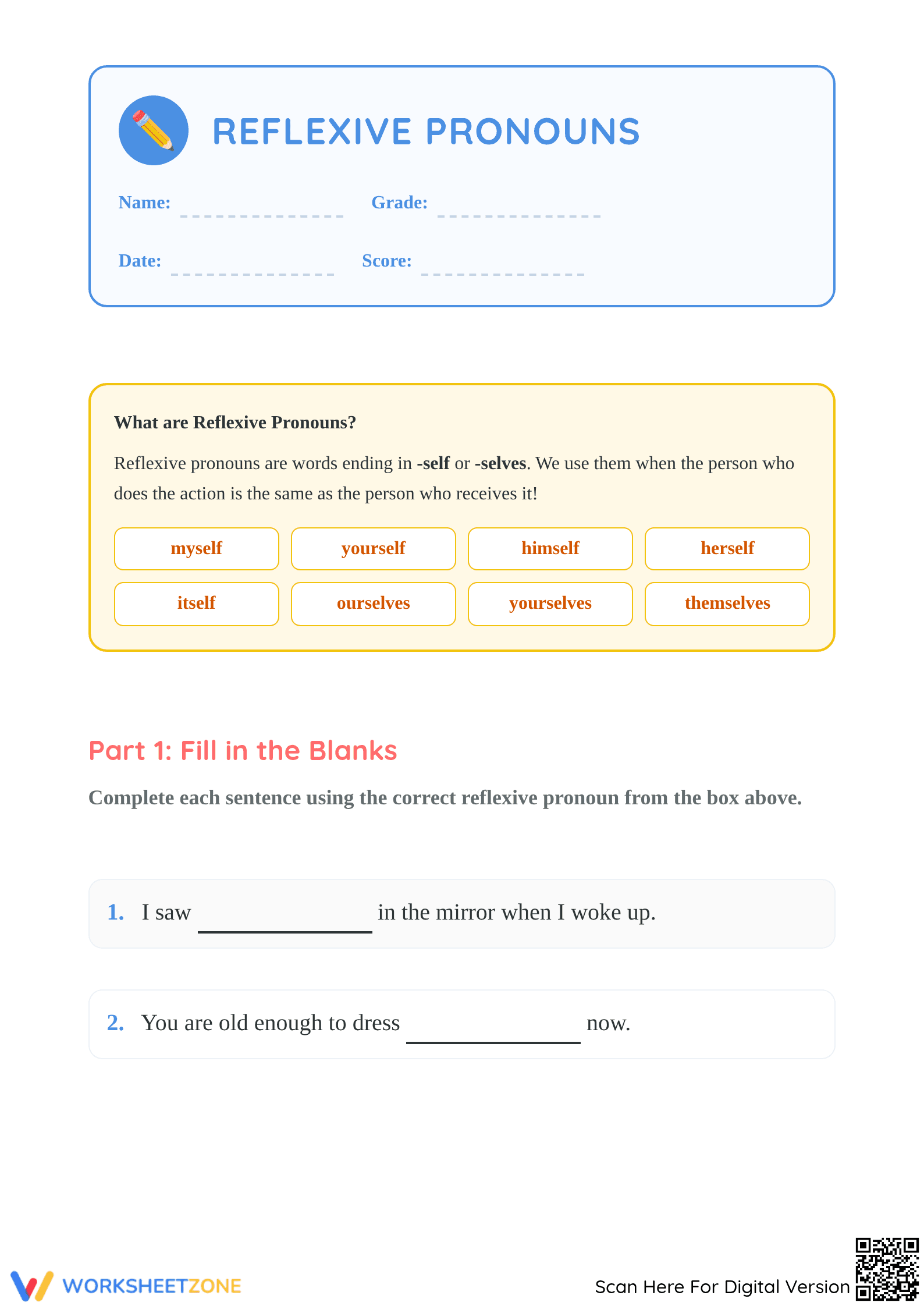
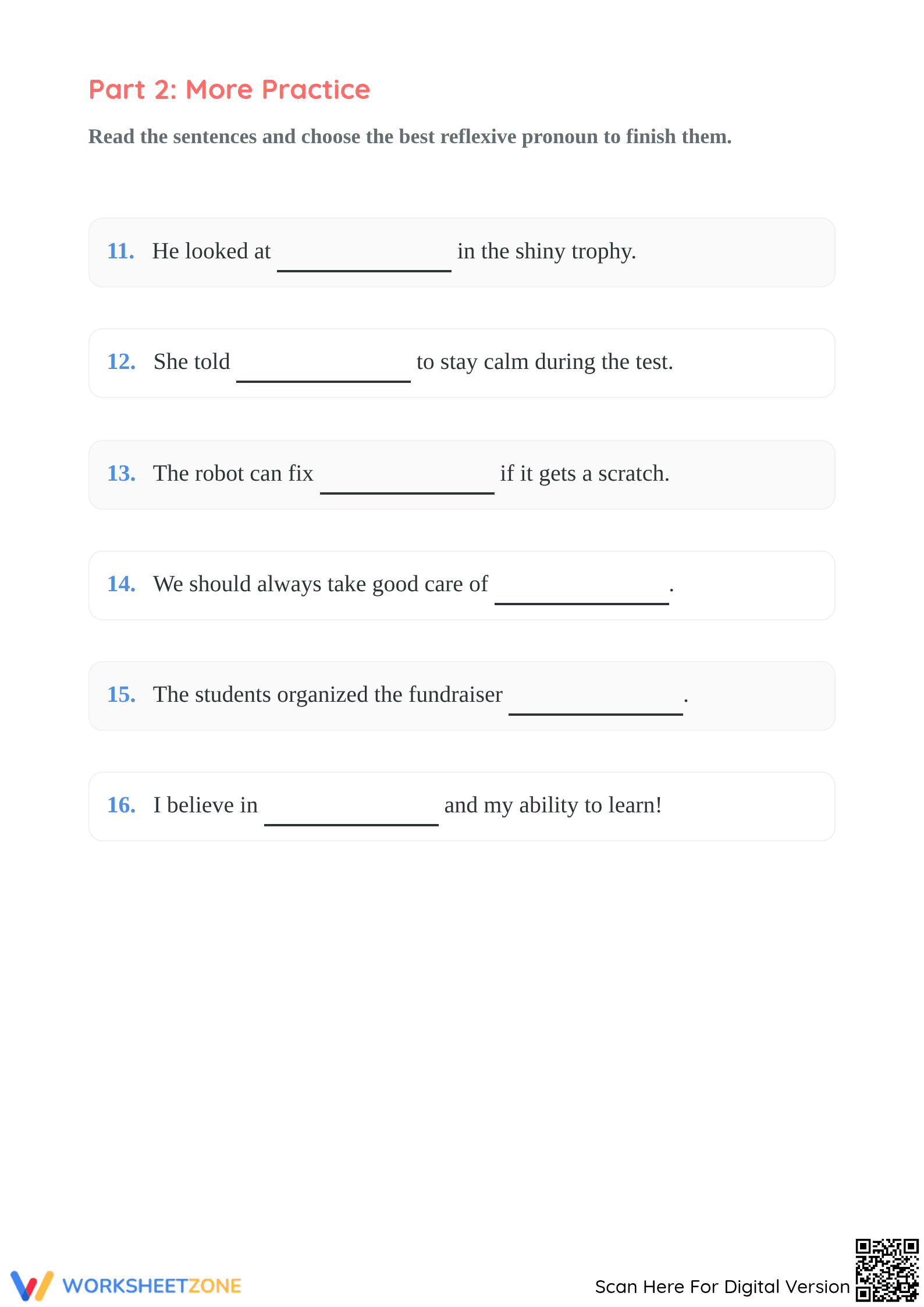
This Grade 1 ELA resource helps students identify and use reflexive pronouns to refer back to the subject of a sentence. By completing these exercises, learners gain confidence in using words like myself, yourself, and themselves correctly in context. It provides a clear path from recognition to application in original writing.
At a Glance
- Grade: 1 · Subject: English Language Arts
- Standard:
CCSS.ELA-LITERACY.L.1.1.D— Use personal, possessive, and reflexive pronouns correctly in sentences- Skill Focus: Reflexive Pronouns
- Format: 5 pages · 22 problems · Answer key included · PDF
- Best For: Independent practice or grammar centers
- Time: 20–30 minutes
The 5-page PDF includes a reference box defining reflexive pronouns, 20 structured fill-in-the-blank and matching exercises, and a creative writing section. A full answer key is provided for quick grading or student self-correction. The layout is clean and student-friendly, ensuring that young learners can focus on the linguistic patterns without visual clutter.
Skill Progression
- Guided Practice: Students use a provided word bank to complete 10 sentences, identifying the correct pronoun based on the sentence subject.
- Supported Practice: A matching section requires students to connect subject pronouns (I, You, He, She, It) to their corresponding reflexive forms.
- Independent Practice: The final section asks students to generate two original sentences, demonstrating mastery of the reflexive pronoun function.
This sequence follows a gradual-release model, moving from high support to independent application.
Standards Alignment
This worksheet is aligned to CCSS.ELA-LITERACY.L.1.1.D: "Use personal, possessive, and reflexive pronouns." This standard ensures students understand how pronouns function within a sentence structure to clarify who is performing and receiving an action. Both standard codes can be copied directly into lesson plans, IEP goals, or district curriculum mapping tools.
How to Use It
Use this as a primary practice tool after an introductory lesson on pronouns. It works well for small group instruction where the teacher can model the first few problems before allowing students to work independently. For a formative assessment, observe students during the matching phase to see if they can correctly pair singular and plural subjects with their reflexive counterparts. Completion typically takes 20–30 minutes.
Who It's For
Designed for first-grade students, this resource is also suitable for second-grade review or ESL learners who need targeted practice with English grammar conventions. It pairs perfectly with a pronoun anchor chart or a mentor text that features repetitive reflexive language. The inclusion of an answer key makes it an excellent choice for substitute folders or homework assignments.
According to research by Fisher & Frey (2014) on the gradual release of responsibility, providing students with structured scaffolds—such as the word banks and matching tasks found in this 5-page set—is essential for moving from teacher-led instruction to independent mastery. This worksheet applies these principles by offering 22 distinct opportunities for students to engage with reflexive pronouns. By starting with recognition and ending with sentence production, the resource ensures that the student internalizes the grammatical rule rather than just memorizing a list. This alignment with CCSS.ELA-LITERACY.L.1.1.D provides a rigorous yet accessible framework for Grade 1 ELA instruction. Educators can use the results of these tasks to identify specific gaps in pronoun-antecedent agreement, making it a valuable tool for data-driven instruction and progress monitoring in early elementary classrooms.


