Worksheets
Lesson Plans
Coloring Pages
Home
Activity:
Topic:
CCSS:
What is fiction: Writing that comes from the author's imagination. Historical Fiction: Sets characters against historical events. The purpose of Fiction is to:: Entertain. Biographical Fiction is :: About a real person, but events are made up. The three elements of fiction are :: Characters, setting, and plot. If the story is factual, about real events, subjects, or ideas, it is most likely:: . What are two genres of Fiction: Fables and Legends
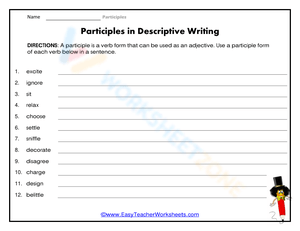
Master participles with this Grade 4 ELA worksheet. 12 tasks focus on using verb forms as adjectives in writing. Aligned to CCSS.ELA-LITERACY.L.4.1. Print.
What is a narrative: A story . True of False. Descriptive words are important because they add detail to the story. : True . In this element of plot the author introduces the characters and setting..: Orientation . Climax is..: The most intense, exciting, or important point of a story. The time and place in which a story happens: Setting. What is a rising action: A series of events that build suspense . Which are examples of narratives: All of the above . What is the purpose of a narrative: To tell a story. The falling action occurs..: After the climax. True or False. Simple sentences CANNOT be used to create emphasis in a story. : False
What is a narrative: A story. True or False. Descriptive words are important because they add detail to the story: True. Dialogue is : The conversation between characters. True or False. It is a good idea to "hook" reader at the beginning of the story: True. An example of a sensory detail is: Rattling thunder and lightening flashes. True or False. A narrative must have characters: True. The person telling the story: Narrator. The author describes how the problem is solved: Falling Action. The end of the story; brings the story to a satisfactory close: Resolution. _________________ means the time and place in which the events happen in a story: Setting. The turning point of the story where the main conflict is decided one way or another: Climax. The author describes the conflict or problem the characters must face; tensions rise: Rising Action. The time and place in which a story happens: Setting. Opening of the story; author describes the setting, gives background info & intros characters: Exposition. The struggle between opposing forces; the problem handled by the main character: Conflict
What is a narrative: A story. _________________ means the time and place in which the events happen in a story: Setting. True or False. Descriptive words are important because they add detail to the story: True. Dialogue is : The conversation between characters. The part of the story that ties up all the loose ends and takes care of the conflict: the resolution. What is the purpose of a narrative: To tell a story. Why should we use descriptive words in our narrative essays: They "paint a picture" for our readers. What is narrative writing: Fictional story with a problem, events, and a solution. What is the first step of the writing process: . Why do we need to brainstorm before writing a narrative essay: It helps us organize our thoughts and ideas before writing.. When a main character's problem is resolved authors call that the _______________ of the story: Solution. Select the word that correctly defines each story element. The characters of a story are.: who is in the story.. Select the word that correctly defines each story element. The plot of a story includes..: . Select the word that correctly defines each story element. The conflict of a story is the..: problem the character faces.. Select the word that correctly defines each story element. The protagonist of a story is..: the main character. . Select the word that correctly defines each story element. The introduction, or exposition, of a short story is also its..: beginning.. All of the following are elements of narrative writing except: Teaches the reader something new. A strong, meaningful story title and introduction serves the purpose of making the reader ..: want to keep reading. Narrative writing tells a story to ........... the reader: entertain. All narratives have.......Choose all correct answers: point of view and plot
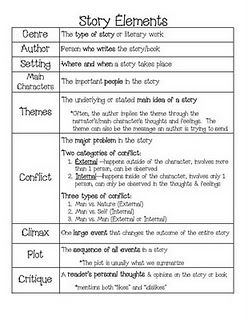
The time and place or the "when and where" of a story are called the..: setting. the first step of the writing process is called: prewriting. The person, animals, and things participating in a story: characters. The feeling that the author tries to convey throughout the story: mood. events that occur as result of central conflict : rising action. highest point of interest or suspense of a story: climax. Tension eases; events show the results of how the main character begins to resolve the conflict: falling action. Loose ends are tied up; the conflict is solved: resolution
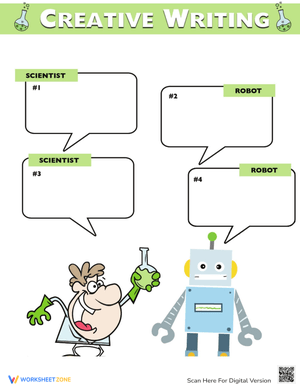
Craft realistic dialogue with our creative writing worksheet! Enhance storytelling abilities. Download now and start writing engaging conversations!
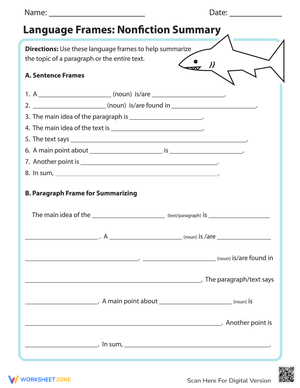
Write nonfiction summaries! Learn to include main ideas and key details. Improve comprehension skills with this guide to effective summaries!
Improve Writing Skills with our Language Frames: Nonfiction Summary worksheet! Enhance summarization abilities. Perfect for students. Write a summary now!
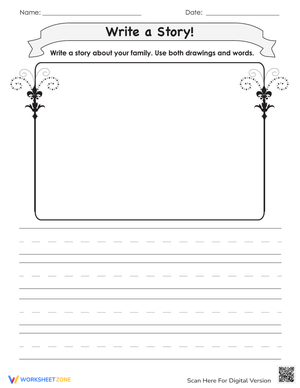
Unleash creativity with our Write a Story worksheet! Prompts to inspire storytelling. Download now and help students develop their writing skills.
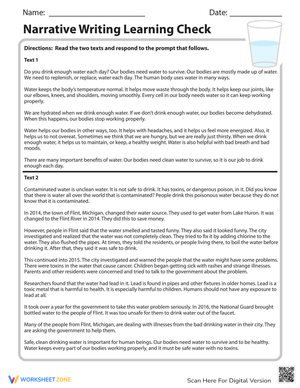
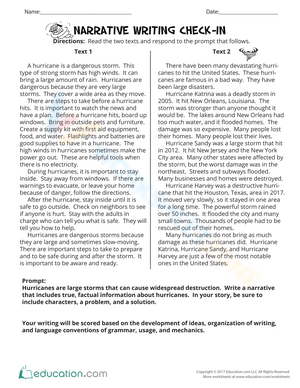
Evaluate narrative writing skills with this worksheet! Check understanding of narrative elements. Perfect for assessing Narrative Writing. Try it now!
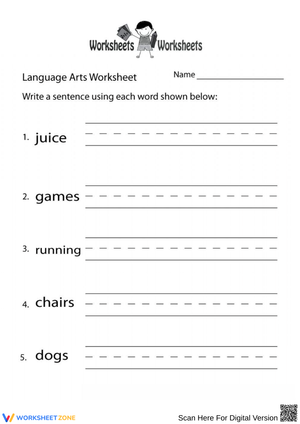
Build writing fluency with this Grade 2-3 ELA sentence practice worksheet. Students write 5 sentences using specific vocabulary. Aligned to L.2.1. Print now.
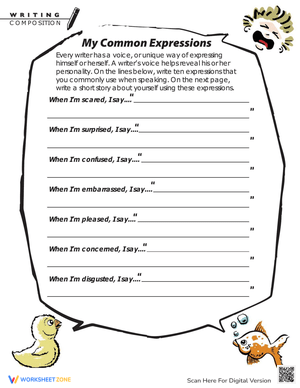
Write a short story using personal expressions with this creative worksheet! Enhance writing skills and foster self-expression. Start writing your story now!
The writer's position on a problem or issue is called the: claim. In order to write a successful argument, you must use ___ to support claims, and ____ to support your reasons: reasons, evidence. When gathering evidence, use credible ___ and take notes: sources. Always make sure to disprove the ___ argument: opposing. This element is the first line of your writing: Hook. Acknowledging why someone may disagree with you is known as this: Counterclaim. This is based on personal experience, quotes, facts and statistics that support your reasons: Reason. This is a debatable statement that forms the main point of your argument: Claim. This helps support your main claim and gives the reader a basis for accepting your main claim: Reason. This element wraps up all loose ends and finishes strong: Conclusion. This is the part of the introduction paragraph that catches readers’ attention: Hook. This shows how you know you’re right: Evidence. This disputes or disagrees with your claim: Counterclaim. This follows your claim: Reason. Introduce this with statements such as, “It may be argued that ….”, “Contrary to evidence…”, “It is true, however, ….” or any other statement that acknowledges conflicting viewpoints: Counterclaim. What type of hook is this?I was living in Arkansas the first time I met prejudice face to face: Personal Anecdote. What type of hook is this?Each year there is one Lego block made for every person in the world. Think about it: Fascinating Fact. One type of hook you can use for writing is called an anecdote. What is the definition of anecdote? : A short story or scene. Which type of hook is this?John Wooden once said, "Never mistake activity for achievement." : Quote
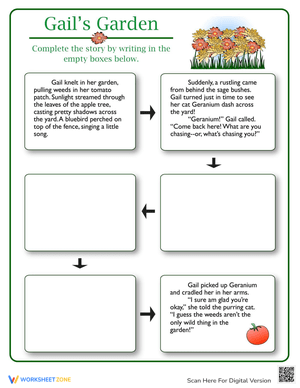
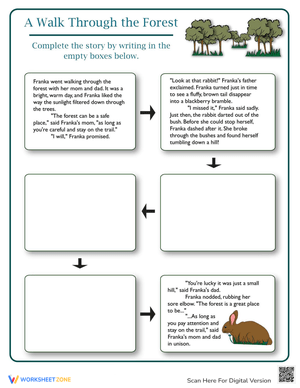
Enhance writing skills with this story completion worksheet! Use creativity to finish a narrative. Perfect for improving storytelling abilities. Try it now!
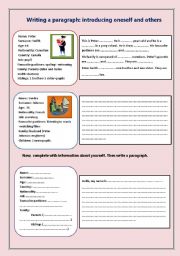
A good paragraph is like a _____________: hamburger. The _______ is the FIRST sentence of a paragraph: topic sentence. A good paragraph has ______ details: 3. The _____ is the LAST sentence of a paragraph: closing sentence. I love butterflies! Butterflies cannot be heard when they are flying. They have very colorful wings. It tickles when they land on my finger. This is why I love butterflies. What is the TOPIC SENTENCE: I love butterflies!. I love butterflies! Butterflies cannot be heard when they are flying. They have very colorful wings. It tickles when they land on my finger. This is why I love butterflies.What is the CLOSING SENTENCE: This is why I love butterflies.. I love butterflies! Butterflies cannot be heard when they are flying. They have very colorful wings. It tickles when they land on my finger. This is why I love butterflies.What are the 3 DETAILS? You MUST choose 3 sentences. : It tickles when they land on my finger.
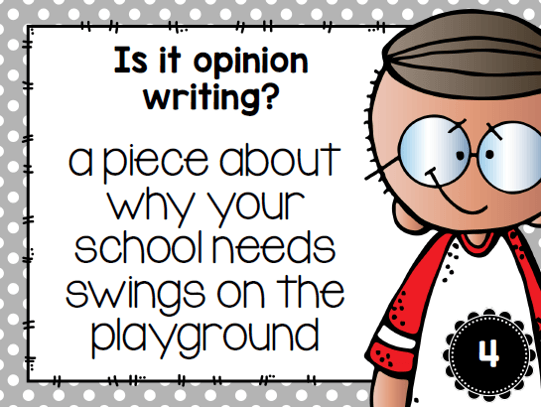
What is an opinion: The way you think or feel about a topic. What is the purpose of opinion writing: To tell others what you think and persuade them to agree with you. We must introduce the _________ in our topic sentence: topic. In our topic sentence, we must also clearly state our ___________: opinion. We must use clear, relevant ___________ to support our opinion: reasons. What should you have at the end of your opinion writing: STRONG concluding statement. What are pros and cons of something: Both the good and bad things about something. Is it okay to change your opinion as you learn more about a certain topic or issue: Yes. In opinion writing, we must use linking words and phrases to connect ____________ to ____________: opinions; reasons. We must ____________ our reasons so they are grouped together: organize. Begin every body paragraph with..: A topic sentence. . What is the first step of any writing process: Plan using notes and or graphic organizers. . What do you call the last paragraph in an essay: Conclusion. What do you call the first paragraph in an essay: Introduction. An opinion essay is written to convince the reader..: My opinion is right, and here are the reasons why. . At the end of an opinion writing piece a good writer will..: Review it for correct spelling, grammar and punctuation. . When you write an Opinion Essay, the writer should..: dig in the text for examples to prove your opinion. What is a hook in an essay: it grabs the readers attention. What is a counterargument: The opposing viewpoint. We get milk and other dairy products from cows: Fact. Vanilla ice cream tastes better than chocolate ice cream: Opinion. Libraries are too quiet: OPINION. Baseball is the best game ever played: Opinion. In an opinion essay, one should always use..: examples and reasons. The R in O.R.E.O. stands for...: Reasons why someone should agree with your opinion. The E in O.R.E.O. stands for..: Evidence and examples from the text. In the last paragraph, you should include your opinion restated and..: a conclusion statement to leave your reader thinking. What are some good transition words and phrases to use in the conclusion paragraph: In conclusion, all in all, to sum it up, finally. What does it mean to elaborate when writing: Say more. In an effective opinion essay, there should be at least __?___ reasons to support your thesis statement: 2. Which of these gives you instructions on what to write about: Prompt. A fact is..: . Everyone has opinions. How do you make your opinion matter: By supporting your argument with facts.. Select Step #1: Read the prompt, mark key words, and turn the prompt into a question you can understand.. What is the final step before submitting your essay: Check and edit your work for mistakes.. Good transitions to use when providing evidence:: For instance, for example, in fact. What is a good piece of EVIDENCE to use to support the reason that going screen free will help you complete tasks more quickly: A study shows that it takes 50 percent more time to complete a task if you are looking at an electronic device.. How many owls are in Mrs. B's mail center: 5. What color is Mrs. B's Incendio sign: red. Who is on room #29's chore chart: Dobby. How tall is Khaleesi: 1 foot
Master explanatory writing! Learn structure and organization techniques, including narrative pieces and comparison. Enhance your essay skills effectively!
Finish the story and boost your writing skills! Develop narrative abilities with this worksheet. Encourages imaginative thinking. Start writing your story today!
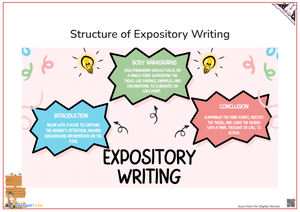
Learn the essential structure of expository writing: Introduction, Body Paragraphs, and Conclusion. Discover how to craft a compelling, informative essay!
What is the purpose of informational writing: to teach your reader about a topic. How might a writer get information for writing an informational piece: all of the above. Is a fantasy story an example of informational writing: No. Is a report about natural disasters an example of informational writing: Yes. Which of the following would you not find in an informational piece: opinions. In informational writing, you begin with a..: introduction. What is the purpose of having a hook in your informational writing: to grab the reader's attention. What is the purpose of a conclusion in your informational writing: to summarize what you discussed in your essay. An author uses different text structures in informational writing to organize it in a way that makes sense to the reader. : True. The author uses text features in informational writing because..: it helps the reader understand the topic better
What is one type of a controlling idea: Topic Sentence. True or False: The topic sentence belongs in the first sentence of each body paragraph: True. True or False: The topic sentence should explain what the entire essay will be about: False. True or False: The thesis statement belongs in your body paragraphs: False. True or False: The topic sentence should be at the beginning of each body paragraph and should tell what the body paragraph will be about. : True. In each body paragraph you should have a topic sentence followed by a __________: Connection. True or False: The text evidence can be anything from the article, even if it doesn't support the reason: False. True or False: Textual evidence can only be dialogue from an article. : False. Which is the correct example of parenthetical documentation: . Each body paragraph should have a topic sentence, an example, final commentary, and....: Text Evidence . True or False: You should start your thesis statement with a yes or a no then followed by your reasons: False. True or False: You should start your thesis statement with "I believe," then followed by your reasons: False. What should be in your introduction: Introduction of the topic and thesis statement
In the word informational you can find the word ___________: inform . A thesis statement _________________: tells the readers position on the topic . The final project for this unit will be ________________: an informational essay. What word can be found in the word explanatory: explain. In his ___________ the Lakers are the best basketball team: point of view . He is ________ because his favorite team is playing in the tournament: bias. An inference is a __________: logical guess. A person's point of view is the same as their __________: opinion . An informational text structre might include _________: text boxes. One of the digital sources I used was ____________: an article I read online.. An example of ___________ is taking someones painting and taking credit for their work: plagiarism. An example of evidence for an essay you are writing on jungle animals is ________: "...20% of jungle animals are nocturnal".. I do not like Mondays.Chosose the sentence that is a good paraphrase: I dislike Mondays.. _________ tells you what the paragraph will be about: Topic sentence
Check-in on narrative writing progress with this helpful worksheet! Guide students through planning and revising their stories effectively!
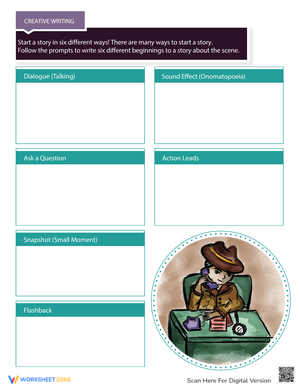
Learn to begin a story effectively with our worksheet! Develop creative writing skills and narrative hooks. Start your writing journey now!
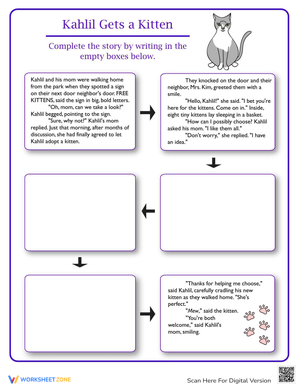
Boost creative writing skills with our 'Finish the Story' worksheet! Develop narrative abilities in an engaging way. Get started now!
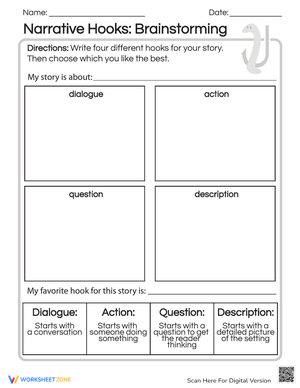
Improve your writing skills by brainstorming narrative hooks! This worksheet helps you create compelling opening lines. Start crafting better stories today with Narrative Hooks!
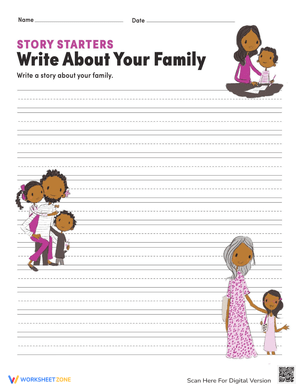
Unleash creativity with these Family Story Starters! Perfect for imaginative storytelling. Download now to develop writing skills!
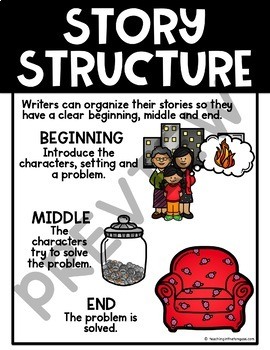
Teach story structure, plot, setting, and character basics with this interactive worksheet. Boost creative writing skills through engaging activities for young learners.
Find perfect worksheets
Grade + Topic search
Select your Grade level, Topic and Subject to find worksheets instantly or you can use keyword below to search what you need.
Make your own worksheets