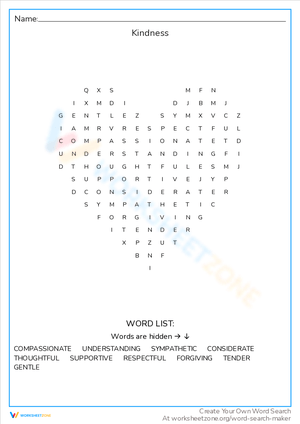
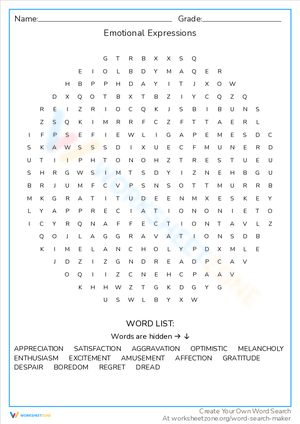
Emotions Word Search For Classroom Learning
Every student carries a unique emotional world with them into the classroom, and giving them the right tools to name and understand what they feel can transform how they learn and connect with others. Emotions word search puzzles offer a structured yet playful approach to building that emotional vocabulary, asking learners to scan for hidden words that represent real feelings they experience every day. The act of searching for terms like "anxious," "content," or "frustrated" on a printed page turns an often abstract topic into something concrete and manageable.
These worksheets work particularly well during morning meeting time, social-emotional learning blocks, or as a calm transition activity between more demanding lessons. Teachers appreciate how emotions word search materials encourage independent focus while simultaneously reinforcing the language students need to articulate their inner experiences. The puzzles are designed to be accessible for a range of reading levels, making them useful in mixed-ability classrooms without requiring additional differentiation prep.
Parents who practice social-emotional activities for young learners at home will find these worksheets slot naturally into an evening or weekend routine. Sitting down together to complete an emotions word search sparks gentle conversations about how a child felt during the day, what made them happy or nervous, and how they managed those feelings. That dialogue, often prompted by a simple puzzle on paper, carries more developmental value than many formal exercises.
For classrooms building a broader emotional literacy curriculum, pairing these puzzles with identifying emotions worksheets creates a coherent learning sequence. Students first recognize and label emotions through structured activities, then revisit that vocabulary in a puzzle format that reinforces recall through active searching. Over time, this repetition builds the kind of fluent emotional language that supports conflict resolution, empathy, and self-regulation.
Worksheetzone provides a curated collection of emotions word search printables designed to meet the needs of educators and parents working on social-emotional development. Each PDF is formatted for easy classroom use, with clean layouts that keep learners focused on the task. Whether used as a bell-ringer, a station activity, or a homework supplement, these worksheets make the exploration of emotions word search an engaging part of any lesson plan.
Frequently Asked Questions
Question 1: What grade levels are emotions word search worksheets suitable for?
Emotions word search worksheets are well-suited for students in kindergarten through fifth grade. Simpler versions with basic feeling words like happy, sad, and scared work for early learners, while more complex puzzles featuring nuanced emotions such as apprehensive or elated challenge older students. Teachers can select difficulty levels that match their classroom needs and adjust as learners grow more confident with emotional vocabulary.
Question 2: How do emotions word search activities support social-emotional learning?
Emotions word search activities reinforce social-emotional learning by helping students associate written words with real feelings they experience. Searching for terms like calm, embarrassed, or excited builds vocabulary that learners can use to express themselves clearly. When teachers follow up with brief discussions about the words found, the activity becomes a meaningful bridge between recognizing feelings on paper and articulating them in everyday social situations.
Question 3: Can emotions word search worksheets be used in homeschool settings?
Emotions word search worksheets integrate easily into homeschool routines. Parents can use them as a starting point for conversations about emotional well-being, pairing the puzzle with a brief journaling prompt or a read-aloud that explores character feelings. The printable PDF format means families can work at their own pace, revisiting puzzles as needed and tracking which emotion words a child has learned to identify and use confidently.
Question 4: What skills do students develop by completing emotions word search puzzles?
Students develop several skills through emotions word search puzzles, including vocabulary acquisition, visual scanning, concentration, and letter pattern recognition. Repeated exposure to feeling words in a low-pressure activity helps learners internalize that language for use in writing and speaking. Beyond literacy benefits, the emotional themes woven into each puzzle encourage learners to reflect on their own experiences and practice labeling them accurately using the emotions word search format.
Clear All