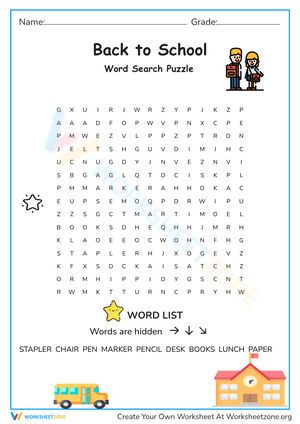
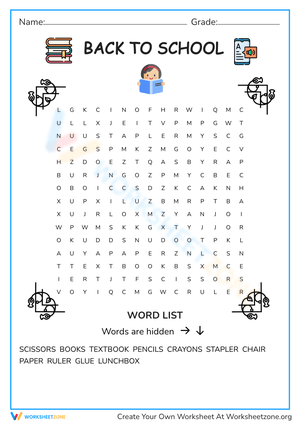
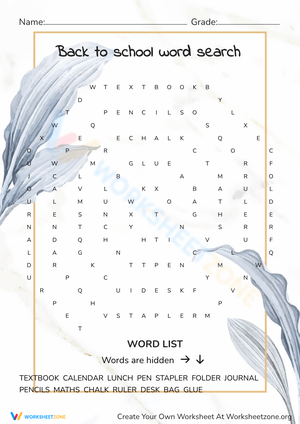
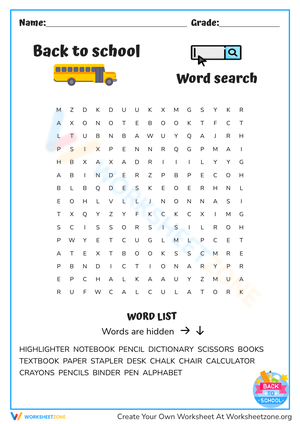
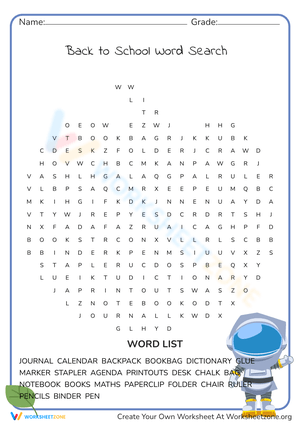
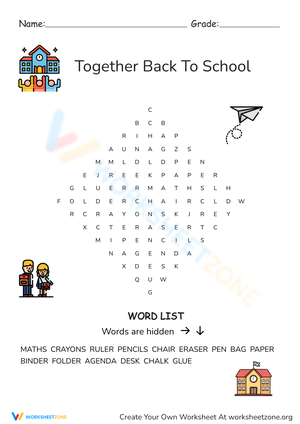
The first days of school are packed with logistics: seating charts, supply checks, name games, and a dozen procedural mini-lessons. A back to school word search gives you a ready-to-use activity that fills transition time without adding to your prep list. Students get a quiet, low-stakes task while you finish attendance, greet late arrivals, or circulate to answer questions. Because the puzzle format is familiar to nearly every student by kindergarten, you can hand it out on day one without spending instructional minutes on directions.
Beyond classroom management, a themed word search does real instructional work. A list built around classroom objects, school routines, and subject names previews vocabulary students will hear all year, from "cafeteria" and "locker" to "schedule" and "homeroom." Students who scan a grid for these words are also rehearsing spelling patterns before they ever write the words themselves.
What Skills a Word Search Builds
It's easy to dismiss word search puzzles as filler, but the scanning process draws on specific cognitive skills. Finding a target word inside a grid of letters requires sustained visual scanning and pattern recognition, the same skills that underlie early reading fluency and sustained attention. Students have to hold a word's letter sequence in mind, compare it against rows, columns, and diagonals, and reject near-matches, which is a form of active decoding practice disguised as a game.
A ResearchGate study on word search puzzles found the activity supports vocabulary mastery and spelling improvement in language learners, with students showing measurable gains in word recognition after repeated puzzle practice. That finding matters for back-to-school planning because it means the activity is doing more than occupying time; it is reinforcing the exact words you want students recalling later in units on classroom routines and school vocabulary.
Word Search for English Language Learners
Word search puzzles offer a particular advantage for English language learners during the first weeks of school. The activity separates word recognition from spoken production, so a student who isn't yet comfortable speaking in class can still succeed by matching visual letter patterns. Pairing the puzzle with a simple picture-word list or bilingual glossary lets ELL students connect the target vocabulary to meaning while they practice spelling recognition.
Because the format doesn't require writing complete sentences or answering aloud, it lowers the anxiety that often accompanies the first days in a new classroom. Teachers can use the puzzle as an entry point, then follow up with a short partner conversation once students have already seen the words in print. That sequencing, print recognition before spoken production, tends to build confidence faster than starting with open-ended speaking tasks.
Pairing the Puzzle With Vocabulary Discussion
A word search is strongest when it's the start of a short instructional sequence rather than a standalone worksheet. After students find the words, spend five minutes having them circle three words they didn't already know and write a one-sentence guess at the meaning. This turns passive scanning into active vocabulary work and gives you a quick formative check on which classroom-routine terms need more explicit teaching.
You can extend the activity further by asking students to sort the found words into categories, people, places, objects, or actions, which reinforces both vocabulary and basic classification skills. For older students, a quick writing extension works well: choose three words from the puzzle and use each one in a sentence describing your ideal first week of school. These extensions cost only a few extra minutes but shift the activity from busywork to a genuine vocabulary lesson.
Classroom Implementation
Print the puzzle at a grid size that matches your class's fine-motor and visual-scanning needs; younger grades benefit from a larger font and wider letter spacing. Set a clear time limit, five to ten minutes for primary grades and up to fifteen for older students, so the activity stays a warm-up rather than the whole period.
Use the puzzle strategically across the first week rather than only on day one. A word search works well as a quiet opener while you take attendance, as an early-finisher task for students who complete other first-week paperwork quickly, and as a take-home activity that gives families a low-pressure look at classroom vocabulary. Keep a few extra copies at a classroom center so students who finish other tasks early always have something purposeful to do.
Frequently Asked Questions
1. What grade levels benefit most from back-to-school word search puzzles?
Word search puzzles work across the K-8 range when the grid size and word list are adjusted. Younger grades need short, horizontal-only word lists, while upper elementary and middle school students can handle longer lists with diagonal and backward placements.
2. How can teachers use a word search as more than busywork on the first day?
Pair the puzzle with a short follow-up, such as circling unfamiliar words, sorting found words into categories, or writing a sentence using three of the words. That five-minute extension turns passive scanning into active vocabulary practice.
3. What skills does a word search actually build in students?
The scanning process builds visual scanning, pattern recognition, and letter-sequence memory, skills that support early reading fluency. Research on word search puzzles also links the activity to measurable spelling and vocabulary gains in language learners.
4. How long should a back-to-school word search activity take in class?
Plan for five to ten minutes with primary grades and up to fifteen minutes with older students, including a short follow-up discussion. Keeping it time-boxed preserves its role as a warm-up rather than a full lesson.
5. Can word searches support English language learners during the first weeks of school?
Yes. The format lets ELL students demonstrate word recognition without requiring spoken production, which lowers first-week anxiety. Pairing the puzzle with pictures or a glossary helps connect the target vocabulary to meaning before students are asked to speak or write independently.












 Interactive Worksheet Maker
 Quiz Maker
 Word Search Maker
 Crossword Puzzle Maker
 Word Scramble Generator
 Sentence Scramble Generator
 Handwriting Worksheet Generator
 Name Tracing Generator
 Fill In The Blank Generator




 BACK TOSCHOOL