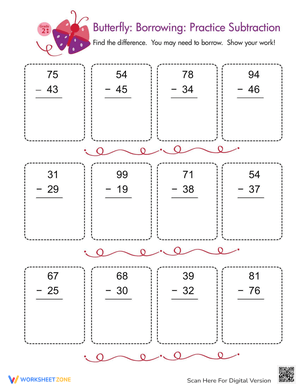
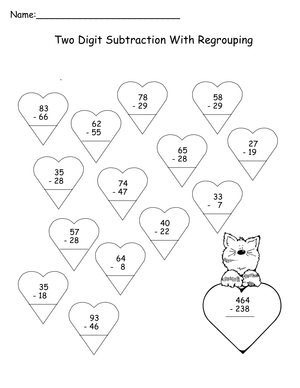
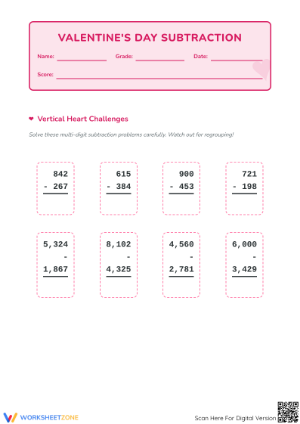
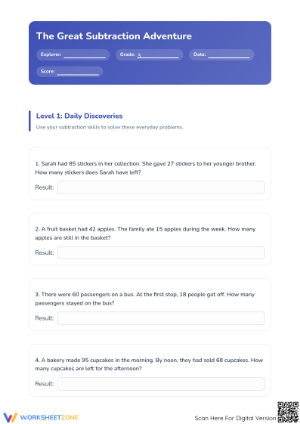
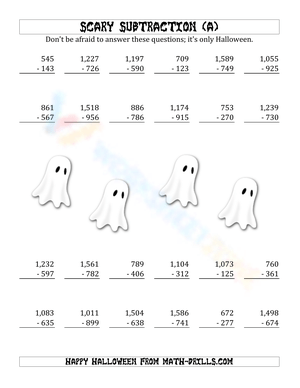
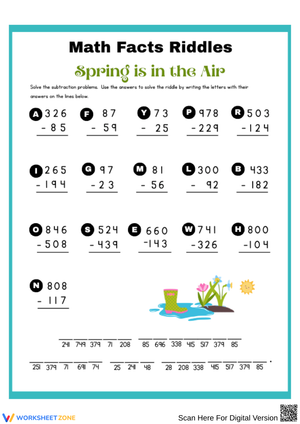
These subtraction with regrouping printable worksheets give 2nd through 4th grade teachers a ready-to-print set of exercises covering every regrouping scenario students encounter — from single-column borrowing in 2-digit problems to the multi-step exchanges required when zeros appear in the minuend. The set produces clear formative data because each worksheet isolates one regrouping type rather than mixing skill levels into one undifferentiated pile.
The Specific Skills Each Worksheet Targets
The four skill levels in this set follow a deliberate progression, and that structure matters more than it first appears. Students who attempt 3-digit work before 2-digit borrowing is automatic end up taxing their working memory on the mechanics rather than on the math — a problem that shows up as inconsistent errors and unusually slow completion. These subtraction with regrouping printable worksheets are organized so teachers can match each student or small group to exactly the right level rather than assigning one problem set to everyone and hoping for the best.
- 2-digit minus 2-digit, single regrouping: Problems like 52 − 37, where only the ones column requires borrowing. Consistent accuracy here is the prerequisite for everything above it, and rushing past this level creates gaps that compound at every subsequent stage.
- 3-digit subtraction with one or two regroupings: Students borrow across the tens and hundreds columns — sometimes once, sometimes twice in the same problem. The written-notation habits built at the 2-digit level get their first real pressure test here.
- 4-digit subtraction: Three place-value columns to track simultaneously while maintaining accurate notation. Students who rely on memory rather than written cross-outs begin producing structural errors at this level that look careless but are not.
- Subtraction across zeros: Problems like 300 − 148 require regrouping from the hundreds before the ones column can be touched. This type is kept on its own worksheet because folding across-zero problems into a general set makes it nearly impossible to identify whether a student understands the multi-step exchange or is simply making arithmetic slips.
Student Errors Worth Anticipating Before You Distribute These
The most durable error in regrouping — the one that survives weeks of instruction and resurfaces on unit assessments — is inverting the subtraction when no borrowing is needed. A student who computes 63 − 47 correctly will still write 8 for the ones column in 86 − 42 because they have internalized "subtract smaller from larger" as an unconditional rule rather than a conditional fallback. Worksheets that mix problems requiring regrouping with problems that do not are more effective at exposing this confusion than a worksheet composed entirely of borrowing problems, because students must decide whether to regroup rather than executing the same step automatically every time.
Across-zero problems generate a second, distinct error pattern. After correctly regrouping from the hundreds in a problem like 400 − 167, many students then treat the tens column as 0 − 6 = 6 — as if the regrouping action reset rather than changed the tens digit. This mistake tells you something specific: the student is following a remembered sequence of steps rather than tracking the actual values being exchanged. Spotting it during worksheet practice, before the unit test, gives you time to address it with a concrete demonstration using base-ten blocks.
Working These Worksheets Into Your Instructional Week
The most productive use of these worksheets is as a daily 8-minute warm-up during the week a new regrouping level is introduced. Project one worksheet under the document camera, solve the first two problems while narrating each step explicitly — "I cross out the 6, write a 5 above it, and place a 1 next to the ones digit" — then release students to complete the rest independently before whole-class comparison. This approach takes less time than a full lesson but generates enough student work to identify who needs re-teaching before you move on to the next level.
Having a set of subtraction with regrouping printable worksheets already sorted by level also makes it straightforward to pull a targeted small group during independent work time. While the rest of the class finishes 3-digit problems, a group of three or four students working on 2-digit borrowing can sit with you for ten focused minutes — no additional prep required beyond printing a different worksheet from the same set. That kind of responsive grouping works precisely because each worksheet covers a single, clearly defined skill rather than a mixed range of difficulty.
Tiering the Practice for Students at Different Stages
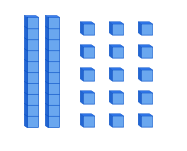
For students still building place-value understanding, pair any worksheet in the set with base-ten block manipulatives during the first few exposures. The physical act of trading one tens rod for ten ones cubes gives meaning to the written notation that a page of problems alone cannot provide. The transition off manipulatives is ready when a student can predict which digit will change before picking up the blocks — at that point, the concrete support has done its job, and the written procedure carries enough meaning to stand on its own.
Advanced students who have mastered 3-digit regrouping but are not yet ready for 4-digit problems respond well to the across-zero worksheet as an extension. The multi-step reasoning keeps them challenged without simply assigning more of the same problem type. For students who need a layer of challenge beyond 4-digit computation, these subtraction with regrouping printable worksheets work well as source material for student-created word problems — converting a bare equation into a situational context adds reading-comprehension demand without requiring any new materials or additional prep time.
Standard Alignment
The 2-digit worksheets address CCSS 2.NBT.B.5, which expects fluent addition and subtraction within 100 using place-value strategies. The 3-digit worksheets align with CCSS 3.NBT.A.2, extending that expectation to within 1,000. The practical distinction matters: at the 2nd-grade level, regrouping is being introduced as a formal procedure for the first time, so accuracy is the goal. By 3.NBT.A.2, the standard explicitly calls for fluency — which means accumulated distributed practice over weeks, not a single-unit lesson, is what actually moves students to the benchmark. The 4-digit and across-zero worksheets support 4th-grade review and targeted intervention rather than a specific new standard introduction.
Frequently Asked Questions
When should a student stop using manipulatives and work from the worksheet alone?
The concrete-to-abstract shift is ready when a student can consistently predict the outcome of a regrouping exchange before physically performing it with blocks. If a student looks at 52 − 37 and immediately identifies that a ten needs to be traded, they are ready to work with written notation only. If they still need the blocks to recognize that a trade is required, continued hands-on support is appropriate. Most 2nd graders make this transition within two to three weeks of initial instruction, though students with weaker place-value foundations may need longer.
How do I tell whether a student's regrouping errors are procedural or conceptual?
Ask the student to talk through one problem aloud before writing anything. A procedural error sounds like a student who describes the steps correctly — "I turn the 6 into a 16" — but then writes the wrong value during execution. A conceptual error sounds like a student who cannot explain why the 6 becomes a 16 in the first place. Those two students need different responses: the first benefits from slowing down and annotating each step carefully; the second needs to return to place-value work with physical materials before the written algorithm carries any real meaning.
Is it better to use these worksheets as timed drills or untimed practice?
Both serve a purpose, but not at the same instructional stage. Untimed practice belongs early, while students are still building accuracy — timing a student who has not yet internalized the steps produces anxiety without any fluency gain. Once a student is completing problems with fewer than one error per ten across two or three sessions, a timed warm-up adds the automaticity component that fluency actually requires. A workable rhythm: untimed practice Monday through Wednesday, then a 5-minute timed set Thursday and Friday of the same week, repeated over the two-week window when a new regrouping level is introduced.
Do the worksheets include answer keys?
Yes. Each worksheet comes with a corresponding answer key formatted to match the problem layout, which makes student self-checking during independent work faster and more reliable than comparing against a handwritten key on the board. Answer keys also allow families to support homework practice without needing to rework every problem themselves — a practical detail that becomes significant when regrouping is a concept the adults at home last saw in third grade.













 Interactive Worksheet Maker
 Quiz Maker
 Word Search Maker
 Crossword Puzzle Maker
 Word Scramble Generator
 Sentence Scramble Generator
 Handwriting Worksheet Generator
 Name Tracing Generator
 Fill In The Blank Generator