These cylinders worksheets cover the full instructional arc from kindergarten shape recognition through eighth-grade volume and surface area calculations, giving teachers a single organized collection rather than a patchwork of unrelated printables. Each page is built around a specific skill so you can pull exactly what a lesson calls for — a labeled diagram, a net-matching task, a guided formula problem — without sorting through materials that don't fit.
What's on These Cylinder Worksheets
These worksheets move through four distinct skill areas:
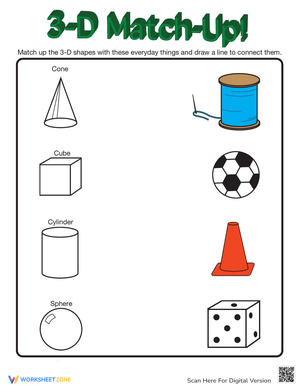
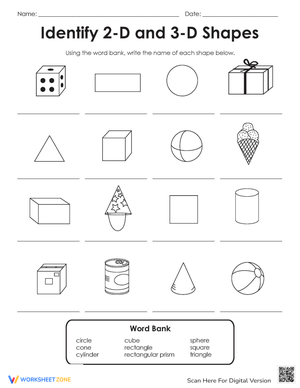
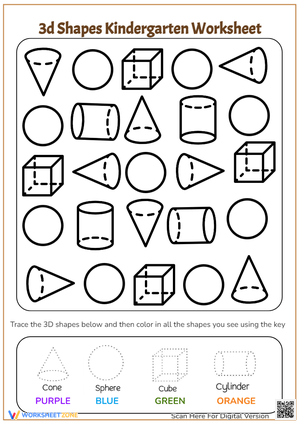
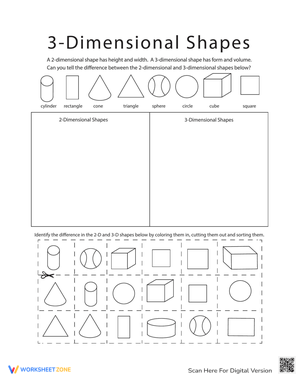
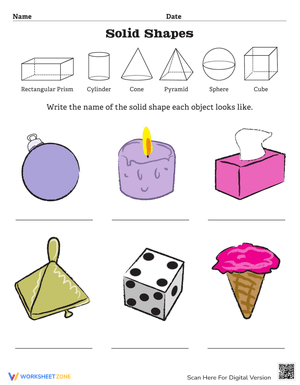
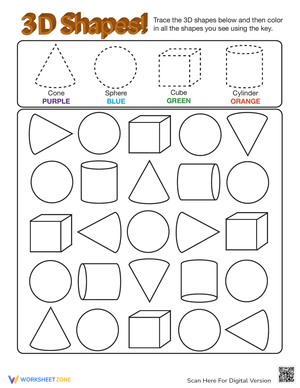
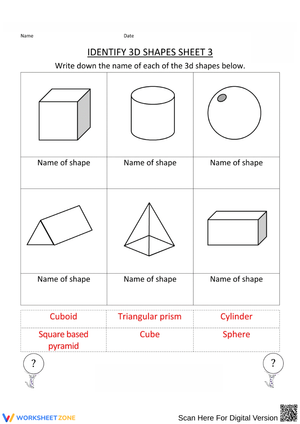
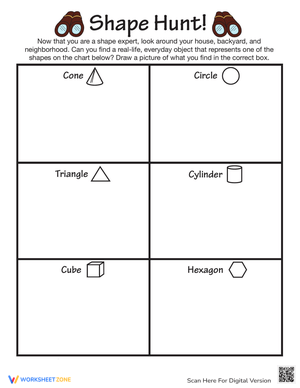
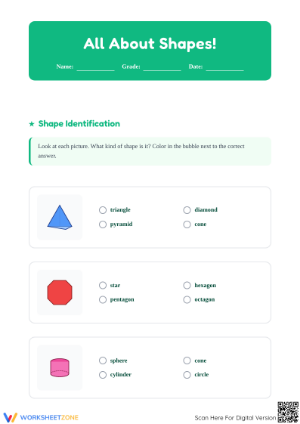
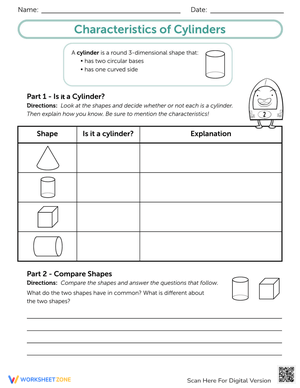
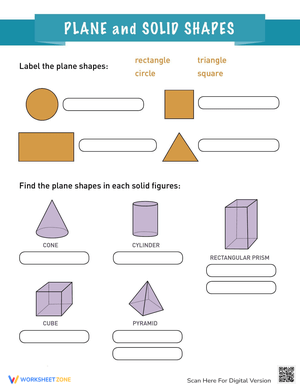
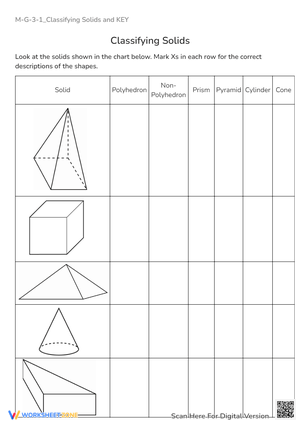
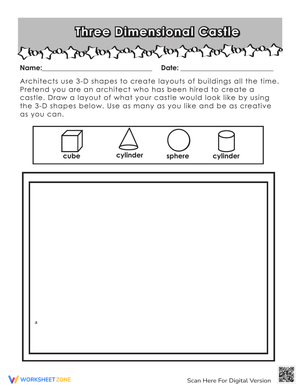
Early pages focus on identification: students look at illustrated objects and mark the cylinders, sorting soup cans and markers from cubes and pyramids. The next tier addresses properties — students label the radius, diameter, height, and circular faces on a diagram, and a few pages ask them to distinguish between the flat bases and the curved lateral surface in writing, not just by pointing.
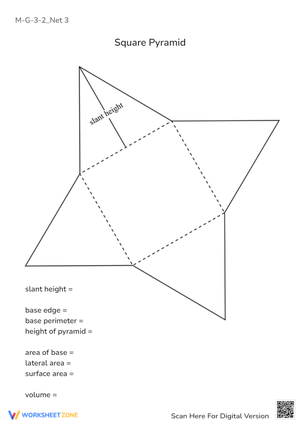
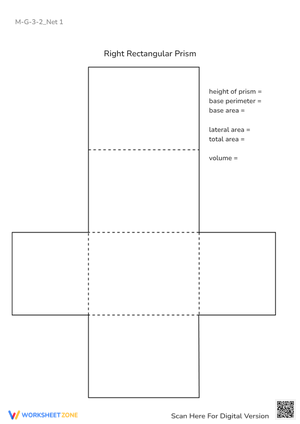
Net activities form their own section. A cylinder's net unfolds into a rectangle and two circles, and students who can match the flat layout to the assembled shape have a much easier time with surface area formulas later. Some pages show a net and ask students to identify the shape; others work the other direction, giving the 3D image and asking students to sketch or select the corresponding net.
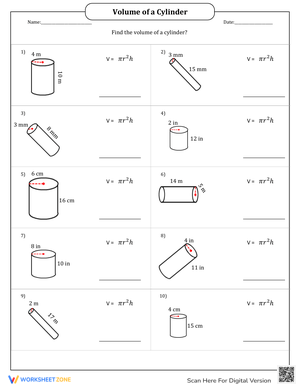
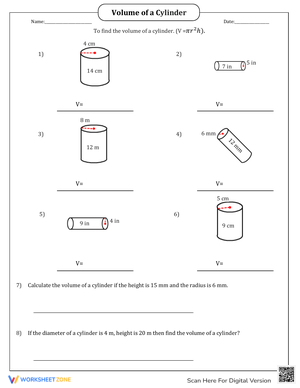
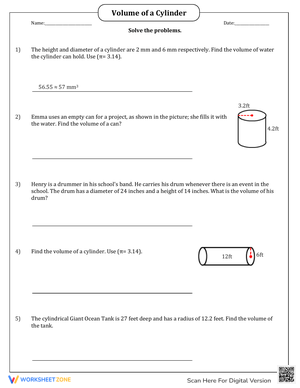
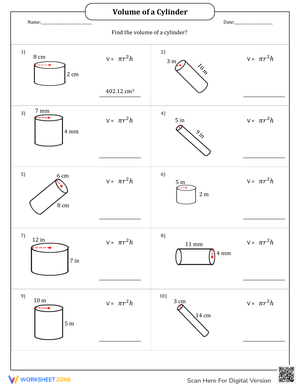
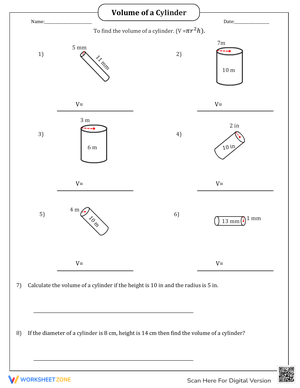
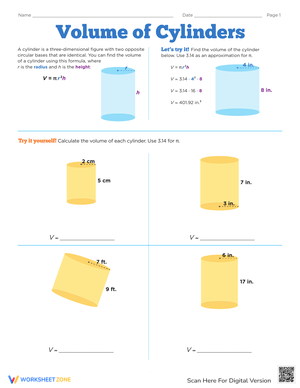
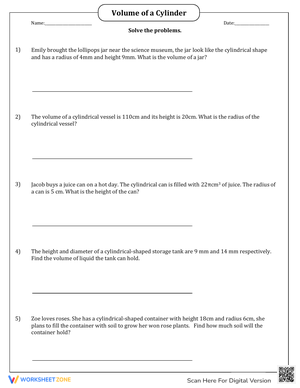
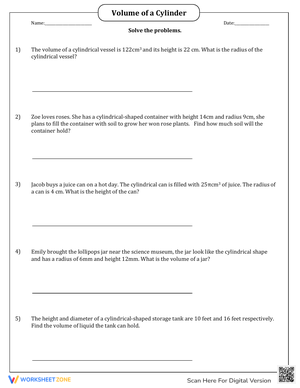
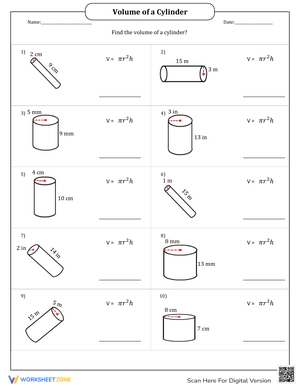
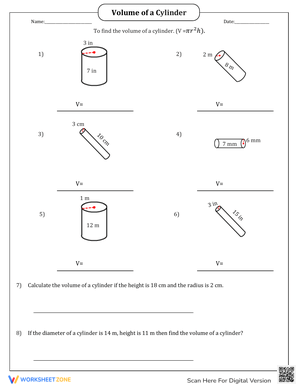
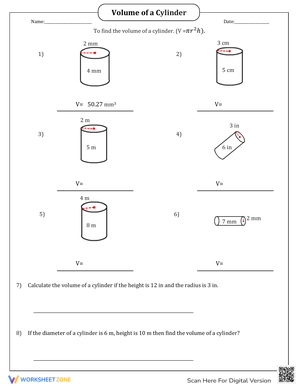
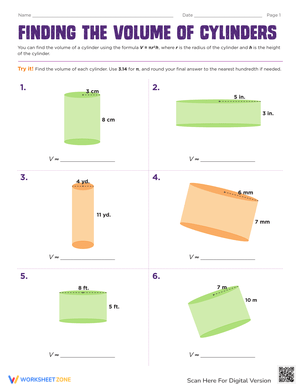
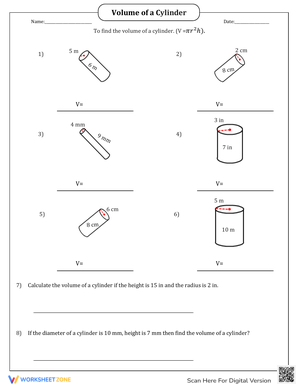
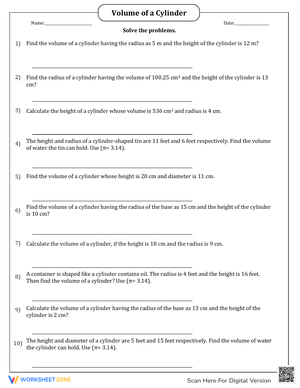
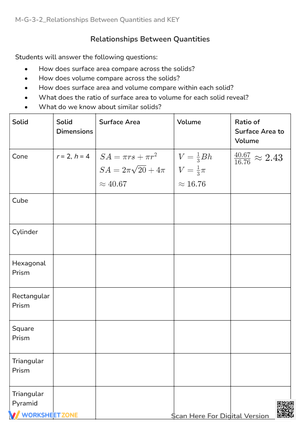
The upper pages shift to formula work. Volume problems use V = πr²h with labeled diagrams, progressing from single-step substitution to multi-step word problems. Surface area pages separate the lateral area (2πrh) from the full formula (2πrh + 2πr²) so students calculate each component before combining them — a structure that catches the common error of forgetting to add both circular bases. A final group of challenge problems asks students to compare what happens to volume when only the radius changes versus when only the height changes, which targets the conceptual gap between linear and squared relationships.
Standards Alignment
The identification pages address K.G.A.2, which asks kindergartners to name shapes regardless of their orientation or overall size. Cylinder is one of the named 3D shapes in that standard, and the worksheet format — cylinders shown upright, on their side, and at an angle — matches the standard's intent directly.
The volume and surface area pages align to 8.G.C.9, the Common Core standard that covers formulas for cylinders, cones, and spheres. In most eighth-grade sequences, cylinders come first in that cluster because the volume formula extends naturally from circle area work students completed in seventh grade under 7.G.B.4. Teachers who use these pages as part of that transition find that referencing the circle area formula explicitly — rather than presenting the volume formula as something new — shortens the time students need to feel confident with it.
Where These Worksheets Fit in the Lesson Plans
At the kindergarten and first-grade level, the identification sheets work well after a brief tactile introduction — pass around a few actual cylinders, let students run a finger along the curved surface and press on the flat faces, then hand out the worksheet. The sheet lands differently when students have just held the object.
For upper elementary, the net pages pair naturally with a five-minute cut-and-fold extension. Once students complete the matching activity on paper, give them a cardstock net to assemble. The moment the rectangle curves around and the circles close off each end, the relationship between the flat representation and the solid shape becomes physical rather than abstract. That tactile experience carries forward when the surface area formula appears in sixth grade — students who built the net remember what each term accounts for.
In middle school, the volume worksheet sequence works best when it follows a short warm-up on circle area. Because V = πr²h is just the circle area formula multiplied by height, students who can recall A = πr² quickly find the volume formula intuitive. A three-problem circle area warm-up — printed on a half-sheet to keep it fast — removes that stumbling block before it appears. The guided formula pages work as whole-class practice; the word problem pages are sized for independent work or homework.
The differentiation is built into the collection's structure. During a single class period, you can hand identification and labeling pages to students who need reinforcement while the rest of the class works on surface area problems. Having both levels printed means you're not improvising during the lesson.
Where Students Struggle Most
The radius-versus-diameter confusion shows up consistently at every grade level that works with dimensions. A student who correctly labels the radius on a diagram will still plug the diameter into V = πr²h — especially when a word problem gives the diameter in the problem stem without flagging it. The formula pages on these cylinders worksheets include a reminder line asking students to confirm which measurement they have before substituting, which doesn't eliminate the error but makes it visible before the answer is written.
The squared radius is the other persistent sticking point. Students understand intuitively that doubling the height doubles the volume, but the idea that doubling the radius quadruples it surprises most seventh and eighth graders the first time they see it calculated. The comparison problems in the challenge section are worth assigning specifically because they surface this misconception in a structured way — students who work through the side-by-side calculations remember the relationship far better than students who only hear it explained.
At the net stage, the rectangle dimensions trip students up. The width of the rectangle in a cylinder net equals the circumference of the circular base, not the diameter. Students who try to match nets by eyeballing sometimes guess wrong on that dimension. A few pages include a prompt asking students to calculate the circumference and verify it matches the rectangle's width — that verification step turns a guessing activity into an analytical one.
Frequently Asked Questions
Do these work for students who haven't memorized π yet?
Yes. The guided pages include π as a symbol throughout and instruct students to leave answers in terms of π until they're ready to multiply through. That approach also makes it easier to check work — an answer of 48π is harder to misread than 150.796...
Is there a page that addresses only lateral surface area?
There are pages that calculate lateral area separately before students move to total surface area. This matters because some applied problems — how much label paper wraps around a can, how much paint covers a cylindrical column — call for lateral area only. Treating them as the same calculation is a common instructional shortcut that creates confusion later.
What's a reasonable pacing guide for the full set?
In a typical fifth-grade geometry unit, the properties and net pages take two class periods. In an eighth-grade unit, one period on the circle area warm-up and volume pages, one period on surface area, and one period on the comparison and word problem pages is a reasonable three-day block — though the word problems often need more time than you expect the first time through.













 Interactive Worksheet Maker
 Quiz Maker
 Word Search Maker
 Crossword Puzzle Maker
 Word Scramble Generator
 Sentence Scramble Generator
 Handwriting Worksheet Generator
 Name Tracing Generator
 Fill In The Blank Generator