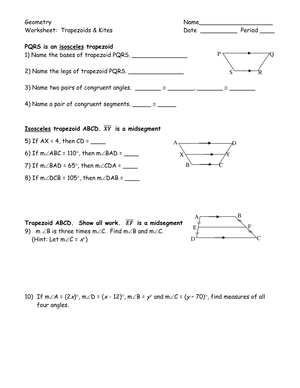
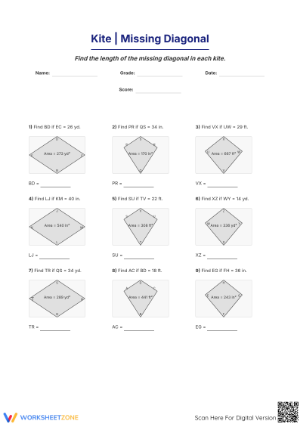
What Trapezoid and Kite Worksheets Actually Build
Trapezoid and kite worksheets give students repeated, structured practice sorting two quadrilaterals that look simple but trip up a lot of learners. The goal isn't just naming a shape on sight. It's teaching students to check specific properties, side lengths, parallel sides, angle types, and diagonals, and to defend a classification with evidence. For US teachers in grades 3 through 6, that shift from it looks like a kite to it has two pairs of adjacent congruent sides is exactly what these practice sets are built to support.
A strong worksheet set moves in a predictable order: identify, then classify, then compare. Students first circle trapezoids and kites in a mixed group, then sort them by attributes, and finally explain how a kite differs from a rhombus or a trapezoid differs from a parallelogram. That progression mirrors how the standards themselves are written, so the practice you assign lines up with the reasoning students owe on state tests.
Trapezoid vs. Kite: The Properties That Matter
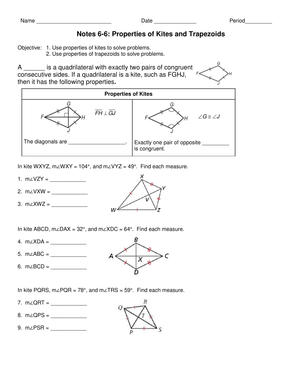
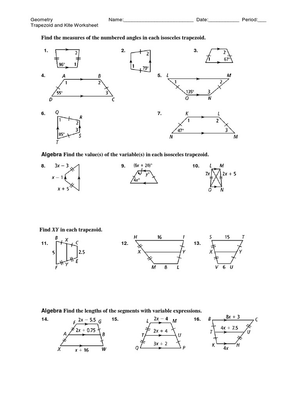
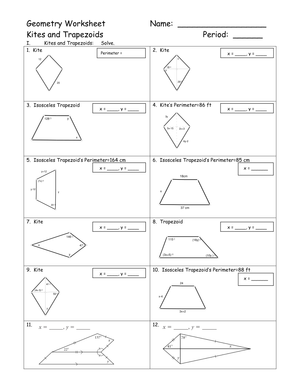
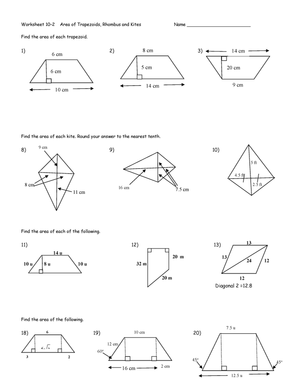
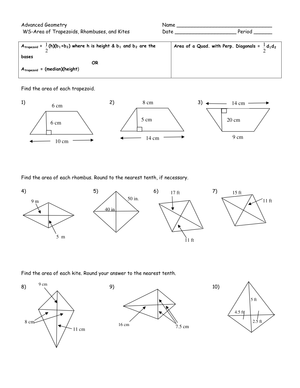
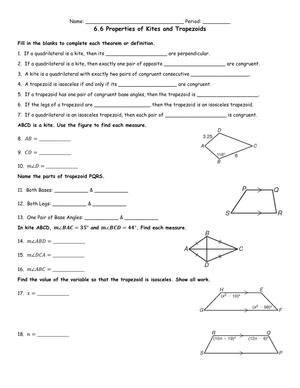
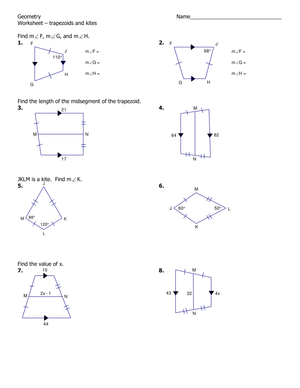
The fastest way to help students separate these two shapes is to anchor each one to a short, testable definition. A trapezoid is a quadrilateral with exactly one pair of parallel sides. A kite is a convex quadrilateral with two distinct pairs of adjacent congruent sides, where not all four sides are congruent. Those two sentences do a lot of work on a worksheet, because every question becomes a property check rather than a guess.
Side relationships are the first filter. In a kite, the congruent sides sit next to each other, not across from each other, which is what separates a kite from a parallelogram or rhombus. In a trapezoid, the parallel pair is what students hunt for, and the exactly one pair wording keeps parallelograms out of the category.
Angle and diagonal behavior give students a second, independent way to confirm their answer. Kites have one pair of equal opposite angles and perpendicular diagonals. Trapezoids don't require any special angle, but the parallel sides create predictable same-side angle relationships that older students can use. Worksheets that ask for two pieces of evidence per shape build far sturdier understanding than single-answer identification.
Where This Fits in the Common Core Progression
These worksheets aren't a standalone topic. They sit inside a multi-year geometry arc, and knowing where a class falls in that arc tells you how much support to build in.
The Common Core State Standards Initiative places quadrilateral classification across three grade levels: students meet shape categories in grade 3 under 3.G.A.1, classify shapes by parallel and perpendicular lines in grade 4 under 4.G.A.2, and build formal shape hierarchies in grade 5 under 5.G.B.3. That three-year arc frames every trapezoid and kite worksheet you assign.
In practice, a third grade class uses these sheets mostly for recognition and vocabulary. A fourth grade class leans on the parallel-and-perpendicular language directly from 4.G.A.2. By fifth grade, students should be placing kites and trapezoids inside a branching quadrilateral hierarchy, which is where 5.G.B.3 and 5.G.B.4 push them toward reasoning like every square is a rhombus, but not every trapezoid is a parallelogram.
Using Diagonals as a Teaching Hook
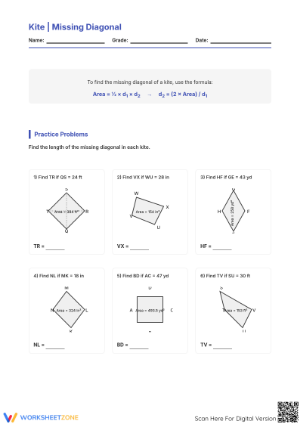
Here's an expert move most worksheets underuse: teach the diagonals before the side counting. In a kite, the two diagonals always meet at a 90-degree angle, and one diagonal bisects the other. That single perpendicular-diagonal test correctly flags a kite in nearly every case students will see, and it gives visual learners a property they can literally see by folding paper along the line of symmetry. A trapezoid's diagonals, by contrast, do not bisect each other and are generally unequal, which quietly rules out the parallelogram family without a single side measurement.
When students have two independent tools, side congruence and diagonal behavior, they stop relying on orientation. A kite rotated 45 degrees still passes the perpendicular-diagonal check, so students who learned to look only for the diamond-on-a-string picture don't fall apart when the figure is tilted.
Classroom Implementation
Start with a five-minute sort. Hand each small group a stack of cut-out quadrilaterals, including trapezoids, kites, rhombuses, and parallelograms, and ask them to make two piles with a written reason taped to each. The reasons are the assessment, not the piles.
For intervention stations, pair a worksheet with physical manipulatives. Geoboards let students stretch a kite and watch the perpendicular diagonals hold, which turns an abstract rule into something they built. Cut-and-paste shape hunts work well for grades 3 and 4, where matching a figure to its name still carries most of the cognitive load.
For enrichment, ask fast finishers to draw a quadrilateral that is neither a kite nor a trapezoid and justify why. That reverse task exposes whether a student truly owns the definitions. Rotate the printed shapes to different orientations across the week so no one anchors classification to a single correct picture.
Frequently Asked Questions
1. What grade level are trapezoid and kite worksheets appropriate for?
They fit best in grades 3 through 6. Grade 3 students use them for shape recognition and vocabulary, grade 4 students classify by parallel and perpendicular lines, and grade 5 students place both shapes inside a quadrilateral hierarchy. Intervention groups in middle school also use them for review before coordinate geometry.
2. What is the difference between a trapezoid and a kite?
A trapezoid is a quadrilateral with exactly one pair of parallel sides. A kite is a convex quadrilateral with two pairs of adjacent congruent sides, where not all four sides are congruent. Trapezoids are defined by parallel sides; kites are defined by adjacent equal sides and perpendicular diagonals.
3. How do these worksheets align with Common Core geometry standards?
They map to the grade 3-5 geometry progression: 3.G.A.1 for shape categories, 4.G.A.2 for classifying by parallel and perpendicular lines and angle types, and 5.G.B.3 with 5.G.B.4 for building shape hierarchies. That lets you assign the same topic while adjusting the reasoning demand by grade.
4. What classroom activities pair well with trapezoid and kite worksheet practice?
Cut-and-paste shape sorts, geoboard building, small-group intervention stations, and quick exit-ticket checks all reinforce the same properties. Physical manipulatives are especially useful for showing the perpendicular diagonals of a kite, which many students grasp faster by folding than by reading a definition.













 Interactive Worksheet Maker
 Quiz Maker
 Word Search Maker
 Crossword Puzzle Maker
 Word Scramble Generator
 Sentence Scramble Generator
 Handwriting Worksheet Generator
 Name Tracing Generator
 Fill In The Blank Generator