


























Views
Downloads

Printable Kite Diagonal Worksheet | Grade 6-9 Math
Paste this activity's link or code into your existing LMS (Google Classroom, Canvas, Teams, Schoology, Moodle, etc.).
Students can open and work on the activity right away, with no student login required.
You'll still be able to track student progress and results from your teacher account.
Mastering geometry requires a firm grasp of spatial relationships. This Essential Kite Diagonal Worksheet provides Grade 6 through 9 students with focused practice in calculating missing dimensions. By applying area formulas, learners strengthen their ability to solve for unknown variables while reinforcing their understanding of kite properties.
At a Glance
- Grade: 6-9 · Subject: Geometry
- Standard:
CCSS.MATH.CONTENT.6.G.A.1— Find the area of special quadrilaterals by decomposing into triangles- Skill Focus: Solving for missing diagonal lengths in kites
- Format: 2 pages · 10 problems · Answer key included · PDF
- Best For: Independent practice and formative assessment
- Time: 25–35 minutes
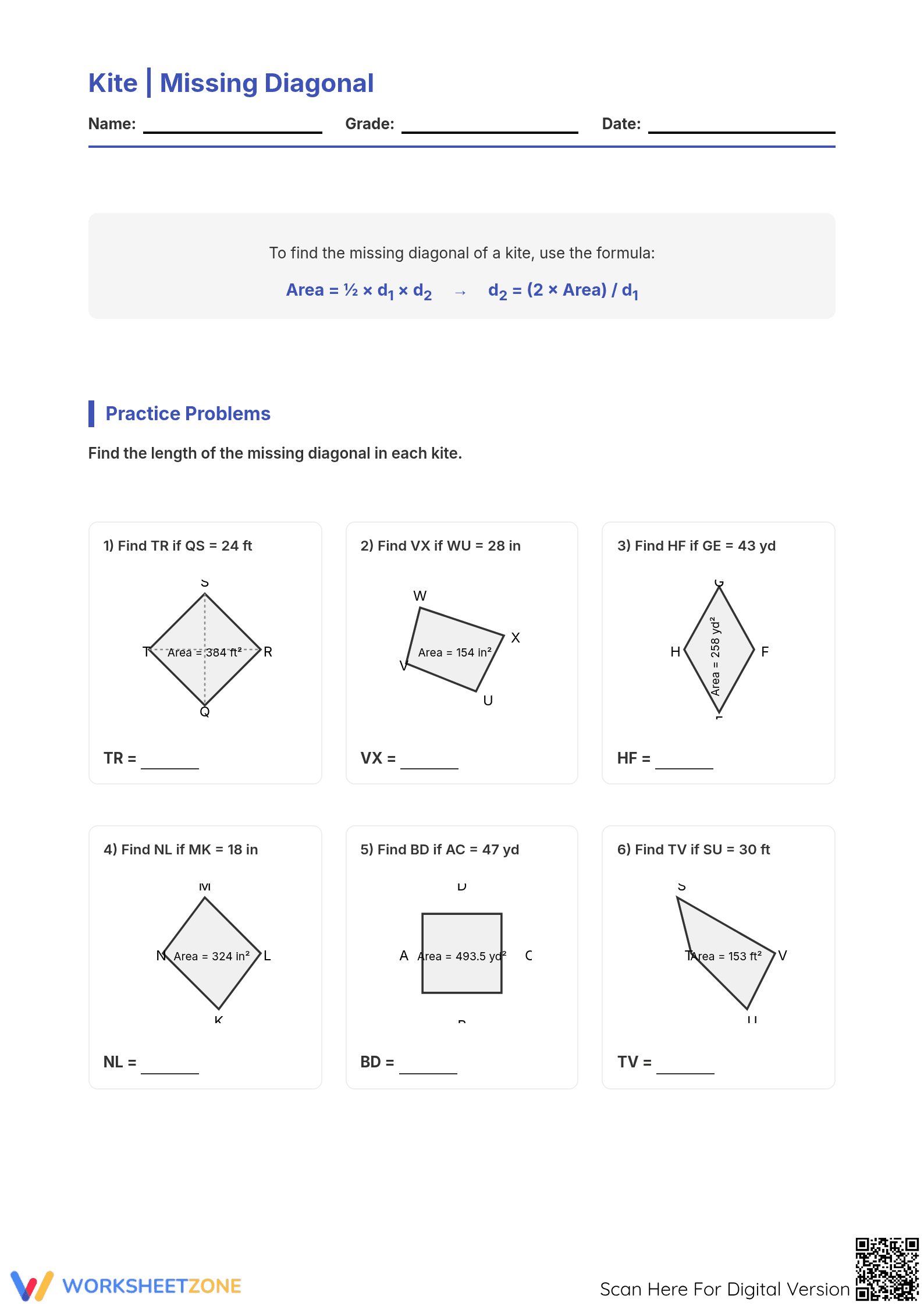
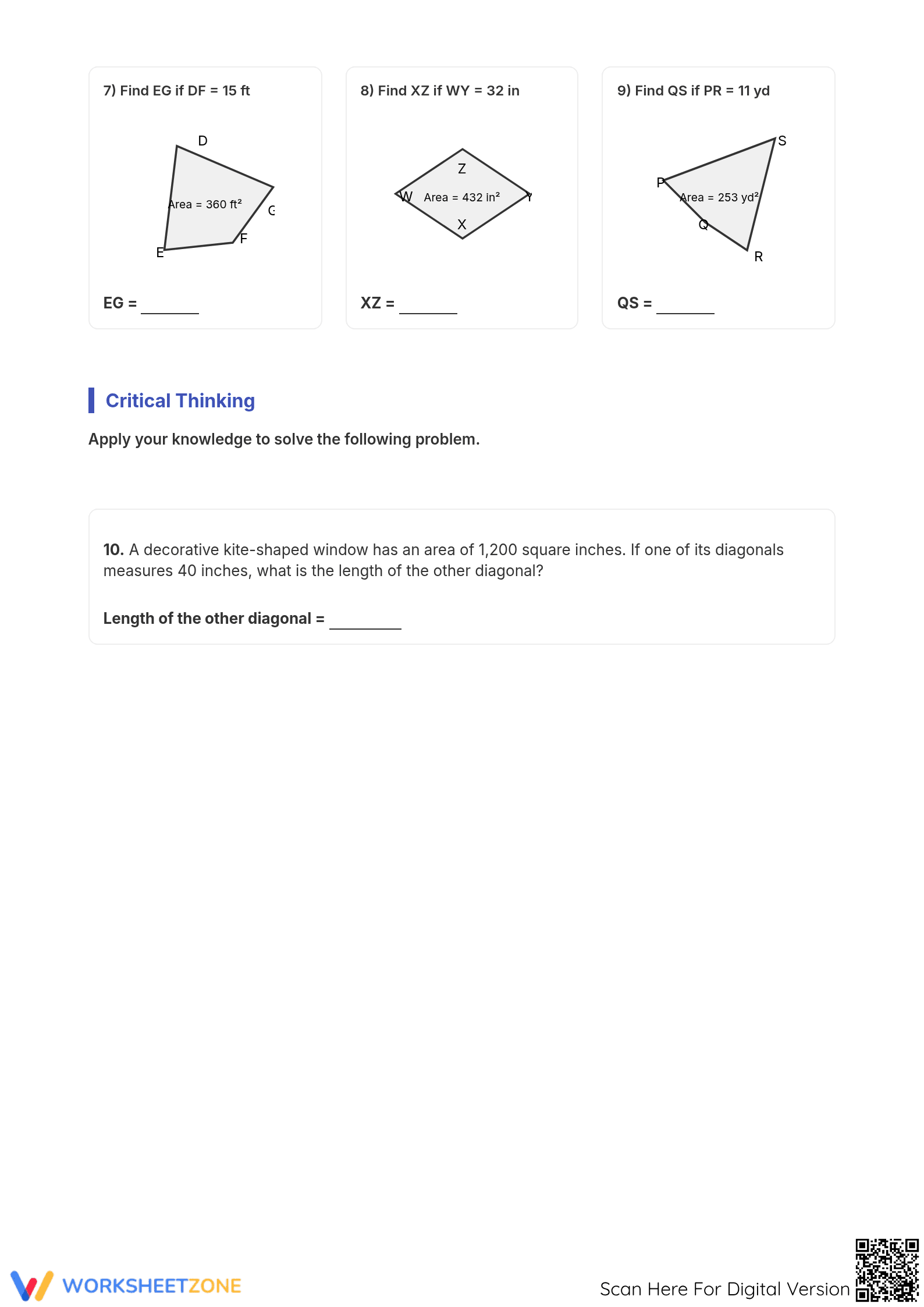
This comprehensive two-page resource contains ten carefully structured tasks designed to build geometric fluency. The first page features six visual diagrams of kites with provided area and one diagonal measure, requiring students to solve for the second diagonal. The second page extends this with three additional diagram-based problems and a challenging critical thinking word problem involving a real-world window application.
Skill Progression
- Guided Practice: A prominent formula box at the top of the first page provides the explicit equation d2 = (2 * Area) / d1, offering immediate support for the first several calculation tasks.
- Supported Practice: Problems four through nine present kites in various orientations and units, including inches, feet, and yards, challenging students to maintain accuracy across different measurement contexts.
- Independent Practice: The final critical thinking task removes visual aids, requiring students to translate a written scenario into a mathematical equation to find a missing diagonal in a practical setting.
This gradual-release approach ensures that learners move from basic calculation to conceptual application.
Standards Alignment
This resource is aligned to CCSS.MATH.CONTENT.6.G.A.1, which requires students to find the area of special quadrilaterals by decomposing into triangles. Understanding the relationship between area and diagonals is fundamental to this mastery. This standard code can be copied directly into lesson plans or curriculum mapping tools.
How to Use It
Teachers can utilize this worksheet as a high-impact independent practice set following a direct instruction lesson on quadrilateral area. During completion, circulate to observe if students are correctly multiplying the area by two before dividing by the known diagonal, a common procedural stumbling block. This resource also functions as an excellent exit ticket or formative assessment to gauge student readiness for more complex polygon decomposition.
Who It's For
This worksheet is designed for middle and early high school students enrolled in General Math or Geometry. It offers valuable differentiation for students needing focused procedural reinforcement. The clear layout and worked formula example make it a natural pairing with an introductory geometry slide deck or a set of interactive anchor charts focused on quadrilateral properties.
According to the RAND AIRS 2024 report on mathematics instructional materials, the use of targeted practice sets that isolate specific geometric procedures is essential for developing long-term procedural fluency. This worksheet addresses a critical sub-skill of the CCSS.MATH.CONTENT.6.G.A.1 standard by requiring students to solve for missing diagonal lengths in kites using the inverse of the area formula. Research suggests that providing students with both visual diagrams and word-based scenarios, as seen in the ten tasks provided here, supports the transition from concrete calculation to abstract reasoning. By reinforcing the relationship between area and linear dimensions, this resource helps bridge the gap between basic polygon recognition and advanced spatial analysis. Educators can rely on this structured approach to provide the high-repetition practice necessary for students to master special quadrilateral properties. This tool represents a focused, research-backed method for improving student outcomes in middle school geometry.


