


























Views
Downloads

Missing Diagonal Kite Worksheet | Essential Grade 6-8 Math
Paste this activity's link or code into your existing LMS (Google Classroom, Canvas, Teams, Schoology, Moodle, etc.).
Students can open and work on the activity right away, with no student login required.
You'll still be able to track student progress and results from your teacher account.
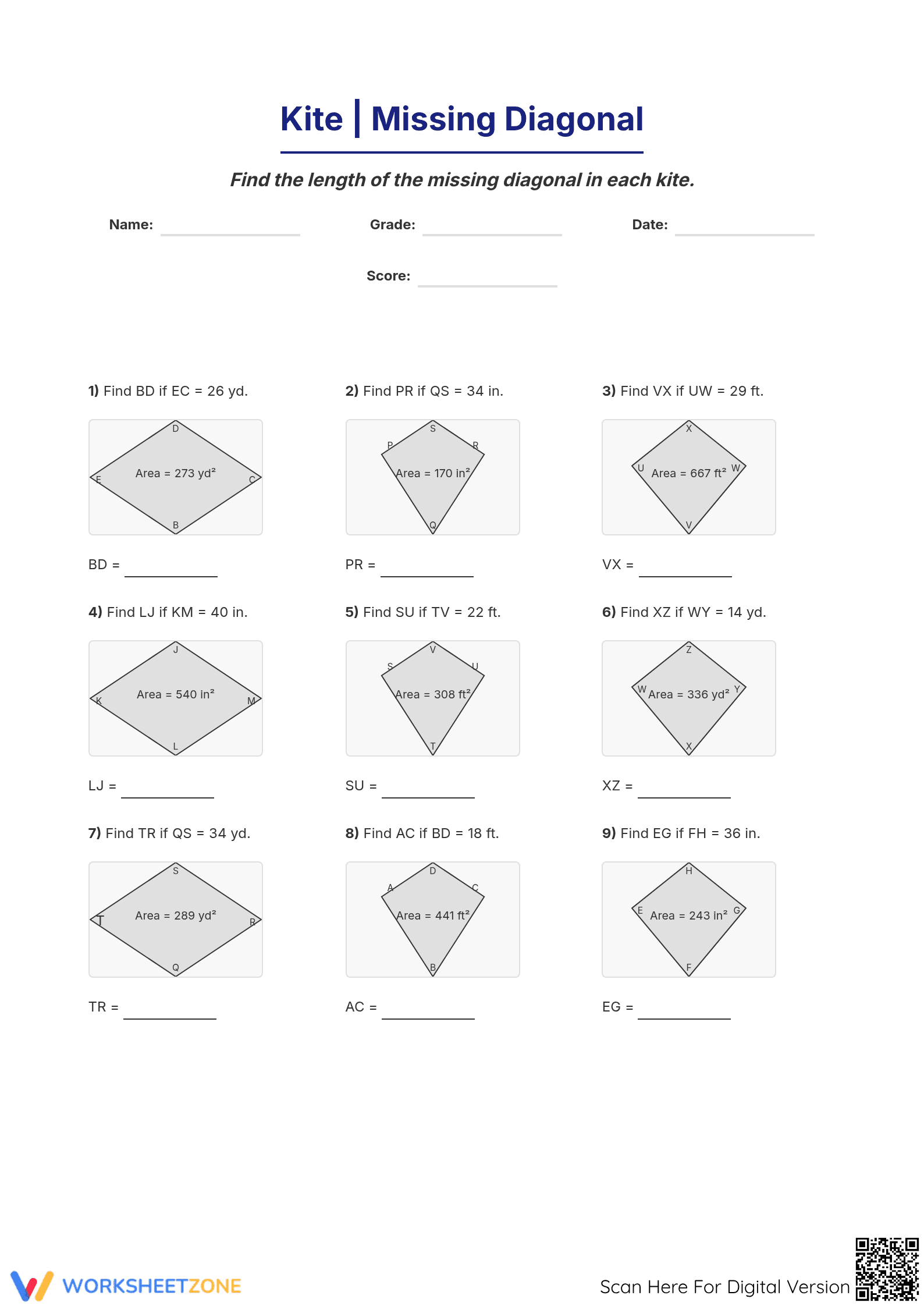
This essential geometry worksheet focuses on the relationship between area and diagonal lengths in a kite. Students apply the area formula to solve for a missing dimension, reinforcing algebraic manipulation within a geometric context. By completing these 9 problems, learners build the precision required for advanced middle school geometry and coordinate plane applications.
At a Glance
- Grade: 6–9 · Subject: Geometry
- Standard:
CCSS.MATH.CONTENT.6.G.A.1— Find the area of special quadrilaterals by decomposing into triangles- Skill Focus: Kite diagonal calculation
- Format: 1 page · 9 problems · Answer key included · PDF
- Best For: Homework, geometry centers, or quiz prep
- Time: 15–25 minutes
The worksheet presents nine distinct kite diagrams, each labeled with its total area and the length of one diagonal. Students are tasked with finding the length of the intersecting diagonal. The clean, professional layout provides ample space for students to show their work, with a full answer key provided for immediate feedback.
- Guided Practice: The first three problems use whole number area values and even-numbered diagonals to introduce the inverse operation of the kite area formula without complex arithmetic.
- Supported Practice: Problems 4-6 introduce larger dimensions and varied units (yards, feet, inches), requiring students to maintain unit consistency while isolating the missing variable.
- Independent Practice: The final three tasks challenge students to apply the formula to kited orientations that require careful identification of which diagonal is provided versus which is missing.
The progression follows a gradual-release model, moving from simple calculation to robust algebraic application.
This resource is aligned to CCSS.MATH.CONTENT.6.G.A.1, which requires students to find the area of special quadrilaterals, including kites, by composing into rectangles or decomposing into triangles. This standard code can be copied directly into lesson plans, IEP goals, or district curriculum mapping tools to ensure instructional consistency across the grade level.
Use this worksheet as a post-instruction practice session after teaching the kite area formula. It serves as an excellent formative assessment tool; observe if students remember to multiply the area by two before dividing by the known diagonal. Expect students to complete the set in 20 minutes. It is also suitable for a self-guided math center or as a homework assignment.
This resource is designed for Grade 6 through Grade 9 students who are mastering area formulas. It is particularly effective for learners needing targeted practice in multi-step equations within geometry. Pair this worksheet with a kite properties anchor chart or a short introductory passage on the characteristics of perpendicular diagonals.
To master the measurement of special quadrilaterals like kites, students must move beyond rote memorization of formulas to an understanding of spatial relationships and algebraic derivation. This worksheet facilitates this transition by requiring the inverse application of the area formula, a core competency for Grade 6-9 geometry. According to the RAND AIRS 2024 report on mathematical instructional materials, high-quality practice sets that focus on a single, isolated skill—such as finding a missing dimension—significantly improve long-term retention compared to broad, multi-topic reviews. By focusing exclusively on the CCSS.MATH.CONTENT.6.G.A.1 standard, this resource ensures that students develop the computational fluency necessary for higher-level geometry and physics. The inclusion of nine distinct tasks allows for the repetition needed to achieve mastery, while the varied units of measurement prevent students from relying on surface-level pattern recognition. This focused approach provides educators with a reliable tool for both primary instruction and targeted intervention.


