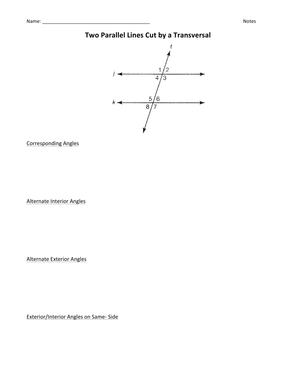
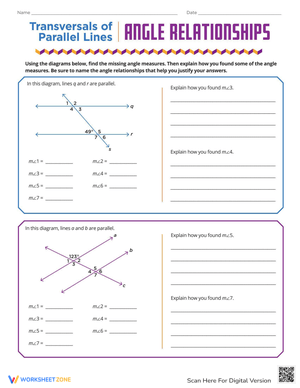
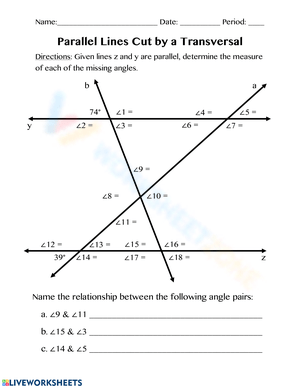
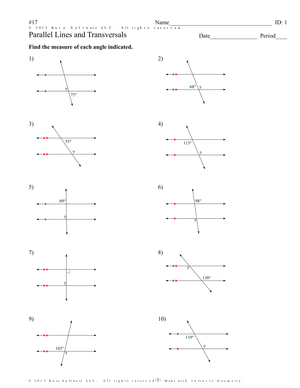
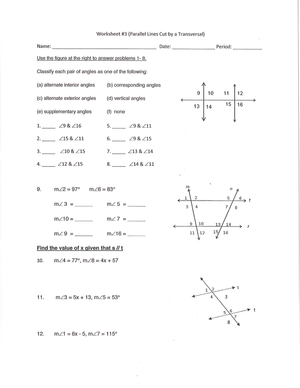
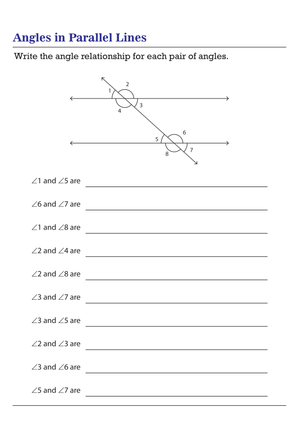
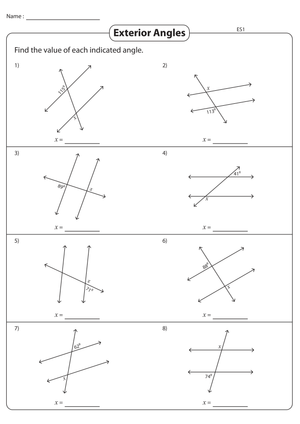
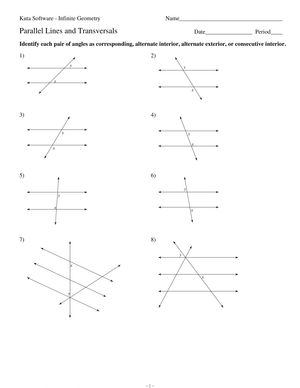
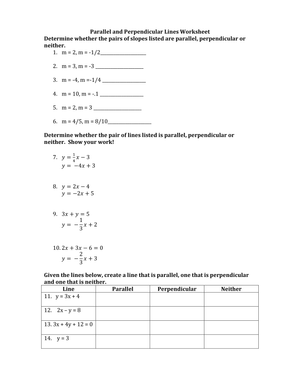
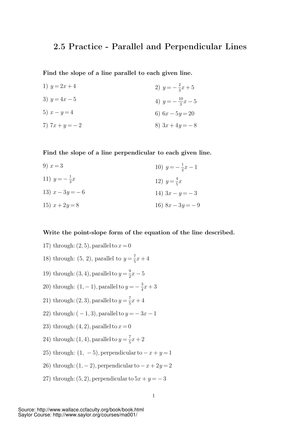
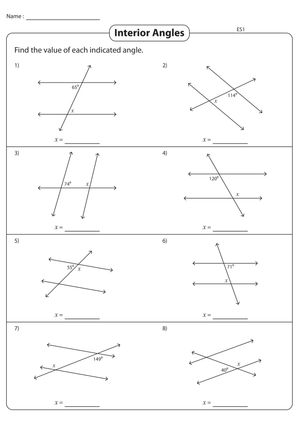
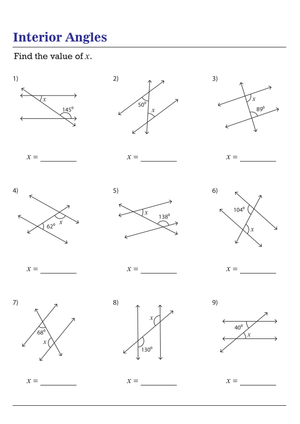
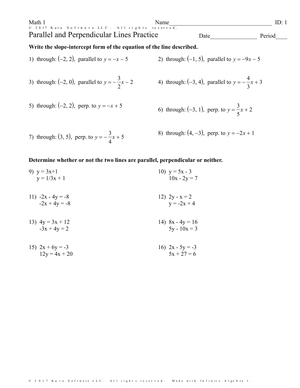
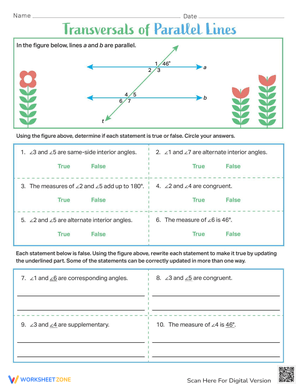
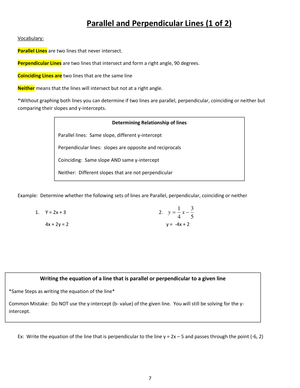
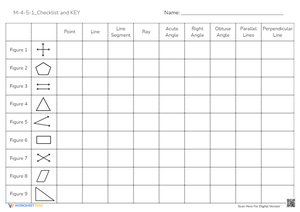
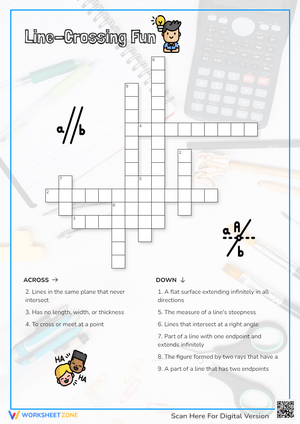
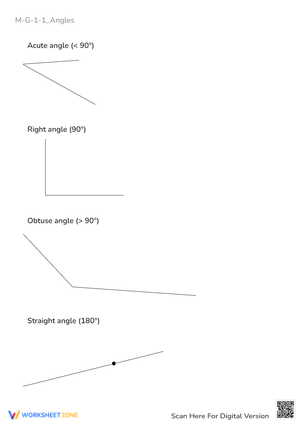
These parallel and perpendicular lines worksheets give fourth graders structured, repeated practice with two geometric relationships that students frequently confuse well into fifth grade — and the confusion is understandable, because both involve pairs of lines, both require some spatial reasoning, and the vocabulary itself carries no visual memory the way words like "triangle" or "square" do. The set covers identification, drawing, and shape analysis, so teachers have material for initial instruction, guided practice, and review without building from scratch.
Concepts Covered Across the Worksheet Collection
Each page targets a specific aspect of the skill rather than mixing tasks in ways that obscure where a student is breaking down. The types of practice included:
- Sorting line pairs as parallel, perpendicular, or intersecting-but-not-perpendicular — a distinction that forces students to look at angle measure rather than just "do these lines cross"
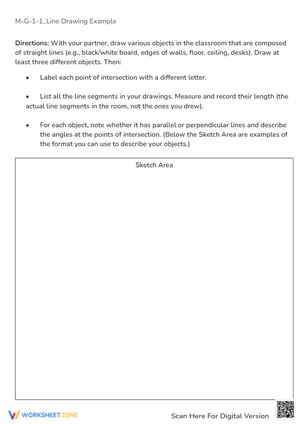
- Drawing a line parallel or perpendicular to a given line using a ruler, with starting points provided to reduce the blank-page problem
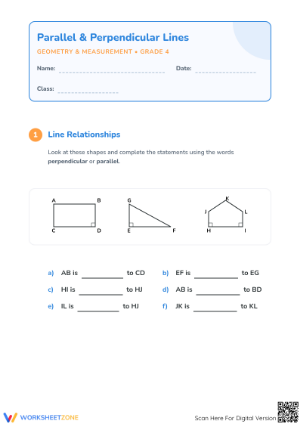
- Analyzing quadrilaterals and other polygons to identify which sides share a parallel or perpendicular relationship — the application that actually appears on state assessments
- Labeling diagrams of real-world grids, including simplified street maps, where students mark parallel avenues and perpendicular intersections
- Completing partially drawn figures by adding a side that is parallel or perpendicular to a given side
Standards Alignment
The anchor standard is CCSS.Math.Content.4.G.A.1, which asks students to draw and identify points, lines, line segments, rays, angles, and perpendicular and parallel lines in two-dimensional figures. Classroom teachers will recognize this as the standard that opens the 4.G cluster before students move into classifying shapes by their properties in 4.G.A.2. That sequence matters: identification and drawing work done here builds the vocabulary students need to explain why a trapezoid has exactly one pair of parallel sides or why a rectangle has four right angles. These worksheets occupy the instructional space between introducing the definitions and asking students to apply them in shape classification — a stretch many teachers under-resource because it feels like review once the lesson is done, but it is where the conceptual work actually consolidates.
Where Students Struggle Most
The most persistent error is treating any intersection as a perpendicular one. Students who have just learned that perpendicular lines cross will look at two lines crossing at 60 degrees and mark them perpendicular without checking the angle. This is a definitional overgeneralization — they have encoded "cross" rather than "cross at 90 degrees" — and it shows up on almost every first assessment. The identification pages address this directly by including several pairs of non-perpendicular intersecting lines alongside true perpendicular pairs, so students have to discriminate rather than apply a simpler rule.
The drawing tasks surface a different problem: students who understand the concept still produce parallel lines that slowly drift together because they measure from a single point rather than maintaining consistent distance at two points along the line. A quick correction is to have students mark two points on their reference line, measure the same distance perpendicular to the line at each point, then connect those two new points. The worksheet pages include tick-mark guides at two positions precisely to prompt this habit without requiring the teacher to reteach it every time.
How Teachers Use These Pages In Their Lesson Plans
The drawing and construction pages work well during the initial lesson, when students have a ruler in hand and the teacher is circulating — they give students something concrete to do while the concept is fresh rather than asking them to listen for twenty minutes. The identification and shape-analysis pages work better as the Monday warm-up after a weekend gap, when spaced retrieval is doing more work than re-teaching would. That brief retrieval effort — four or five problems, five to eight minutes — tends to stabilize the vocabulary better than additional same-day instruction.
For math centers, a small laminated stack of the identification pages with dry-erase markers lets students work independently without consuming more paper. The street-map pages hold up well in partner work; students argue productively about whether two roads that nearly converge actually qualify as parallel, which is a better discussion than most of the scripted turn-and-talk prompts we use for this standard.
Adjusting for Different Learners' Levels
Students who freeze when a worksheet shows an unfamiliar polygon will have a harder time with the shape-analysis pages than with the simpler line-pair sorting tasks — that's not a reading problem or a geometry problem, it's a cognitive load problem. For those students, covering all but one shape at a time reduces the visual complexity enough that they can reason about the sides without losing track of the task. On the other end, students who have mastered identification and drawing can be pointed toward the grid pages and asked to write a rule: what would have to be true about two lines for them to be parallel on a coordinate plane? That question doesn't require slope notation — it's accessible in fourth grade as an informal observation — and it sets up the formal slope relationship they'll encounter in middle school.
Frequently Asked Questions
My students keep writing "parallel" when they mean "perpendicular" and vice versa. Is that a vocabulary issue or a concept issue?
Usually both, and it's worth separating them. If a student can point to a parallel pair correctly but writes "perpendicular," the label is the problem and vocabulary practice fixes it quickly. The double-l in "parallel" running side by side the way the lines do is a mnemonic that sticks for most students by third repetition. If a student is also pointing to the wrong pairs, the concept itself needs more work with physical objects — two pencils, two rulers — before the paper tasks will help.
Should students use protractors on these worksheets?
For the drawing tasks, yes — or at minimum the corner of a second sheet of paper as a right-angle check. For the identification tasks, the diagrams are constructed so that right angles are clearly marked with a small square symbol, following standard geometric notation. Teaching students to look for that symbol, rather than eyeballing angle size, is itself a standards-aligned skill and prevents a lot of the mis-classification errors described above.
How do these connect to the quadrilateral work later in the unit?
Directly. When students reach 4.G.A.2 and have to classify quadrilaterals by their properties, "has one pair of parallel sides" and "has two pairs of parallel sides" are the distinguishing features that separate trapezoids from parallelograms. Students who did not solidify the definition of parallel during earlier practice will default to visual impression — "it looks like a rectangle" — rather than geometric reasoning. The shape-analysis pages in this set ask students to mark parallel sides with matching arrows and perpendicular corners with the right-angle symbol, which is exactly the notation they'll use when they write formal classification justifications later.













 Interactive Worksheet Maker
 Quiz Maker
 Word Search Maker
 Crossword Puzzle Maker
 Word Scramble Generator
 Sentence Scramble Generator
 Handwriting Worksheet Generator
 Name Tracing Generator
 Fill In The Blank Generator