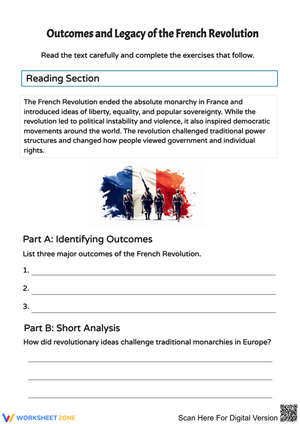
These 9th grade French Revolution worksheets give history teachers a focused, manageable set of materials for one of the most conceptually dense units in the high school curriculum. Each worksheet targets a specific layer of the revolution — social structure, Enlightenment ideology, key events, the Terror, and Napoleon's rise — so teachers can sequence them across a multi-week unit rather than scrambling to cover everything in a single lesson block.
What Each Worksheet Covers
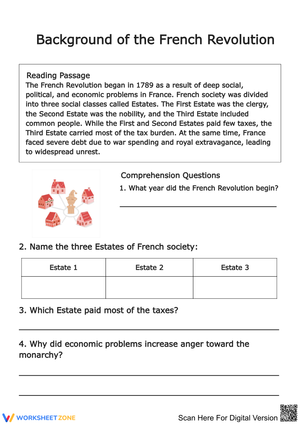
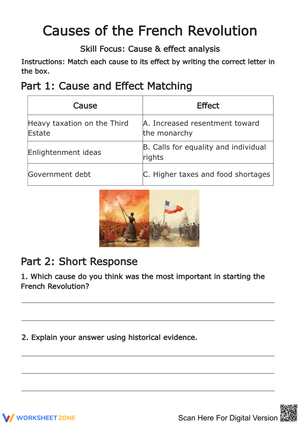
The set moves chronologically through the revolution while pausing on the analytical pressure points where students consistently struggle. The Three Estates worksheet asks students to annotate a social pyramid with population percentages and tax burden data, then write a short explanation of why that imbalance became politically unsustainable by the 1780s. The Enlightenment worksheet runs matching and short-answer tasks that connect specific philosophers — Rousseau's general will, Montesquieu's separation of powers — to concrete revolutionary actions, so students stop treating Enlightenment influence as a vague background force.
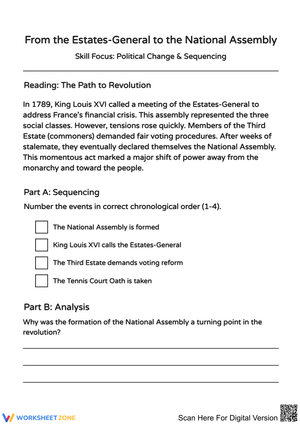
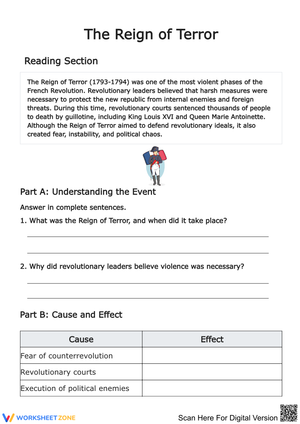
Later worksheets move into the event timeline. Students map cause-and-effect chains from the Estates-General through the Tennis Court Oath, the Bastille, and the Declaration of the Rights of Man. One worksheet excerpts articles from the Declaration directly and asks students to identify which grievances from the Cahiers de doléances each article addresses — a task that builds documentary analysis alongside content knowledge. The Reign of Terror worksheet asks students to evaluate whether Robespierre's Committee of Public Safety was a rational emergency measure or an ideological betrayal, using sourced evidence rather than gut reaction. The final worksheet covers Napoleon's 1799 coup and the Napoleonic Code, asking students to sort specific legal changes into two columns: revolutionary principles preserved, revolutionary principles reversed.
Frequent Student Errors Worth Watching For
The most persistent misconception at this grade level is treating the revolution as a single, unified uprising with a consistent goal. Students who grasp the early phase well — the National Assembly forming, the Declaration drafted — are often genuinely confused when the same revolution produces mass executions two years later. They read this as a contradiction rather than as a political process with competing factions and shifting power dynamics. The worksheets address this directly by asking students to track which group held power at each stage and what that group's stated justification was, making the radicalization visible rather than abrupt.
A second pattern that shows up in student writing: collapsing the Enlightenment into "people had new ideas, so they rebelled." Ninth graders often miss the mechanism — how ideas circulating in salons and pamphlets gave the Third Estate a political vocabulary they could deploy in the Estates-General. The matching activity on the Enlightenment worksheet is specifically designed to force that connection at the level of specific text, not general influence.
On the Napoleon worksheet, expect students to frame his rise as either pure hero or pure betrayal. The two-column sorting task is meant to complicate that binary by making them sit with specific code articles rather than big-picture judgments.
How to Build These Worksheets Into Your Lesson Plans
The Three Estates and Enlightenment worksheets work well as pre-reading scaffolds — assign them the day before the lecture or Socratic seminar so students arrive with the structural vocabulary already in place. The timeline and Declaration worksheets are strongest in the middle of the unit, either as in-class paired work or as the anchor of a 30-minute document analysis block. Save the Terror and Napoleon worksheets for the end of the unit, when students have enough context to argue rather than just describe.
One format that works especially well with the Terror worksheet: give students 15 minutes to complete the evidence columns independently, then run a four-corners activity where they physically move to positions on a justification spectrum. The worksheet becomes the evidence base for the discussion rather than a standalone task, and the physical movement breaks the passive rhythm that builds up mid-unit.
The Napoleon worksheet also makes a natural exit ticket for the final class of the unit. Students who can correctly sort the Napoleonic Code changes — recognizing, for instance, that the Civil Code's property protections extended revolutionary gains while its restrictions on women's legal standing rolled them back — have demonstrated genuine analytical command of the unit's central tension.
Frequently Asked Questions
Are these worksheets appropriate for students who haven't covered the American Revolution yet?
Yes. The worksheets don't assume prior knowledge of the American Revolution, though the Declaration worksheet does include one comparative prompt that asks students to note parallels with the U.S. Declaration of Independence. That question can be skipped or scaffolded without disrupting the rest of the worksheet.
How long does each worksheet take to complete in class?
Most run 20 to 30 minutes for on-level students working independently. The Terror worksheet tends to run closer to 35 minutes when the evidence evaluation is done carefully. If you're using a worksheet to open a seminar rather than as a standalone assignment, plan for 15 minutes of completion time and build your discussion launch from there.
Can the Napoleon worksheet stand alone if we're short on time near the end of the unit?
It can, but students will do stronger analytical work on the two-column sorting task if they've already completed the Three Estates worksheet — the sorting requires them to apply the concept of "who benefits" to legal changes, which the earlier worksheet establishes. A five-minute review of the Estates system at the start of the Napoleon lesson covers the gap if the earlier worksheet wasn't used.












 Interactive Worksheet Maker
 Quiz Maker
 Word Search Maker
 Crossword Puzzle Maker
 Word Scramble Generator
 Sentence Scramble Generator
 Handwriting Worksheet Generator
 Name Tracing Generator
 Fill In The Blank Generator