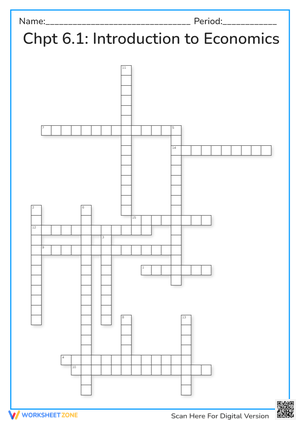
9th Grade Economics Printable Worksheets for High School
These 9th grade economics printable worksheets address the concepts that most reliably derail freshmen in the first semester: scarcity, opportunity cost, supply and demand mechanics, comparative economic systems, and introductory personal finance. Each worksheet targets a specific skill, so teachers can drop it into a warm-up, a guided practice block, or a review day without rebuilding the surrounding unit.
Concepts and Skills Each Worksheet Targets
The set opens with the foundational logic of economic reasoning. Students work through scarcity scenarios that require them to allocate a fixed pool of classroom currency across competing needs — amounts too small to cover every option — and then write a short justification for each allocation. That combination of quantitative decision and written rationale pushes students to articulate opportunity cost rather than just recite a definition.
The 9th grade economics printable worksheets covering supply and demand make up the largest portion of the set. Students plot curves from data tables, locate equilibrium, and analyze market shifts triggered by written scenario prompts. Skills include:
- Reading and plotting supply and demand curves from raw data tables
- Identifying equilibrium price and quantity on a completed graph
- Distinguishing between a shift of an entire curve and movement along a stationary curve
- Predicting how a producer-side or consumer-side change moves equilibrium price and quantity
- Labeling shortage and surplus regions and tracing their effects on price
The economic systems worksheets ask students to place countries on a spectrum from fully market-based to fully command-based, then defend each placement with specific evidence — degree of price control, state ownership of key industries, legal protections for private property. Personal finance worksheets cover budgeting on a fixed income, compound interest mechanics, and the difference between gross pay and net pay, including a pay stub exercise where students calculate federal and state withholdings and compare what they expected to keep versus what actually remains.
Student Errors Worth Watching For Before You Grade
The most persistent mistake on supply and demand worksheets is treating a change in quantity supplied as identical to a shift in supply. A student reads "rising input costs cause producers to offer fewer units at every price level" and draws a new point on the existing curve rather than redrawing the entire curve to the left. The phrase "at every price level" signals that the whole curve moves — not just one point — but many students read past it. Flagging that language explicitly before independent practice begins cuts the frequency of this error considerably.
On factors of production, students almost universally misidentify capital. Outside economics class, "capital" means money, and students carry that usage into their work. When asked to classify the contents of a factory — the machinery, the raw materials, the workers, the owner's decision to expand — they mark the owner's savings account as capital rather than recognizing that capital in economic terms means physical tools and equipment used in production. A classification worksheet that includes money as one of the options, then asks students to explain why it does not appear in the four-factor model, forces that distinction into the open before it calcifies.
In the economic systems unit, students default to a binary: free market versus communism. The concept of a mixed economy — where the real question is what ratio of private and public control exists, not which pure type applies — requires direct disruption of that habit. Worksheets that ask students to mark specific countries on a continuum and support each placement with one concrete policy example interrupt binary thinking more reliably than additional reading does.
How to Fit These Worksheets Into Your Weekly Lesson Structure
Supply and demand worksheets work well as the anchor for a three-step opener. Show students a single news headline — "Drought Devastates Midwest Corn Harvest" — before they touch the worksheet. Ask them to predict which curve shifts and in which direction. Then have them plot the shift and write two sentences defending their reasoning. The prediction step matters: students who commit to an answer before graphing are more likely to catch their own errors when the drawn result does not match their expectation. That ten-minute sequence surfaces misconceptions before independent practice begins and generates real argument rather than passive compliance.
Factors of production worksheets run well as collaborative sorts. Small groups receive a list of production inputs for a single product — coffee, sneakers, a smartphone — and classify each input before comparing with other groups. Disagreements, especially over whether a shift supervisor counts as labor or entrepreneurship, produce the kind of productive friction that actually teaches the distinction. The whole-class discussion tends to move faster when students have already worked through the tension in pairs.
The 9th grade economics printable worksheets covering personal finance land differently depending on where they fall in the calendar. Using the pay stub and tax withholding exercises in October produces decent work. Using them in April, when students are applying for first jobs and work permits, produces genuine engagement — the arithmetic is no longer abstract, and the question "wait, I only keep this much?" is one students actually want answered.
Standard Alignment
These worksheets align to the C3 Framework for Social Studies State Standards across several economics disciplinary core standards. D2.Eco.1.9-12 asks students to analyze how incentives shape the choices of individuals, households, and firms — addressed directly in the scarcity, opportunity cost, and market behavior worksheets. D2.Eco.4.9-12 and D2.Eco.5.9-12 address competition in specific markets and its consequences for price and quantity, which the supply and demand graphing sequence covers in order. The personal finance section connects to D2.Eco.2.9-12, which requires students to apply marginal cost and benefit reasoning to real financial decisions. Most state-level 9th grade economics standards map onto these C3 codes directly, which simplifies alignment documentation for teachers writing unit plans or presenting curriculum to administrators.
Reaching Different Learners With the Same Worksheet Set
The graphing worksheets are where the room tends to split. Students fluent with coordinate graphs move through the plotting section quickly and can be directed to an extension scenario — a second market disruption that requires tracing a two-step shift in equilibrium. Students who are not yet confident with graph reading need the axes named and the origin marked before they can begin the economic analysis at all. Providing a pre-labeled template graph alongside the worksheet removes that entry barrier without changing what the worksheet actually assesses.
For the economic systems comparison worksheet, a partially completed row helps students who freeze on open-ended tasks get started. Fill in one country's row as a worked example; leave the rest blank. Students who are ready to work independently skip the example and construct their own analysis from scratch. The economic reasoning the worksheet requires is identical for both groups — the difference is only in the starting conditions.
The personal finance worksheets involve arithmetic that can become the obstacle rather than the learning target. Providing a calculator and a completed sample calculation — here is what gross pay, federal withholding, state withholding, and FICA produce as a net figure — keeps attention on the financial concepts: why taxes are withheld, how compound interest accrues, what carrying a high credit balance costs relative to monthly income. The numbers support the reasoning; they should not swamp it.
Frequently Asked Questions
How do I help students tell apart a shift in the demand curve from movement along it?
The most practical classroom fix is a two-column checklist students complete before graphing any scenario: What changed — the price of this good itself, or something external to its price? If only the good's own price changed, students mark movement along the existing curve. If anything external changed — consumer income, tastes, prices of related goods, future price expectations — they shift the entire curve. Running five or six quick classification prompts before students reach a full graphing worksheet cuts the frequency of this error significantly in graded work.
What format works best for teaching incentives through printable activities?
If-then scenario worksheets are the most productive format at this level. "If the city offers a $200 rebate for purchasing an electric vehicle, then..." Students identify whether the incentive is positive (reward) or negative (penalty or added cost), predict the behavioral response, and explain the economic logic behind that prediction. The format reveals whether students understand that incentives operate through expected costs and benefits — not through rules or obligations. A strong extension task is asking students to design their own incentive targeting a stated behavior problem, then trade with a partner who evaluates whether the incentive would realistically shift behavior and explains why.
Are answer keys included?
Yes. The 9th grade economics printable worksheets in this set include answer keys for every activity. For graphing worksheets, the key shows the correctly drawn curve with equilibrium labeled. For written response questions, it provides model answers alongside notes on acceptable variations — which matters when two students phrase the same economic reasoning differently but are both correct. Teachers running multiple sections will find the keys reduce grading time without reducing feedback quality, especially on short-answer items where judgment calls are otherwise inconsistent across a stack of 120 papers.
How do I introduce the circular flow model without losing students in the diagram?
Start with a single transaction before students see the full diagram. "A student earns $12 an hour working at a grocery store — where does that $12 come from, and where does it go?" Trace the chain on the board: the firm pays the household, the household buys goods, goods revenue returns to the firm. Once students can describe that loop verbally, show them the circular flow diagram as the formal name for what they just narrated. A fill-in worksheet that builds the model one actor and one arrow at a time, rather than presenting a fully labeled diagram immediately, gives students a way to construct understanding rather than decode a completed product they had no hand in building.
Clear All