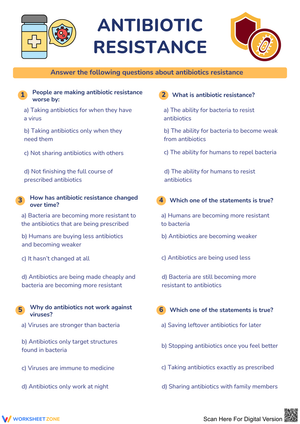
Antibiotic Resistance printable worksheets for Grade 9
These antibiotic resistance worksheets for 9th grade give biology teachers a ready set of tasks that connect bacterial genetics, natural selection, and real-world public health in one cohesive unit of practice. Each worksheet stands alone — usable as a warm-up, a station, a sub plan, or a formative check — so you build lessons around what your class actually needs rather than working through a fixed sequence.
The Specific Skills Targeted
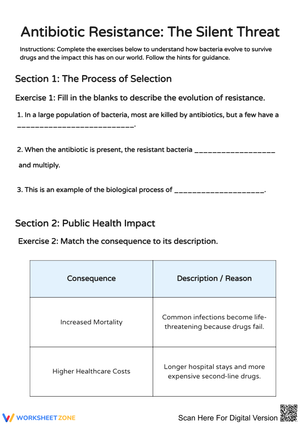
The central challenge in teaching antibiotic resistance is that students must hold three distinct causal chains in mind simultaneously: how mutations arise in bacterial populations, how antibiotic exposure creates selection pressure that favors resistant strains, and how human behavior at the individual and systems level either accelerates or slows that process. Worksheets in this set address each chain separately before asking students to connect them.
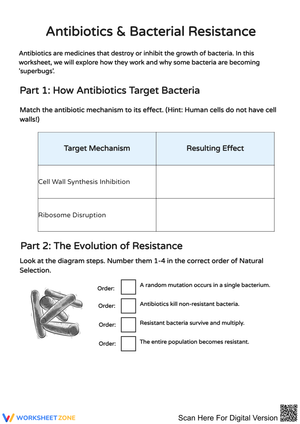
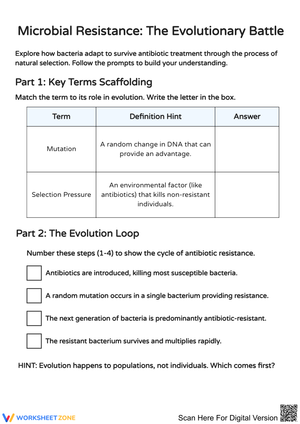
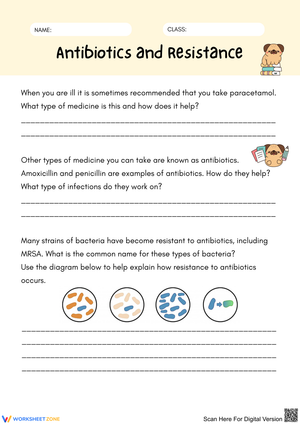
Across the set, students underline evidence in short informational passages, label diagrams that show bacterial populations before and after antibiotic exposure, sort case-study scenarios by whether they accelerate or reduce resistance, write short explanatory responses, and define vocabulary in context rather than from a word bank. That last distinction matters: 9th graders who can match "mutation" to a definition often cannot use the word correctly to explain why a resistant bacterium's offspring are also resistant. The worksheets push past recognition into application.
Standard Alignment
These worksheets align to NGSS HS-LS4-4, which asks students to construct an explanation based on evidence for how natural selection leads to adaptation of populations. Antibiotic resistance is one of the clearest, most data-rich examples available for this standard because the timescale is visible within a single human lifetime and the selection pressure is experimentally documented. Teachers meeting HS-LS4-4 instructional targets can use the diagram and short-response worksheets as formative evidence that students can trace selection in a real biological context rather than a purely hypothetical one.
The case-study and scenario worksheets also support NGSS Science and Engineering Practice 6 (constructing explanations) and Crosscutting Concept 2 (cause and effect), both of which appear in 9th-grade biology performance expectations across most state-level implementations of NGSS.
Where These Worksheets Fit Instructionally
Antibiotic resistance arrives in most 9th-grade pacing guides during a natural selection or microbiology unit, which means teachers are often introducing it immediately after students have worked through Mendelian inheritance or cell processes. That sequencing creates a ready-made hook: resistance is heritable change under selection pressure, which students can recognize as a pattern they already know from genetics. The worksheets exploit that connection explicitly, using bacterial reproduction as a concrete case of trait inheritance before widening to population-level change.
In a single-period lesson, the reading passage and diagram worksheets work well for the first half, with pairs completing a case-study worksheet in the second half and finishing with a brief exit prompt. For stations, the vocabulary worksheet anchors one table, the diagram another, and the scenario cards a third — each taking roughly 10–12 minutes. On review days before a unit assessment on evolution or human body systems, one or two worksheets function as a targeted reteach without requiring new lecture material.
One classroom move worth trying: before students open the case-study worksheet, ask them to mark each scenario with two quick labels — bacterial or viral and reduces resistance or increases resistance. That sorting step alone surfaces the most persistent misunderstanding before students have written a single full sentence, which gives you 8 to 10 minutes of usable formative information while they're still working.
Frequent Student Errors Worth Watching For
The most common mistake 9th graders make on these worksheets is conflating where resistance develops. Students write that a person "becomes resistant to antibiotics" after repeated exposure, applying a model of individual adaptation rather than population-level selection. The diagram worksheets are specifically built to interrupt this misconception — students label which individual bacteria survive, then trace their reproduction in the next generation, making it visually clear that resistance is a property of a bacterial population, not a human body.
A second persistent error involves the viral/bacterial distinction in clinical scenarios. Students who correctly identify that antibiotics target bacteria will still sometimes explain that taking antibiotics for a cold is ineffective primarily because "the dose won't be strong enough" rather than because viruses use fundamentally different mechanisms of replication that antibiotics cannot disrupt. The case-study worksheet addresses this directly by presenting two scenarios side by side — strep throat and a rhinovirus — and asking students to write a mechanistic explanation for each, not just a recommendation.
A third error that shows up in short-answer responses: students describe mutations as something bacteria choose or seek out under pressure, writing sentences like "the bacteria changed themselves to survive the antibiotic." The vocabulary worksheet targets this by asking students to sequence events in the correct causal order — mutation occurs before antibiotic exposure, not in response to it — which forces them to reconstruct the timeline rather than rely on teleological shorthand.
Frequently Asked Questions
Are these worksheets accurate about the science, and how current are the references?
The worksheets are written to reflect current CDC and WHO guidance on antimicrobial resistance — specifically that misuse and overuse of antibiotics are the primary drivers of resistance spread, and that resistance develops in bacterial populations, not in individual human patients. If your district requires sourced reading passages, the informational text sections are straightforward to supplement with current CDC fact sheets without changing the task structure.
Can these worksheets work as a sub plan without teacher setup?
The reading passage and vocabulary worksheets are designed to be self-contained for exactly that reason — directions are embedded in the task, no prior lecture is required, and the comprehension questions walk students through the core concepts in sequence. The case-study and diagram worksheets work better with at least a brief teacher introduction, though a short warm-up paragraph on the sub plan cover sheet is usually enough context for students to proceed independently.
How do these worksheets connect antibiotic resistance to natural selection without turning the lesson into a review of prior content?
The diagram worksheets establish the natural selection connection through the worked example itself — students trace which bacteria survive antibiotic exposure and reproduce, building the concept inductively from a concrete scenario. The connection to prior learning is implicit in the task rather than called out explicitly, which keeps the lesson focused on the health application without becoming a formal revisit of evolution vocabulary.
What if my students have highly varied reading levels?
The reading passages in this set are written at approximately a 7th–8th grade Flesch-Kincaid level to stay accessible while still using discipline-appropriate vocabulary. For students significantly below grade level in reading, chunking the passage into two sittings with a partner-discussion pause in between is more effective than substituting simpler text, because the vocabulary is load-bearing — students need the precise scientific terms to complete the diagram and case-study tasks accurately.
Clear All