9th Grade Claim Evidence Reasoning printable worksheets
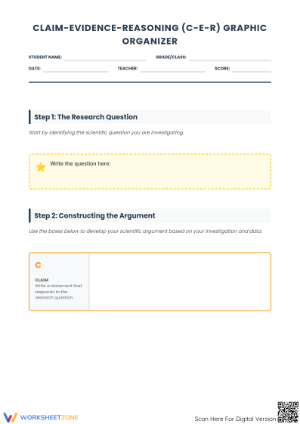
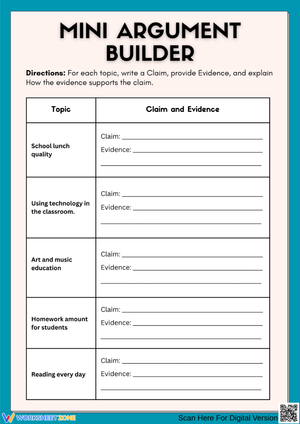
These 9th grade claim evidence reasoning printable worksheets give English teachers a concrete way to address the skill gap that becomes visible almost immediately in September of freshman year: students who can read a text and discuss it in class but collapse when asked to build a written argument from it. Each worksheet moves through the three components — claim, evidence, reasoning — in a fixed sequence that students internalize through repeated use. The set works with both literary and informational texts, which matters because Grade 9 ELA typically demands both.
What Each Worksheet Targets
The framework gets practiced at a depth appropriate for ninth grade, not middle school review. Across the set, students work through three distinct tasks:
- Claim: Write an arguable position in response to a prompt — specific enough that a reader could reasonably push back on it, not a statement of fact and not a summary of what happens in the text.
- Evidence: Select and transcribe the most telling textual support, choosing the precise lines that carry the most analytical weight rather than lifting long block quotes.
- Reasoning: Explain how the evidence supports the claim — through the author's word choice, a structural decision, or an implication built into a detail — without simply restating what the quote already says.
The reasoning section carries the most instructional weight across the set because that is where grade-level argument writing actually lives. A claim is a sentence. Evidence is a quote. Reasoning is the thinking — and for most ninth graders, that thinking does not reach the page without deliberate, repeated practice.
Fitting These Worksheets Into Your Instructional Week
Most teachers introduce one worksheet during the first half of a class period, after shared reading and before independent writing. The gradual release works naturally here: model the claim on the board, draft the evidence together as a class, then let students attempt the reasoning alone before sharing out. That last step — the independent reasoning attempt — is where each worksheet earns its time. Students who nod along during whole-class modeling reveal exactly where their thinking breaks down the moment they have to commit it to writing.
These 9th grade claim evidence reasoning printable worksheets also hold up well as homework when students are working with a text they have already annotated in class. The unfamiliar-text version is better saved for supervised practice, where a teacher can catch confusion before it becomes a completed worksheet full of restated quotes. Exit tickets are a third effective format: a short informational text, a pre-written claim at the top of the worksheet, and fifteen minutes at the end of class gives a clean formative read on where students are before the next lesson.
One specific technique worth building into the routine: have students complete the reasoning section using "because" or "this shows that" as openers, then cross those phrases out before submitting. The finished reasoning still has to hold together without the crutch starter. This pushes students toward analytical verbs — reveals, suggests, demonstrates — rather than transitional filler, and the difference in writing maturity shows up immediately.
Student Errors That Surface Almost Every Time
The most consistent problem in ninth-grade CER work is not in the claim or the evidence — it's in the reasoning, and specifically in what students believe the reasoning section is supposed to do. A majority of students, at least at first, will write some version of "this quote shows that my claim is true" and consider themselves finished. They treat the evidence as self-explanatory and the reasoning as a restatement of it. Catching this pattern in the first two worksheets allows for early intervention before it becomes a habit locked in for the rest of the year.
A second persistent error: students write claims that are factual observations rather than arguable positions. "The story is set in 1930s Alabama" is not a claim. "The author uses imagery" is not a claim. These 9th grade claim evidence reasoning printable worksheets surface this confusion early — when students fill in the claim box and you can see at a glance that half the class has written summaries, you know exactly what the next ten minutes of instruction need to address.
There is also a distinction students consistently miss between paraphrase and analysis in the reasoning section. They rephrase what the quote says rather than explain what it reveals. A student who writes "In other words, the character feels sad" has paraphrased. A student who writes "The author's word choice positions the reader to feel the weight of the character's isolation before any direct statement about his grief is made" has analyzed. The gap between those two responses is the whole game in Grade 9 argument writing, and the worksheets create repeated opportunities to close it.
Standard Alignment
These worksheets address two anchor standards from the CCSS ELA framework for Grades 9-10. CCSS.ELA-LITERACY.W.9-10.1 requires students to write arguments supporting claims with valid reasoning and relevant, sufficient evidence — exactly the three-part process each worksheet isolates before students attempt it in full essay form. CCSS.ELA-LITERACY.RI.9-10.1 requires students to cite strong and thorough textual evidence in support of their analysis, which the evidence-selection work in each worksheet builds directly.
In practice, W.9-10.1 is the standard teachers feel most acutely when grading. The space between "include some evidence" and "explain why this specific evidence supports this specific claim" is where most ninth-grade writing falls short — and it is exactly where the reasoning section of each worksheet does its most important work.
Adjusting Each Worksheet for Different Points in the Learning Curve
Working through the 9th grade claim evidence reasoning printable worksheets with below-grade-level readers requires two specific adjustments. First, provide a pre-written claim at the top so the student's cognitive energy goes entirely toward finding evidence and building reasoning. Second, offer sentence frames for the reasoning section: "The author's use of [word/phrase] suggests that..." Students who have a structured entry point into that reasoning sentence are far more likely to complete it analytically rather than descriptively.
For students ready to work beyond the baseline, remove the section prompts entirely and give a blank version of the worksheet. Require two pieces of evidence from different parts of the text, with separate reasoning for each. The multi-evidence version is significantly harder because both pieces have to serve the same claim without repeating each other — a constraint that pushes more advanced writers toward real argumentative control rather than simply longer responses.
Frequently Asked Questions
What is the difference between evidence and reasoning in the CER framework?
Evidence is a direct quote or specific textual detail — something the author actually wrote. Reasoning is the student's explanation of what that detail means and why it supports the claim. Evidence is what the text says; reasoning is what the student thinks about it. Most of the time, when a CER response feels thin, the reasoning is underdeveloped, not the evidence.
How do I help students who keep writing factual statements instead of arguable claims?
The most reliable test is to ask: could a thoughtful reader reasonably disagree with this statement? If not, it is not an arguable claim. Have students draft a claim, trade papers with a partner, and try to argue the opposite position. If no counter-argument exists, the claim needs to be sharpened into something that actually takes a stance. Running this exchange before students move to the evidence section prevents the most common version of the problem — building an entire paragraph around a point that never needed defending.
How many pieces of evidence should a ninth grader include in a CER response?
One strong piece of evidence with thorough reasoning is the right starting point. The goal in early practice is depth, not volume. Once students consistently explain a single piece of evidence without restating it, move to requiring two pieces — and be explicit that the second must add new support rather than echo the first.
Do these worksheets work with fiction as well as informational text?
Yes. Literary texts require interpretive claims about character, theme, or authorial choice rather than claims about content, which adds complexity to both the claim-writing and reasoning sections. Alternating between one worksheet with a short story and the next with an article lets students see how the same analytical framework applies across text types — a useful habit to establish given the reading range they encounter throughout Grade 9.
Clear All