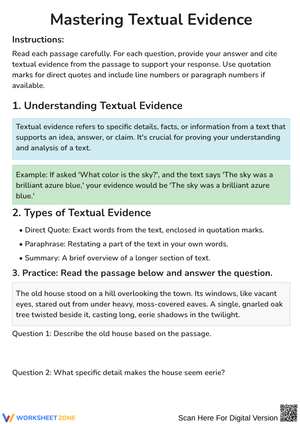
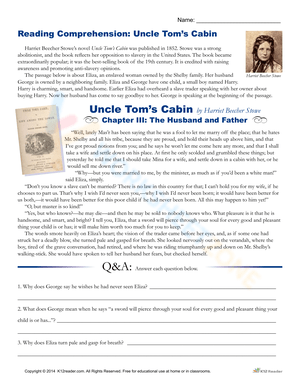
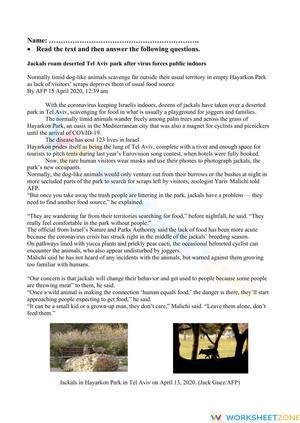
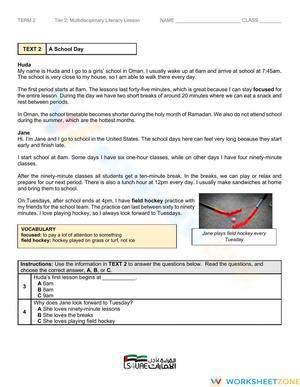
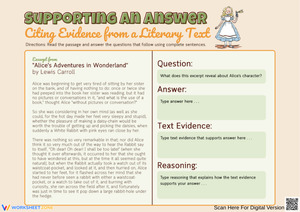
These citing evidence from the text printable worksheets for 9th grade address a transition that catches a lot of students off guard: in middle school, locating a quote was often the goal; by ninth grade, the quote is merely the starting point. Students at this level must select evidence that is both strong and sufficient, integrate it cleanly into their analytical writing, and then explain—specifically—how it earns its place in the argument. That third move is where most ninth graders stall, and it is the focus the worksheets in this set return to most consistently.
What's Inside the Set
Three organizing frameworks run through citing evidence from the text printable worksheets for 9th grade: a three-column graphic organizer, the RACES strategy, and the ICE method. A fourth component—short reading passages paired with text-dependent questions—gives students immediate practice applying those frameworks to actual text. Together, these four elements work across different phases of instruction rather than all at once.
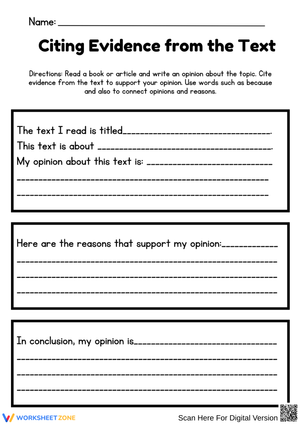
- Three-column graphic organizer — students write their claim in the first column, locate and record supporting evidence in the second, and explain the connection in the third. The structure makes the abstract sequence of analytical writing concrete and repeatable.
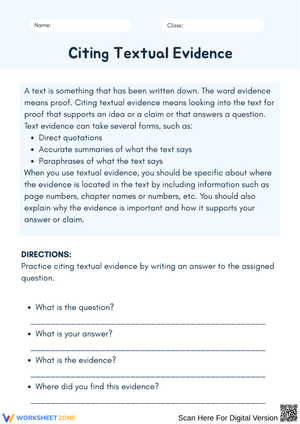
- RACES worksheets (Restate, Answer, Cite, Explain, Sum up) — each step occupies its own section, so teachers can pinpoint precisely where a student's process breaks down.
- ICE method worksheets (Introduce, Cite, Explain) — push students toward cleaner prose, particularly the Introduce step, which requires a lead-in sentence that contextualizes a quote rather than dropping it cold into a paragraph.
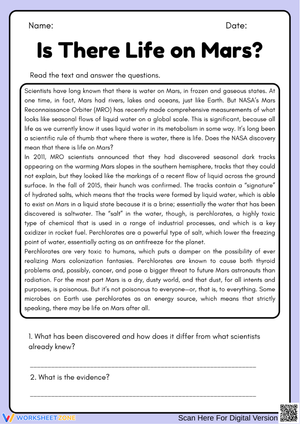
- Text-dependent question sets — paired with short passages and include both literal retrieval items and inferential prompts, covering the full range of RL.9-10.1 and RI.9-10.1.
The distinction between RACES and ICE is worth understanding before assigning either. RACES prioritizes process: it breaks a constructed response into labeled steps and works best when students are still learning what analytical writing is supposed to accomplish. ICE prioritizes prose quality—it asks for a smooth, well-integrated citation and works better once students understand the basic structure but need to improve how their writing actually sounds. Many teachers use RACES in the fall and shift toward ICE by spring.
Frequent Student Errors Worth Watching For
The most persistent error at this grade level is the quote drop: the student copies a sentence from the passage, sets it off in quotation marks, and moves on as if the quote explains itself. This shows up in strong writers and struggling ones alike. It almost always signals that the student understands what the text says but has not yet internalized the idea that their own analysis is what the reader actually needs.
A second pattern is selecting evidence that is broadly on-topic but misaligned with the specific claim. A student arguing that a character experiences internal conflict might cite a line about that character's daily routine—same character, wrong angle. This mismatch is easy to overlook in a running paragraph, but it becomes visible immediately when a student writes their claim in one column and their chosen quote in the next. The visual gap does the teaching that a marginal comment often cannot.
Quote length is worth watching as well. Students with stronger overall writing skills tend to choose long, dense passages—sometimes a full paragraph from the source—because they trust the text to carry the explanatory weight for them. Students who struggle tend to pick single words or very brief phrases that cannot support a claim on their own. Both errors respond to the same correction: require the student to explain, in their own words, what specifically the evidence shows. When that explanation is short and vague, the evidence selection is usually wrong, too.
Building These Worksheets Into Your Teaching Week
The graphic organizer works well as a daily warm-up at the start of class. Project a short passage, hand out the organizer, and give students five minutes to fill in a claim and one piece of supporting evidence before discussion opens. Three weeks of that routine—done consistently rather than once per unit—makes evidence selection feel automatic in a way that a single essay assignment cannot replicate.
RACES worksheets belong in the days just before a major essay. Ninth graders need a lower-stakes space to rehearse constructed responses before committing to something longer and graded. Assigning a RACES worksheet on Thursday, reviewing it together on Friday, and opening a draft on Monday creates a rehearsal sequence that reduces the blank-page paralysis that stalls students at the start of writing tasks.
ICE practice is most useful closest to the drafting phase. Once students have identified the evidence they plan to use, an ICE worksheet helps them work on the lead-in sentence—the specific move that keeps a quote from landing cold in the middle of a paragraph. Working on that one sentence in isolation, without the surrounding pressure of a full draft, produces noticeably cleaner citation work when students get to the essay itself.
One technique worth building into the lesson plan: ask students to deliberately choose a weak piece of evidence first, then replace it with a stronger one. The replacement matters less than the explanation of why the first quote was insufficient. When a student can say that a quote is too vague, too short, or only tangentially related to their claim, they are naming the criteria that strong evidence must meet. That metacognitive naming transfers to independent work more reliably than a rubric checklist does.
Standard Alignment
RL.9-10.1 requires students to cite strong and thorough textual evidence to support analysis of what a text says explicitly as well as inferences drawn from it. RI.9-10.1 mirrors this expectation for informational texts. Citing evidence from the text printable worksheets for 9th grade address both standards—literary and informational passages appear across the set—so teachers can document alignment along the full reading strand, not just the fiction side of the curriculum.
The phrase "strong and thorough" carries specific instructional weight that is easy to underestimate. Strong means the evidence directly supports the specific claim, not merely the general topic. Thorough means a single quote rarely satisfies the standard on its own. Students need practice selecting multiple pieces of evidence and explaining how each connects to the same analytical claim. Worksheets that prompt for only one quote address part of the standard. Prompts that require two or more pieces—and ask students to explain how they work together—come closer to the analytical depth RL.9-10.1 and RI.9-10.1 actually demand.
Adjusting the Worksheets for Different Student Levels
For students who stall during the evidence-search step, pre-highlighting two or three candidate quotes in the passage removes the search burden and frees attention for the harder task: deciding which quote is stronger and explaining why. The comparison is where the analytical thinking happens, and students who freeze during open-ended search can still access that thinking once the search step has been reduced for them.
Removing the column structure entirely and asking students to write a short paragraph—then annotate their own writing by circling the claim, underlining the evidence, and bracketing the explanation—adds difficulty while building a self-editing habit that prepares them for essay revision. Students who move through the columns quickly can also be asked to locate a second piece of evidence and explain how it works alongside the first, which directly addresses the "thorough" requirement that many worksheet sets underemphasize.
For accelerated ninth graders, presenting two pieces of evidence that point in different directions and asking for a claim that accounts for both is a genuinely harder task than standard evidence practice. It prepares students for nuanced argument without requiring an entirely separate set of materials—just a different prompt layered onto the same worksheet format.
Frequently Asked Questions
Do these worksheets require specific reading passages, or can I pair them with what we're already reading?
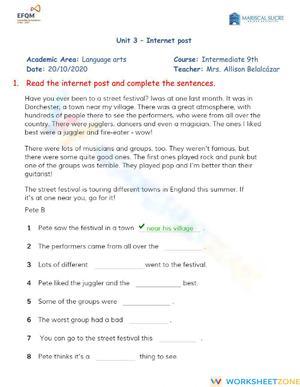
The graphic organizers and strategy-based worksheets—RACES and ICE—are passage-agnostic. Teachers pair them with whatever novel, article, or primary source the class is already working through. The text-dependent question sets include their own short passages and are self-contained. Because the structured-practice worksheets work with any text, citing evidence from the text printable worksheets for 9th grade slot into an existing unit without rearranging the reading calendar.
How early in the school year should I introduce these?
The three-column graphic organizer can go into the first week of school. It asks students to identify a claim and match it to evidence without requiring prior instruction in analytical paragraph structure, so it functions as an informal assessment as much as a practice tool. RACES worksheets belong in the first major writing unit once students understand what a constructed response is meant to accomplish. ICE worksheets are more useful in the second half of the year, when longer literary analysis essays make smooth quote integration a graded expectation rather than a new idea.
What's the most effective way to run the weak-versus-strong evidence comparison?
Present two quotes from the same passage—one that directly supports a given claim, one that is vague or only loosely connected—and ask students to rank them independently before any class discussion. Then have them write out their reasoning before comparing with a partner. The disagreements that surface in partner discussion reveal exactly where students' criteria for strong evidence are still fuzzy. Those disagreements are not a sign the activity failed. They are the diagnostic information that shows teachers what to address the next day.












 Interactive Worksheet Maker
 Quiz Maker
 Word Search Maker
 Crossword Puzzle Maker
 Word Scramble Generator
 Sentence Scramble Generator
 Handwriting Worksheet Generator
 Name Tracing Generator
 Fill In The Blank Generator