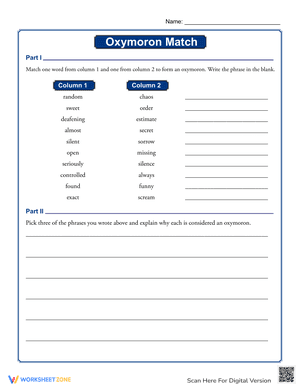
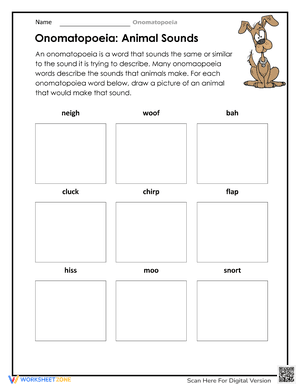
These 8th grade figurative writing printable worksheets give ELA teachers a practical progression that moves students from spotting devices in text to making deliberate style choices in their own writing. The set covers identification, effect analysis, sentence revision, and original composition — connected tasks that build writing craft rather than vocabulary recall. Teachers who need figurative language practice that holds up as Monday morning bell work and still works as a Thursday revision check will find the format useful at multiple points in a unit.
The Specific Skills Each Worksheet Targets
Most eighth graders arrive able to name a simile when one is underlined in front of them. The harder instructional move — and the one this set pushes toward — is asking students why a comparison works, whether a different device would serve the piece better, and what the figurative choice does to the reader's experience. Each worksheet pairs recognition with effect analysis, which is where the real instructional conversation starts.
The devices covered include simile, metaphor, personification, hyperbole, idiom, imagery, alliteration, and onomatopoeia. Across the set, students:
- identify the device used in a sentence or short passage and name it precisely
- explain what the figurative language adds — to tone, mood, or sensory detail — rather than only labeling the technique
- revise literal sentences by replacing flat language with purposeful figurative choices
- write original lines or short paragraphs that use a named device with a clear intended effect
A worksheet that stops at naming devices leaves students stuck at the recognition stage. These worksheets treat identification as the entry point, not the destination.
Frequent Student Errors Worth Watching For
The most predictable error at grade 8 isn't mislabeling — it's hollow correctness. A student writes "her voice was music to my ears" and technically produces a metaphor. But the phrase communicates almost nothing because it arrived pre-formed from ambient language. Students who write this kind of figurative language have found the shape of the device without doing any thinking inside it. The revision tasks in this set specifically address that pattern by requiring students to replace a given literal sentence with their own comparison, which makes borrowed phrases impossible to fall back on.
Personification produces a second, related problem: tone mismatch. A student writing an ominous scene gives the storm "restless fingers" — then undermines the effect by adding "that seemed almost playful." The mechanism is there; the judgment about fit is not. Hyperbole causes a separate issue in emotional writing. Students reaching for something that conveys grief or exhaustion sometimes choose an exaggeration so extreme the sentence reads as accidental comedy — "I cried an ocean's worth of tears" flips the register entirely. The effect-explanation prompts in each worksheet help students catch this drift before it settles into a longer piece.
Lesson-Planning Ideas to Get the Most From This Set
A reliable weekly structure: use a recognition-focused worksheet as a Monday warm-up, then assign a revision task as follow-up after Tuesday's direct instruction on a specific device. By Thursday, most students are ready for a short original composition prompt where they choose two or three devices with intention. That progression uses roughly 8 to 10 minutes of class time per day and produces noticeably stronger figurative writing by the end of the week without displacing the main lesson.
These 8th grade figurative writing printable worksheets also hold up well in several specific routine slots that ELA teachers often need to fill:
- Bell ringers: one sentence to identify and one to revise takes 5 to 7 minutes before instruction begins
- Mini-lesson follow-up: assigning the matching worksheet immediately after modeling a device ensures students apply the concept while it's still fresh
- Sub plans: each worksheet includes worked examples and an answer key, making the activity self-contained without requiring explanation from the sub
- Exit tickets: one original figurative sentence plus a one-line explanation of its intended effect gives teachers a quick read on who is transferring the skill
- Narrative and poetry unit integration: pair each worksheet with current class reading — ask students to locate where an author uses imagery or personification, then mirror that move in their own paragraph before the period ends
One instructional move worth trying: treat figurative language as a revision skill before treating it as a composition skill. Most eighth graders improve a flat sentence more readily than they invent a vivid one from nothing, so starting with a literal sentence to transform often produces stronger figurative choices and more confident writing than an open prompt does.
Standard Alignment
CCSS.ELA-LITERACY.L.8.5 requires students to interpret figurative language — including simile, metaphor, personification, and idiom — and to explain how word choices contribute to meaning and tone. The recognition and effect-explanation tasks in each worksheet address that standard directly. The identification prompts satisfy the surface layer of L.8.5; the effect questions push into the interpretive work the standard actually demands.
CCSS.ELA-LITERACY.W.8.3d, the grade 8 narrative writing standard, calls for precise words, sensory details, and figurative language that conveys experiences and events. The revision and original-writing tasks in each worksheet connect directly to that production standard, not only to literary analysis. That pairing matters instructionally — figurative language practice too often lives entirely in the Language strand without ever touching Writing. This set moves across both, which makes it usable in skill-building lessons and writing workshop sessions alike.
Adapting the Worksheets for a Range of Learners
Students who struggle with figurative writing usually have one of two problems: they can't recognize the device consistently, or they recognize it but can't produce original language that doesn't sound borrowed. For those students, device-specific worksheets — one worksheet focused only on simile and metaphor, with sentence frames for support — reduce the cognitive load enough that students practice the actual thinking rather than just manage the terminology. Narrowing the focus also makes teacher feedback more precise. Instead of writing "add more figurative language," the response can target one specific device and one specific sentence.
Students who are already comfortable with identification benefit most from comparative effect work. Presenting the same scene written three different ways — once with metaphor, once with personification, once with imagery — and asking students to argue which version serves a specific audience produces genuine stylistic analysis. The revision tasks in the 8th grade figurative writing printable worksheets set work especially well for these students as jumping-off points: after completing the revision prompt, they write a brief rationale explaining why their figurative choice fits the sentence's tone better than the literal version did.
Students who freeze on open composition prompts almost always respond better to revision tasks than to starting from scratch. Giving them a literal sentence to transform removes the starting-point problem and puts the cognitive focus where it belongs — on the figurative move itself.
Frequently Asked Questions
What figurative language devices do these worksheets cover?
The set covers simile, metaphor, personification, hyperbole, idiom, imagery, alliteration, and onomatopoeia — the devices students encounter most often in grade 8 reading and are expected to use purposefully in narrative, descriptive, and poetic writing.
Can these worksheets be used for both reading and writing instruction?
Yes, and that flexibility is one of their practical strengths. The recognition and effect-analysis tasks connect to close reading work in the Language standards. The revision and original-writing prompts connect to narrative and descriptive writing in the Writing standards. Teachers working in a reader's and writer's workshop model find the two task types map cleanly onto both sides of their instruction without requiring separate materials for each.
How do I use these worksheets as formative assessment?
The original-writing tasks work best for formative data because they show whether students can apply a device — not just identify one. A quick scan of exit-ticket sentences tells teachers which students are still borrowing stock phrases, which have the right structure but wrong tone, and which are making intentional choices. That information shapes the next day's mini-lesson. The 8th grade figurative writing printable worksheets format keeps responses short enough that this kind of informal check takes fewer than five minutes to review per class set.
What order works best for using these worksheets during a unit?
Start with recognition worksheets early in the unit when students need to solidify vocabulary and identify devices in context. Move to revision worksheets once they can reliably name what they're looking at. Use original-writing worksheets after students have seen multiple models and completed at least one revision task. That sequence — identify, explain, revise, create — mirrors how most students actually internalize a figurative language skill rather than simply memorize it for a quiz.















 Interactive Worksheet Maker
 Quiz Maker
 Word Search Maker
 Crossword Puzzle Maker
 Word Scramble Generator
 Sentence Scramble Generator
 Handwriting Worksheet Generator
 Name Tracing Generator
 Fill In The Blank Generator