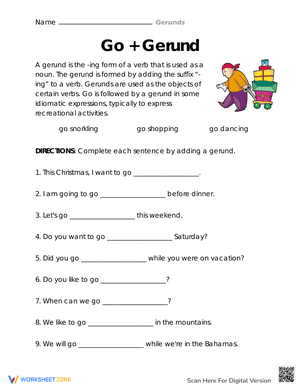
These 8th grade verbals worksheets resources give ELA teachers a printable set for teaching gerunds, participles, and infinitives — the verbal forms that consistently confuse middle schoolers not because the definitions are hard, but because the same word can function three different ways depending on the sentence. Each worksheet moves students from recognition through application, using sentence-level tasks that ask them to identify, classify, and eventually produce verbals in realistic contexts.
What Students Work Through in This Set
Verbals sit at the intersection of two grammar questions students usually handle separately: what does this word look like, and what job is it doing? Holding both questions together — especially when a word looks exactly like a verb but isn't functioning as one — is the genuine difficulty at this grade level. The worksheets in this 8th grade verbals worksheets set move through that analysis in a deliberate sequence, separating the three verbal types before asking students to compare and mix them.
- Gerunds: Students identify -ing verb forms functioning as nouns — as subjects, direct objects, or objects of prepositions — and practice distinguishing them from present-tense main verbs and participial modifiers in similar sentence positions.
- Participles: Students locate present and past participial forms that modify nouns or pronouns, including introductory participial phrases and those placed mid-sentence or after the noun they describe.
- Infinitives: Students identify to + verb constructions and determine whether each functions as a noun, an adjective, or an adverb within that sentence.
- Verbal phrases: Students extend identification to the full phrase — including objects and modifiers — and explain what the entire unit does, not just what the verbal at its head looks like.
- Mixed review: Students sort and classify sentences containing more than one verbal type, then revise sentences to make verbal function clearer.
Select worksheets close with a writing task: students produce original sentences using each verbal type. That step is the clearest check on whether understanding is real or whether a student has been matching surface patterns without analyzing the grammar.
What Student Work Reveals About Verbal Confusion
The most predictable error is treating any -ing word as the main verb of the sentence. A student who correctly identifies "runs" as an action verb will still mark "swimming" as the predicate in Swimming before school energizes her for the day. The word looks like a verb, comes from a verb, and feels like the action — what the student misses is that "swimming" is naming an activity, doing the noun's job as the sentence's subject. Building in a step where students locate the main verb before labeling anything else interrupts that reflex reliably.
Past participial phrases create a second, equally common confusion. In a sentence like Worn out from the three-hour exam, the students moved silently toward the exit, many students mark "worn" as the main verb. They see a past-tense form and default to predicate. A follow-up question on the worksheet — "What is the main verb of this sentence?" — forces students to triangulate: once they find "moved," they can see that "worn out from the three-hour exam" is describing the students, not carrying the sentence's action.
Infinitives produce a subtler pattern. Students correctly spot "to finish" or "to compete" but stop at the label without specifying function. They write "infinitive" in the blank and consider the work done. The worksheets address this by pairing each identification task with a function prompt — students state the verbal type and its grammatical role in the sentence. That second step is where surface recognition separates from actual understanding.
Lesson-Planning Strategies That Work With This Set
The most efficient entry point is a short direct-instruction segment followed immediately by the matching worksheet. Eight to ten minutes on the board — modeling two or three sentences, thinking aloud about how to locate the verbal and name its function — sets students up to work independently without repeated interruption. Teachers who split the set across a full grammar week report better retention: one verbal type per day through Wednesday, mixed review on Thursday, writing application on Friday. By the time the cumulative review arrives, the three types have enough separation in students' memory that comparing them feels manageable rather than overwhelming.
Bell ringer use is a strong secondary option. A single identification item paired with a written justification stem — This functions as a noun because... — takes about three minutes, generates real discussion, and gives a formative snapshot before the rest of the lesson begins. Students who can complete that stem are far less likely to be pattern-matching on surface appearance alone. Those who can't are easy to identify quickly, well before the end of the unit.
For intervention groups, the error-analysis tasks inside the set are the most efficient starting point. Three or four items asking students to find and correct a misidentified verbal surface where the confusion actually lives — whether a student is unsure what a verbal looks like, what it does, or both. That diagnostic clarity matters when pull-out time runs fifteen minutes or less.
Reaching Different Learners With the Same Set of Worksheets
Students still building grammar fluency work best starting with the identification-only worksheets. Pairing those with a reference strip — one sentence example per verbal type — lets them cross-check their answers without requiring a full re-teach every time they hit a difficult item. The goal at this entry point is consistent identification before function questions come into play.
Students who move through identification cleanly benefit from the revision and writing tasks. Asking them to rewrite a flat sentence using a participial phrase, or to construct a sentence with a gerund as the subject, pushes sentence craft alongside grammar knowledge. That's the point where the verbal unit connects directly to what the writing class is simultaneously asking them to do.
In a mixed-readiness room, assigning different worksheets to different groups works without creating an obvious ability split. One group works through focused identification; another handles mixed review and writing application. Both groups are working on verbals — they're just entering the practice at different levels of readiness. The set's task variety makes that distribution quiet and practical.
Standard Alignment
This 8th grade verbals worksheets set addresses CCSS.ELA-LITERACY.L.8.1.A, which asks students to "explain the function of verbals (gerunds, participles, infinitives) in general and their function in particular sentences." The standard language is specific in a way many grammar standards are not — it doesn't stop at identification, it requires functional explanation. A worksheet that asks students to underline a verbal without also describing what it does in that sentence doesn't fully cover L.8.1.A. The tasks here require both: students name the verbal type and state its role in the specific sentence, which is exactly what the standard calls for in classroom practice.
Frequently Asked Questions
Why do verbals appear in 8th grade ELA rather than earlier?
The CCSS places verbal study at 8th grade because it builds on foundational grammar work from earlier grades — parts of speech, phrase identification, clause structure — and then asks students to analyze sentence function rather than just name word categories. The particular challenge is that participial phrases, gerunds, and main verbs can look nearly identical on the surface. That kind of functional, analytical reading of grammar is a higher-level task than most 6th and 7th grade grammar standards require, which is why verbals are typically introduced formally at this grade level.
Should teachers introduce all three verbal types in the same lesson?
Separating the types first consistently produces better retention. When gerunds, participles, and infinitives are all introduced in a single lesson, students tend to apply whichever definition came to them most recently rather than actually reading the sentence for function. Focusing one worksheet on one type before mixing them avoids that pattern and gives students genuine confidence with each category before comparison work begins.
How do the writing tasks work alongside the identification practice?
Writing tasks appear at the end of select worksheets, after students have worked through identification and classification. Students typically produce three to five original sentences — one using a gerund, one using a participial phrase, one using an infinitive. Teachers who assign these as exit tickets get a fast formative read on whether students can transfer the skill outside the examples in front of them. Three sentences is enough evidence. It doesn't need to be a paragraph.
Do these worksheets work as homework, or are they better used in class?
The identification-focused worksheets in this 8th grade verbals worksheets set handle homework well — the brief review note at the top of each worksheet makes the task self-explanatory, and the included answer key makes self-checking or parent-checking straightforward. The revision and writing worksheets are better kept for class, where students can ask questions when they're uncertain about a verbal's function. Splitting the set along those lines balances independent practice at home with supported application in the room.















 Interactive Worksheet Maker
 Quiz Maker
 Word Search Maker
 Crossword Puzzle Maker
 Word Scramble Generator
 Sentence Scramble Generator
 Handwriting Worksheet Generator
 Name Tracing Generator
 Fill In The Blank Generator