Matter and Change Worksheets for 7th Grade
Matter and change worksheets for 7th grade give teachers a direct path into the topic that causes the most persistent confusion in middle school physical science: distinguishing a change in form from a change in substance. Students who can define "physical change" on Monday often stall by Friday when asked whether dissolving sugar, rusting iron, or baking bread belongs in the physical or chemical column—and more importantly, why. The resources in this set move students from memorized vocabulary into the reasoning they need to hold up under real questioning.
What Students Practice Across the Set
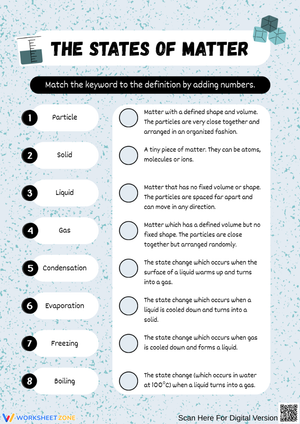
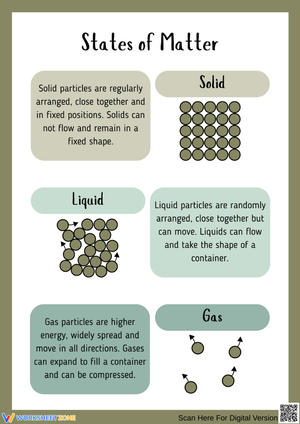
These matter and change worksheets for 7th grade move through the full arc of the unit, beginning with observable properties—mass, volume, color, texture, state—and building toward evidence-based classification of physical and chemical changes. Students compare how particles are spaced and how freely they move in solids, liquids, and gases. Vocabulary work leads quickly into application rather than sitting at the definition stage for an entire week.
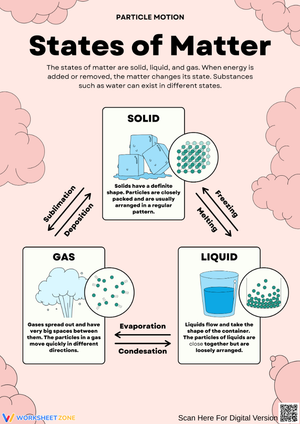
Classification tasks form the core of the set. Students sort examples into physical or chemical change, determine whether a substance is pure or a mixture, and decide whether a change is reversible. Particle model diagrams add a visual layer: each worksheet that includes diagrams asks students to identify which model represents a gas, explain what happens during condensation, or describe why melting is a physical rather than a chemical event. These visual tasks connect an observable change to what is happening at the particle level before students are expected to explain it in writing.
Evidence-based reasoning runs through the full set. Students aren't allowed to label a change chemical simply because it looks dramatic—they work from specific clues: gas production, precipitate formation, a temperature shift without an external heat source, a new color in the products, or an unfamiliar odor. Each classification task also asks students to name the evidence behind their answer, which is where the real learning happens.
Common Misconceptions to Watch For and Address
Dissolving is the most reliably misclassified example at this grade level. Students see sugar disappear into water and conclude that a new substance formed—it looks like the sugar is gone, so it must have changed into something else. They haven't connected "dissolving" to the idea that the sugar molecules are intact and fully recoverable by evaporating the water. That misconception is stubborn enough that dissolving appears multiple times across the set, not just once.
Burning creates the opposite problem. Students sometimes label it physical because they focus on the flame itself rather than what remains after the flame is out. Asking students to name what's left behind—ash, carbon dioxide, water vapor—and whether those substances existed before the match was struck shifts their attention to the right evidence. A worksheet prompt like "List what was present before and after" does more diagnostic work than one that only asks "physical or chemical?"
A third pattern involves color change. Students learn it as one sign of a chemical reaction, then encounter a phase change—liquid water becoming clear ice—and freeze, unsure whether the rule still applies. Including borderline examples like this in the set surfaces overgeneralizations before a test does, and gives teachers a specific error to address rather than a vague sense that students "sort of" understand the concept.
Fitting These Worksheets Into Your Weekly Plan
A pre-assessment worksheet at the unit's opening—five or six classification items and one short written response—quickly reveals whether students are working from evidence or from surface impressions. That data changes how much direct instruction is needed before students work independently, which is more useful than discovering the gap mid-unit.
During instruction, the most productive structure is to model two examples aloud, thinking through the evidence explicitly, then release partners to complete the rest of the worksheet together. Physical and chemical change sorts produce genuine disagreement on cases like dissolving or baking. That disagreement is worth slowing down for—it surfaces exactly the reasoning the lesson needs to address before students move to independent practice.
After a lab or demonstration, a short follow-up worksheet anchors the written work to something students actually observed. Students who watched burning steel wool or mixed baking soda with vinegar record raw observations first, then use the worksheet to classify and justify. Matter and change worksheets for 7th grade work particularly well in this lab-then-worksheet sequence because students are applying the physical/chemical distinction to evidence they actually gathered rather than a hypothetical scenario.
For warm-ups and exit checks, a single sorting task or one evidence-based sentence takes eight to ten minutes and gives clear formative data without requiring a full class period.
Adjusting the Set for Students at Different Points
The most practical move is varying the response demand without changing the content. A student who needs more support circles examples from a provided list and labels each one; a student ready for extension writes a full evidence-based explanation for the same examples without a list to draw from. Both students work with identical concepts—the difference is how much language they generate independently.
A vocabulary reference box embedded in the worksheet—sublimation, condensation, precipitate, exothermic, endothermic—lets students concentrate their energy on reasoning rather than word retrieval. Removing that box for students who have already demonstrated fluency raises the demand appropriately without redesigning the whole worksheet.
These worksheets also convert easily into station tasks. Turn the classification examples into cards, and students physically sort them before recording answers on the worksheet. That movement and discussion step improves accuracy on the written task, particularly for students who need to talk through an example before committing to an answer in writing.
Standard Alignment
NGSS MS-PS1-2 asks students to analyze and interpret data on the properties of substances before and after substances interact to determine if a chemical reaction has occurred. The evidence-based classification tasks in this set directly address the reasoning that standard requires. MS-PS1-4 connects through the phase-change and particle-model worksheets, which ask students to describe changes in particle motion and state when thermal energy is added or removed. Both standards appear in the seventh-grade physical science progression because they build on elementary understanding of states of matter while adding the demand for evidence-based explanation. The vocabulary and classification practice in these matter and change worksheets for 7th grade gives students the language they need to meet the written reasoning demands of both standards.
Frequently Asked Questions
How long does each worksheet take to complete?
Most sorting and classification worksheets take ten to fifteen minutes for a typical seventh grader working independently. Worksheets that include a short written response or evidence justification generally run fifteen to twenty minutes. Used as guided practice with partner discussion, any worksheet in the set can reasonably anchor a twenty-five to thirty minute instructional segment.
What is the clearest way to explain physical versus chemical change at this level?
Anchor the distinction to one question: did a new substance form? Physical changes alter shape, size, or state without producing anything new—the substance remains what it was. Chemical changes produce one or more new substances, and students should check for specific evidence: gas production, temperature change without an external heat source, formation of a solid in a solution, a new color in the products, or an unfamiliar odor. Teaching students to ask "What's there now that wasn't there before?" focuses their attention on the right evidence rather than surface impressions.
Which examples create the most confusion for seventh graders?
Dissolving and rusting are the two most common stumbling points. Dissolving looks like a disappearance, so students assume the substance transformed into something new. Rusting happens slowly and without visible heat or flame, so some students file it as physical. Both appear multiple times across the set because one exposure is rarely enough to correct a firmly held misread.
How do I connect these worksheets to a hands-on lab?
Run the lab first—burning steel wool, combining baking soda and vinegar, melting ice—and ask students to record raw observations before introducing any classification vocabulary. Then use the worksheet as the analysis step: students apply the physical/chemical distinction to evidence they actually gathered. This shifts the written task from abstract exercise to genuine data interpretation, and the reasoning students produce on paper is noticeably stronger.
What vocabulary do students need before working through classification tasks independently?
The minimum working set includes:
- Core terms: matter, physical change, chemical change
- States of matter: solid, liquid, gas
- Phase-change vocabulary: evaporation, condensation, melting, freezing, sublimation
- Classification terms: pure substance, mixture
Students who are shaky on these terms will guess rather than reason on classification tasks. The vocabulary-focused worksheets in the set function as a first step, not something to skip when time feels short.
Clear All