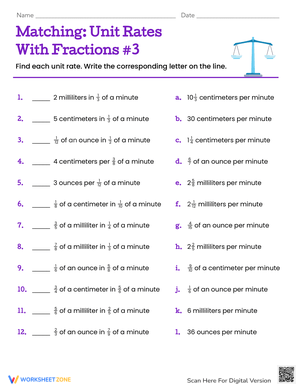
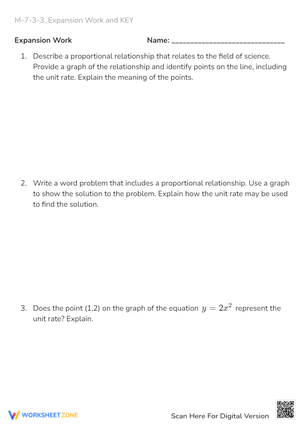
These ratios and rates printable worksheets for 7th grade address the full arc of proportional thinking demanded by Grade 7 math — from reading and writing ratios in part-to-part and part-to-whole form through finding unit rates, completing equivalent ratio tables, and explaining whether a set of values represents a proportional relationship. Each worksheet targets a specific slice of that progression, so teachers can match the right resource to the right moment in a unit rather than hunting through a mixed collection of problems.
What Each Worksheet Targets
The set covers the skills most Grade 7 students need to work through before ratio reasoning extends into percent applications, scale drawings, and eventually linear relationships in Grade 8. Rather than mixing every related concept into a single practice worksheet, each resource stays focused on one or two connected ideas.
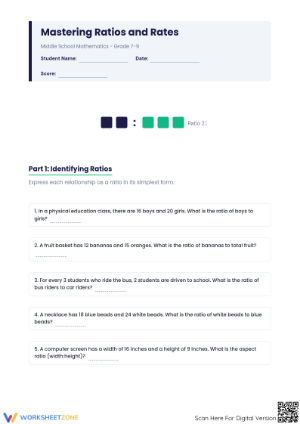
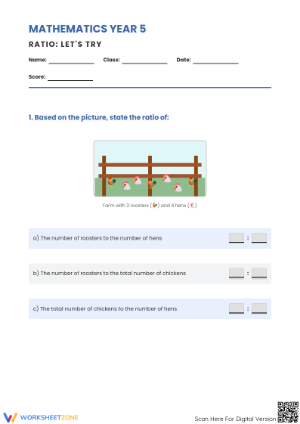
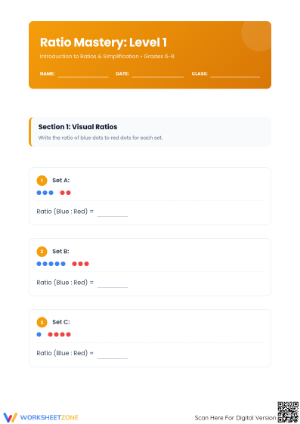
- Writing ratios in fraction form, colon form, and word form — and identifying whether the comparison is part-to-part or part-to-whole
- Distinguishing rates from ratios by attending to units: three notebooks to five folders is a ratio; $12 for four notebooks is a rate
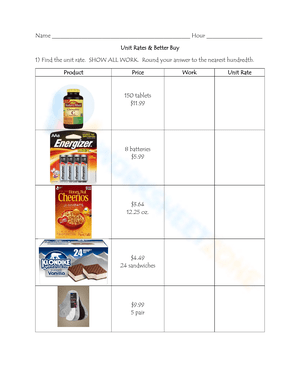
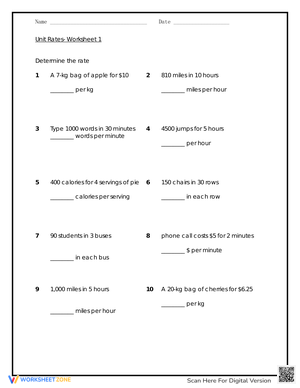
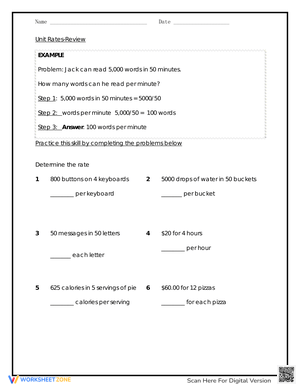
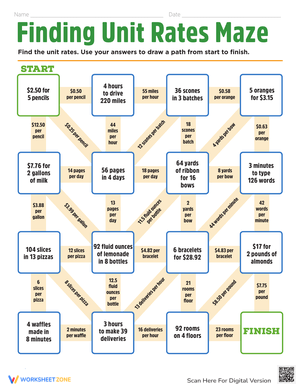
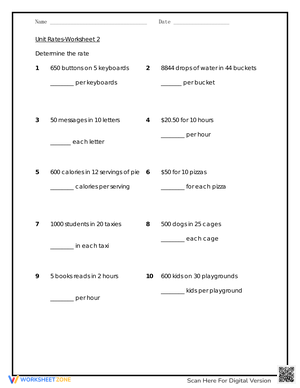
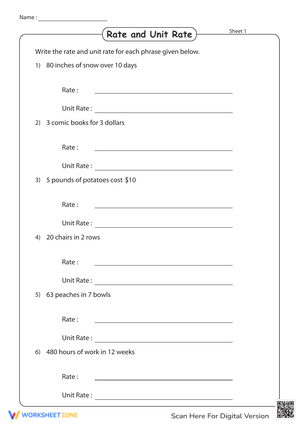
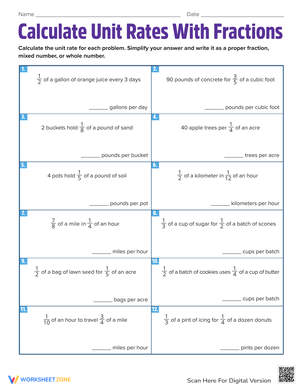
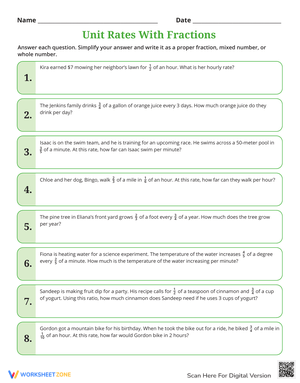
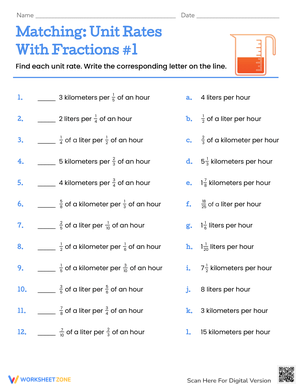
- Simplifying rates to unit rates and stating the meaning in context — not just the quotient, but what the quotient actually tells you
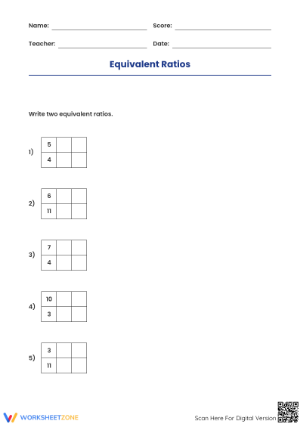
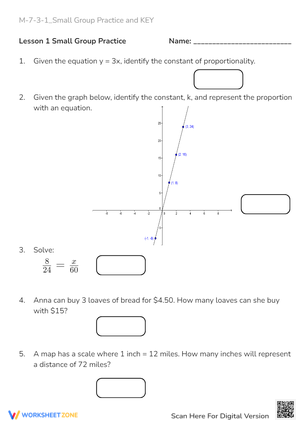
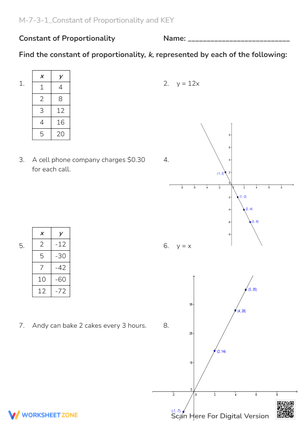
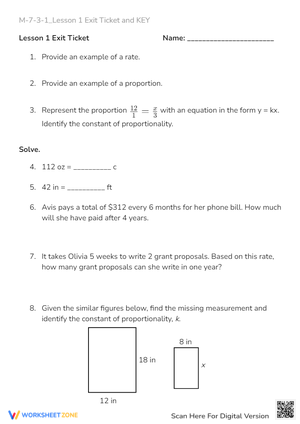
- Completing equivalent ratio tables and identifying the constant of proportionality
- Reading double-number line diagrams and using them to solve proportional problems
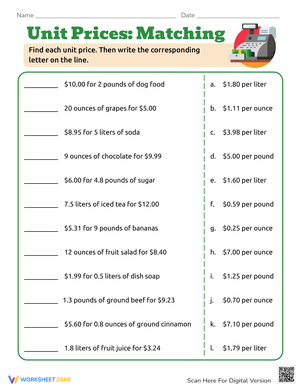
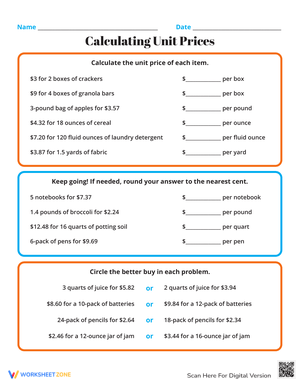
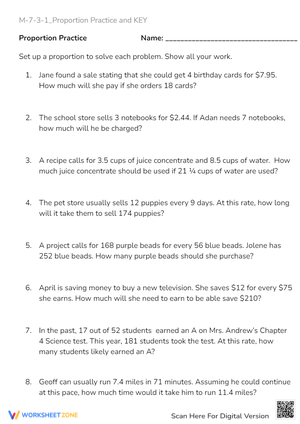
- Solving word problems involving price per unit, speed, recipe scaling, and similar real-world contexts
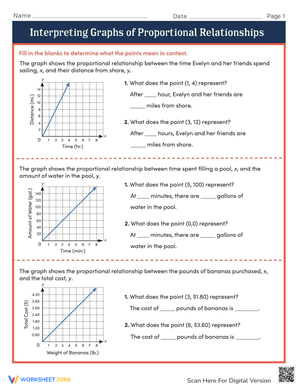
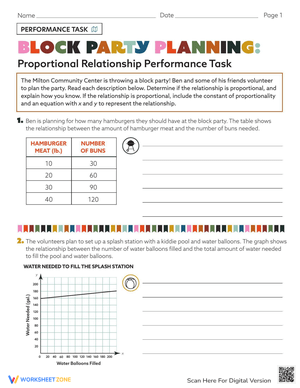
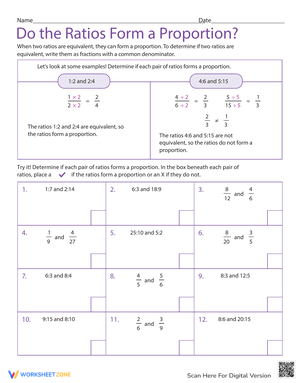
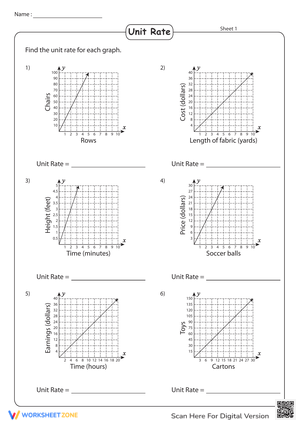
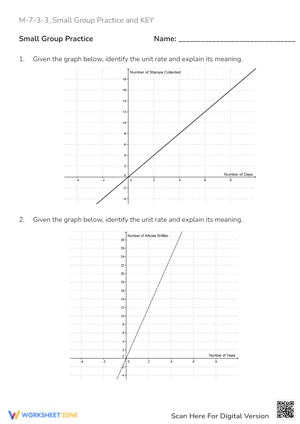
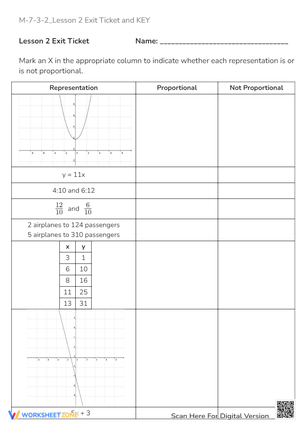
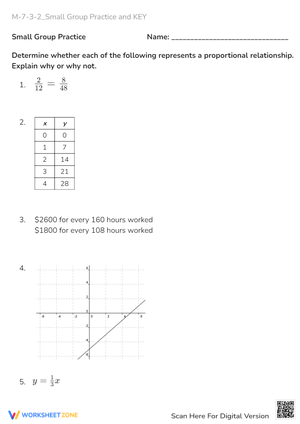
- Deciding whether a table or graph shows a proportional relationship and writing a sentence explaining why
That last task is the one that separates students who understand proportional structure from those who have learned a procedure. Worksheets that include a short written explanation prompt after a table task surface that gap faster than any multiple-choice item.
Frequent Student Errors Worth Watching For
Ratio order is the most predictable mistake at this level. A student who correctly identifies that a recipe calls for 3 cups of flour and 2 cups of sugar will still write 2:3 when asked for the ratio of flour to sugar. This isn't carelessness — it reflects incomplete understanding of what ratio order encodes. Worksheets that name both quantities clearly in the problem stem and ask for a specific comparison give students a chance to slow down and track which number belongs first.
Unit rate problems generate a separate class of errors. Students often perform the division correctly and then write an answer with no units, or with reversed units — they get 4.5 but cannot say whether that means dollars per notebook or notebooks per dollar. That distinction becomes critical when problems ask which of two rates is the better buy. Adding a unit box next to each answer line on these worksheets catches the habit early, before it creates problems in multi-step work.
The subtler error appears in table tasks: many Grade 7 students extend a ratio table by repeated addition rather than by recognizing the multiplicative relationship. They produce correct values but cannot identify the constant of proportionality or explain why dividing any y-value by its corresponding x-value gives the same result. A worksheet that includes a prompt like Explain how you know this table shows a proportional relationship after a table task exposes this gap quickly — and catching it during practice is far better than encountering it on an assessment.
Fitting These Worksheets Into Your Planning Week
The most reliable entry point is the warm-up. Two or three ratio or rate questions at the start of class take about eight minutes, reactivate vocabulary from the previous lesson, and give a quick read on where students are before new content begins. A worksheet focused on ratio language fits this slot well early in the unit; unit rate questions work better mid-unit, once students have the vocabulary to state what a unit rate means rather than just calculate it.
During guided practice, having students stop partway through a worksheet and compare answers with a partner works better than completing the entire set at once. The pause catches ratio-order errors before students have practiced them incorrectly through ten more problems. For independent work toward the end of a lesson, a mixed-review worksheet that draws on two or three related skills — rather than drilling only the day's new concept — reveals whether students can move between ideas without prompting.
Stations also fit this content well. One station might ask students to sort a set of contexts into "ratio" and "rate" categories, then write each comparison two ways. A second station might have them complete an equivalent ratio table and label the constant of proportionality. A third might present a worked unit rate problem with an error and ask what went wrong and why. All three tasks use the ratios and rates printable worksheets for 7th grade format while demanding different kinds of mathematical thinking within the same class period.
Standard Alignment
These worksheets align to CCSS 7.RP.A.1, which addresses computing unit rates associated with ratios of fractions, and 7.RP.A.2, which covers recognizing and representing proportional relationships in tables, graphs, and equations. In classroom terms, 7.RP.A.1 typically takes priority in the first two to three weeks of the unit, when students are working with rates involving familiar units — miles, dollars, cups. 7.RP.A.2 follows as students start connecting their rate work to tables and coordinate graphs. The strongest ratios and rates printable worksheets for 7th grade address both standards in tandem — pairing a unit rate question with a table showing the same relationship — so students see those as two representations of one proportional structure rather than two unrelated skills.
Adjusting These Worksheets for a Range of Learners
Students who need additional support work best with worksheets that use whole-number ratios, clearly labeled units, and a worked model at the top showing each step. The numbers matter more than most teachers expect: 12 miles in 3 hours is far easier to process than 17.5 miles in 2.5 hours, and students who are still building fraction fluency should practice ratio and rate reasoning with simpler values before the computation becomes an obstacle to the concept.
Students ready for extension benefit from tasks that require comparing two rates — which grocery package is the better buy, and by how much? — or interpreting a graph and explaining what the point (1, k) represents, where k is the constant of proportionality. Adjusting the numbers and the depth of the explanation prompt, rather than switching to different materials entirely, keeps the class working toward the same Grade 7 standard while giving teachers meaningful information about where each student's understanding actually sits.
Frequently Asked Questions
What is the difference between a ratio, a rate, and a unit rate?
A ratio compares two quantities — it can be part-to-part or part-to-whole, and no specific unit is required. A rate compares two quantities that have different units, such as miles and hours or dollars and items. A unit rate simplifies a rate so the second quantity equals 1, giving a comparison like 65 miles per hour or $3.50 per notebook. Grade 7 students need to work with all three and distinguish between them, because ratio questions and rate questions call for different attention to units and different types of answers.
Can these worksheets work for both in-class practice and homework?
Both work, but different worksheets suit each context. A worksheet focused on ratio language and basic unit rates is more manageable homework than one that includes graph interpretation — graph tasks are better handled in class, where students can ask clarifying questions. Teachers who build ratios and rates printable worksheets for 7th grade into both settings find that assigning previously practiced skill types as homework, and reserving new problem formats for in-class work, produces cleaner evidence of independent understanding.
How does this content connect to what students will study in Grade 8?
The proportional reasoning work in Grade 7 — identifying the constant of proportionality, reading ratio tables, interpreting graphs — feeds directly into Grade 8 content on linear relationships, slope, and functions. A student who can explain that a table shows a proportional relationship because every y/x quotient is the same is already thinking about slope as a rate of change. These worksheets build that reasoning without introducing Grade 8 vocabulary, which keeps instruction grade-appropriate while laying the groundwork for the next year's standards.













 Interactive Worksheet Maker
 Quiz Maker
 Word Search Maker
 Crossword Puzzle Maker
 Word Scramble Generator
 Sentence Scramble Generator
 Handwriting Worksheet Generator
 Name Tracing Generator
 Fill In The Blank Generator