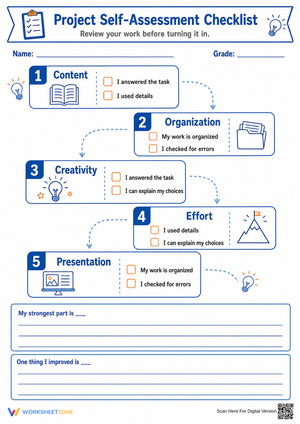
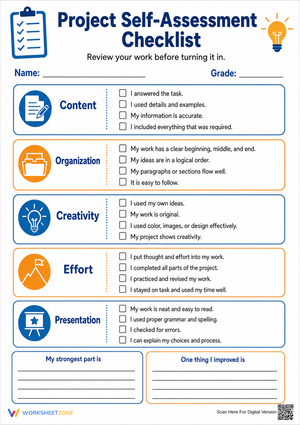
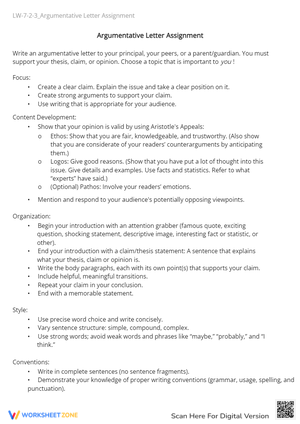
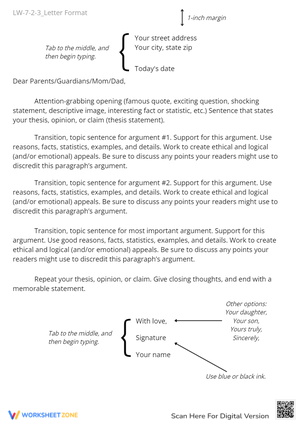
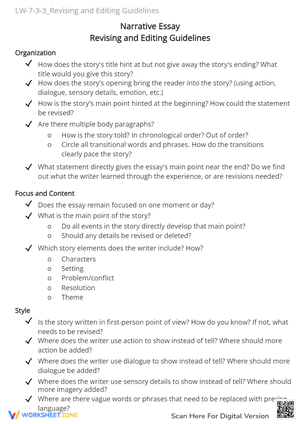
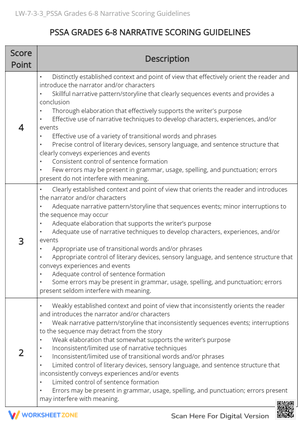
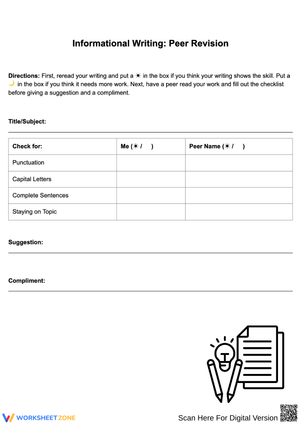
These revising writing printable worksheets for 7th grade give teachers a structured entry point into one of the hardest writing habits to build in middle school: returning to a draft with real critical distance and making changes that actually improve the writing. Most seventh graders equate revision with fixing spelling or tacking a sentence onto the end. These worksheets push past that by requiring students to make deliberate decisions about meaning, structure, and support.
The Writing Moves Each Worksheet Targets
The skills covered here are the ones that determine whether a seventh grader's essay communicates its point or just fills space. Each worksheet focuses on one revision move rather than asking students to improve everything at once — a narrower task produces more transferable learning than a general "make this better" instruction.
- Claim and thesis revision: Students rewrite broad or unfocused central ideas into specific, arguable statements.
- Paragraph organization: Students assess whether paragraphs follow a logical sequence and whether each one stays focused on its own point.
- Transitions: Students identify where connections between ideas break down and replace weak links with specific transition language.
- Evidence and elaboration: Students add or strengthen details and explanations that genuinely support a claim rather than restate it.
- Precise word choice: Students replace vague language with words that fit the audience and writing purpose.
- Sentence clarity: Students rewrite choppy, repetitive, or tangled sentences so the logic reads cleanly.
These moves apply across argument, informative, and narrative writing assignments — which is what makes revision practice at this level worth the instructional time.
Student Mistakes Worth Anticipating Before the Lesson
The most consistent problem in seventh-grade revision work is students changing words without changing meaning. When asked to strengthen a weak topic sentence, a student will often swap a phrase or two — turning "My essay is about social media and teenagers" into "This paragraph is going to discuss social media and teenagers" — without reconsidering what the sentence is supposed to do. Both versions are announcements. Neither stakes a position or introduces an idea worth developing. The student reads the change as a revision because different words appear; the actual problem, that the sentence doesn't function as a claim, stays intact.
Elaboration tasks produce a different but equally predictable pattern. When students are told to add a supporting detail, they often pull an idea already in the paragraph and reword it slightly. Sentence count goes up; meaning doesn't. Showing two versions side by side — one where the added sentence introduces genuinely new evidence and one where it just echoes — tends to clarify the distinction faster than any explanation. Many of the passage-based tasks in this set are built around exactly that kind of comparison.
Building These Worksheets Into Your Writing Workshop
The most reliable pattern when using revising writing printable worksheets for 7th grade is to teach one revision move with the worksheet, then connect it directly to a student draft. Complete part of the worksheet together so students hear the reasoning behind the change — not just what to fix, but why a reader would find the revised version clearer or more convincing. Then ask students to apply the same move in a draft they're currently working on. The worksheet is the middle step, not the destination.
Passage-based revision tasks work especially well in the 10 to 15 minutes before a writing workshop transition. Students can focus on a short draft, make one targeted improvement, and finish before the block ends — useful at a point in the period when starting something new doesn't make sense. These worksheets also fit naturally into Friday review time when drafts are due the following week, and in small-group conferences where a student has one persistent weakness worth isolating from the rest of the draft.
One practical organizational move: sort the worksheets by writing problem rather than by unit. A folder labeled "unclear introductions," another for "thin evidence," and one for "transition problems" makes it fast to pull the right worksheet during a writing conference or reteach session without hunting through a binder by week or assignment.
Standard Alignment
These worksheets align most directly to CCSS ELA-Literacy W.7.5, which calls for students to develop and strengthen writing by planning, revising, editing, rewriting, or trying a new approach. That standard draws a deliberate distinction between revising — improving ideas, organization, and support — and editing, which addresses surface correctness. Keeping those two stages separate in classroom instruction helps students understand the purpose of what they're doing at each step, and it gives teachers a cleaner framework for offering feedback. At the seventh-grade level, W.7.5 works alongside W.7.1 through W.7.3, which set the expectations for argument, informative, and narrative writing. Revision practice is where students close the gap between a first draft and writing that actually meets those genre-specific expectations.
Adjusting the Worksheets for a Mixed-Readiness Class
For students who struggle with open-ended revision tasks, narrowing the prompt produces better work than simplifying the passage. A direction like "Rewrite this topic sentence so it introduces a specific claim about the character's decision" gives students something concrete to aim for without removing the thinking. Broad instructions — "make this paragraph better" — tend to produce either cosmetic word changes or no changes at all. Shorter passages with more directed prompts work better for students who need more support; open-ended tasks where students first identify the weakness and then fix it are more appropriate for students who are ready for that two-step process.
For students working beyond grade-level expectations, adding a comparison layer raises the cognitive demand meaningfully. Asking them to evaluate two possible revisions and explain which is stronger for a specific audience — that task still uses revising writing printable worksheets for 7th grade as its starting point, but the focus shifts from execution to evaluation. That's a genuine difference in the kind of thinking involved, and it's appropriate for seventh graders who have already internalized the basic revision moves.
Peer review can be differentiated the same way. A pair working on evidence uses a worksheet focused only on that feature; a more advanced pair uses a checklist covering claim, support, organization, and language simultaneously. Both are doing genuine revision work — the task scope just reflects where they are.
Frequently Asked Questions
How is revision different from editing, and do these worksheets address both?
They address revision specifically. Revision improves meaning — strengthening a claim, reordering paragraphs, adding relevant evidence, rewriting unclear sentences. Editing addresses correctness: grammar, spelling, and punctuation. Keeping the two stages separate in classroom instruction helps students understand what they're trying to accomplish at each step, and it helps teachers target feedback at the right layer of the draft.
Where in a writing unit do these worksheets fit best?
They work best after students have a working draft, but they're also useful earlier in the unit as a way to study what strong revision decisions actually look like. A passage-based worksheet used before students begin drafting helps them internalize the difference between "good enough" and "genuinely revised" — which tends to make their own first drafts more intentional from the start.
Do these worksheets help with test preparation?
Passage-based revision tasks are a direct match to the format many state assessments use, where students read a student draft and identify or write an improvement. These revising writing printable worksheets for 7th grade build the same core skill — reading a draft critically, diagnosing a specific weakness, and making a purposeful change — while also building the revision stamina students need during timed writing.
Do these worksheets work for narrative writing, or only for argument and informative pieces?
Many of the skills — clarity, transitions, relevant detail, effective openings — transfer across all three genres. Some worksheets are genre-specific: tasks focused on thesis statements or counterargument belong to argument writing, while tasks around pacing, sensory detail, or character motivation fit narrative work. Teachers can select the worksheet that matches the current assignment or use genre-specific worksheets when students shift between writing modes.












 Interactive Worksheet Maker
 Quiz Maker
 Word Search Maker
 Crossword Puzzle Maker
 Word Scramble Generator
 Sentence Scramble Generator
 Handwriting Worksheet Generator
 Name Tracing Generator
 Fill In The Blank Generator