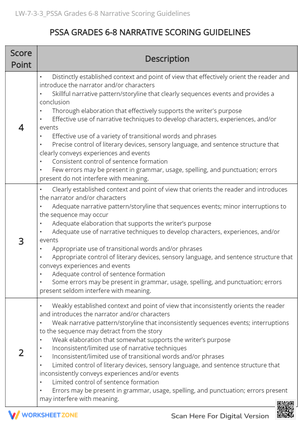
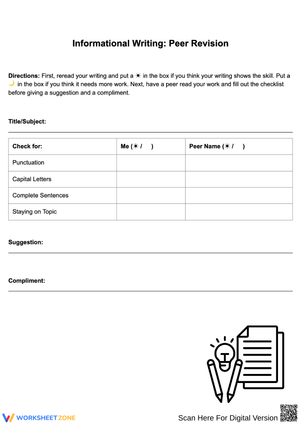
These editing pdf worksheets for 7th grade give teachers a focused, low-prep way to build the proofreading habits that middle schoolers need before they can reliably clean up their own writing. The set addresses the errors that appear most consistently in 7th grade drafts — sentence boundary problems, verb tense shifts, comma errors in compound and complex sentences — and asks students to correct them in short, readable passages rather than isolated fill-in-the-blank sentences.
The Specific Skills Each Worksheet Targets
The skills in this set reflect where editing attention pays off most in 7th grade writing. Students who have been writing independently for several years have usually internalized some conventions and missed others entirely, which means a single mixed-error paragraph can reveal five different problems from five different students. These worksheets narrow the focus so students practice one or two error types at a time before moving toward mixed proofreading.
- Fragments and run-ons: Students mark or rewrite sentences with boundary problems, practicing the difference between a complete thought and a dependent clause left standing alone.
- Comma placement: The set addresses commas after introductory elements, between items in a series, and before coordinating conjunctions in compound sentences — three trouble spots that appear in almost every 7th grade essay.
- Verb tense consistency: Students identify and correct unintentional tense shifts within paragraphs, a skill that matters especially in personal narratives and research-based explanations.
- Pronoun agreement and reference: Students underline unclear pronoun references and rewrite the sentence to remove the ambiguity.
- Apostrophes and quotation marks: Both cluster in narrative and dialogue writing, where errors accumulate quickly.
- Capitalization in complex sentences: Not just proper nouns — students also work with titles, direct address, and capitalization after colons, where the rules are less automatic.
The progression across the set moves from narrower skill worksheets to mixed-error passages. That structure reflects how editing actually works: you get faster at catching one error type, then you start carrying that awareness into longer, more complex text.
Where 7th Graders Consistently Go Wrong
The most reliable predictor of an error in student writing is how close that error sits to something the student already knows. Editing pdf worksheets for 7th grade surface this pattern clearly: a student who correctly places a comma after a long introductory clause will often insert that same comma into a short sentence where none belongs — writing By noon, she finished correctly and then writing She ran, and tripped right below it. The confidence from getting one structure right spills into adjacent structures where the rule does not apply.
Verb tense consistency produces a similar effect. Students shifting into past tense mid-paragraph are not making random errors — they're often recounting a source they read in present tense while their own explanation slips into past. The shift is logical from the student's perspective, which is exactly why it's hard to self-correct without a deliberate editing routine. When students underline every verb in a passage and check each one against the paragraph's established tense, they catch errors they would miss reading for meaning alone.
Pronoun reference is the third frequent problem area. Students write sentences like When Marcus told his brother that he had failed the test, he started crying and see nothing unclear about it — to them, the story is obvious. Editing practice that asks them to circle ambiguous pronouns and mark every possible referent forces the kind of reader-perspective thinking that simply telling them to "be clear" does not produce.
Smart Ways to Build These Worksheets Into Your Week
The most sustainable use of this set is as a brief Monday-through-Thursday routine that runs parallel to whatever writing unit is in progress. Ten minutes at the start of class — before morning meeting wraps up and while students are still settling — gives you a low-stakes formative window into exactly which conventions are holding and which are not. One effective pattern: Monday for punctuation, Tuesday for sentence structure, Wednesday for usage, Thursday for a mixed passage that asks students to apply all three. Friday becomes conferencing or drafting time without a warm-up interruption.
These worksheets also work during the eight or nine minutes before dismissal when pulling out a full writing activity is not realistic. Students correct and discuss one passage, teachers collect and scan for patterns before the next day. That quick cycle gives you useful information without a 45-minute grading session. For sub plans, an editing worksheet with a clear answer key keeps class time structured and gives the substitute something concrete to review at the end of the period.
For small-group intervention, the narrow-skill worksheets work best. Sit with three or four students who share a specific error pattern — say, run-ons — and have them read each sentence aloud before deciding whether it needs a period, a conjunction, or a semicolon. The oral reading step slows them down in a way that silent reading does not, and you hear exactly where their thinking breaks down.
After completing any editing pdf worksheets for 7th grade from this set, ask students to spend two minutes rereading their current draft for that same error type. That bridge between practice and application is what keeps worksheet work from feeling disconnected from real writing.
Standard Alignment
The worksheets address CCSS.ELA-LITERACY.L.7.1 (command of standard English grammar and usage when writing or speaking) and CCSS.ELA-LITERACY.L.7.2 (command of standard English capitalization, punctuation, and spelling when writing). In classroom terms, L.7.1 covers pronoun case, subject-verb agreement, and misplaced modifiers — the errors that make a 7th grade draft harder to follow even when the ideas are strong. L.7.2 addresses comma use and spelling strategies. These are the standards that surface during writing conferences when a student has good content but weak execution. The worksheets give teachers a way to address both standards within a writing workshop structure, not as a disconnected grammar unit.
Adjusting These Worksheets for a Range of Learners
Students who struggle with editing often need to know what they're looking for before they look. For those students, marking the error type at the top of each passage — or telling them "this paragraph has four comma errors" — reduces the cognitive demand enough that they can focus on applying the rule rather than hunting for something undefined. That adjustment turns the same worksheet into a more guided practice without requiring a separate version.
Students who are ready for a greater challenge need the opposite condition: no hints, no error count, no labeled skill focus. Give them a mixed-error passage and ask them to produce a clean rewrite of the entire paragraph, then explain each change in a sentence. That moves from identification to production, which is closer to what standardized editing tasks require and demands more from students who have already mastered the basic identification step.
One honest limitation worth naming: the passage-editing format frustrates students who freeze when encountering unfamiliar syntax. A student who struggles to read a passage fluently cannot also proofread it simultaneously — decoding and editing compete for the same attention. For those students, reading the passage aloud together first, then returning to it for editing, makes the worksheet usable rather than overwhelming.
Frequently Asked Questions
What is the difference between editing and revising at the 7th grade level?
Revising is about improving ideas — strengthening a claim, adding evidence, cutting what wanders. Editing is about correctness at the sentence level: grammar, punctuation, spelling, and word-level clarity. Seventh graders need practice with both, but the two processes require different reading modes. These worksheets build the slower, more deliberate reading mode that editing demands, which is a distinct skill from the bigger-picture thinking revising requires.
How often should these worksheets appear in the weekly schedule?
Three to four times per week is enough to build a routine without crowding out actual writing time. Short, frequent practice outperforms longer, infrequent sessions for convention work — students internalize patterns through repetition, and a 10-minute daily editing routine sustained over six weeks produces more lasting results than a full-period grammar lesson once a month.
Do these worksheets support test preparation?
Editing pdf worksheets for 7th grade that include multiple error types in a single passage ask students to read carefully, identify specific problems, and make deliberate corrections — exactly the thinking state assessments measure in their editing and language sections. Using these as the Thursday mixed-passage routine across a semester builds that test-day skill without turning daily instruction into pure test prep.
What should teachers look for in the answer keys?
The most useful answer keys mark each correction clearly and make it easy to run a quick whole-class review without hunting through the passage for every change. For passages with multiple error types, a key that identifies what changed and where supports efficient discussion and gives students specific feedback rather than just a final score.












 Interactive Worksheet Maker
 Quiz Maker
 Word Search Maker
 Crossword Puzzle Maker
 Word Scramble Generator
 Sentence Scramble Generator
 Handwriting Worksheet Generator
 Name Tracing Generator
 Fill In The Blank Generator