These 6th grade roles of the president worksheets printable give teachers a structured entry point into executive branch civics — the kind of content where students can name the president without being able to describe what the office actually does. Each worksheet moves students from passive recognition toward applied thinking: reading a scenario, naming the role at work, and identifying whether that action has constitutional backing or reflects tradition and political expectation.
The Seven Roles and the Harder Question They Lead To
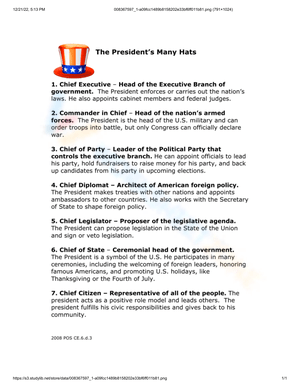
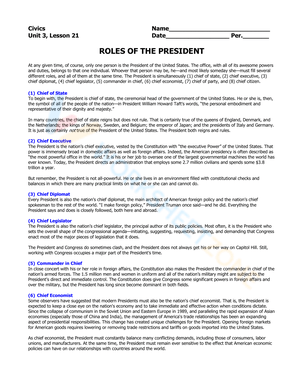
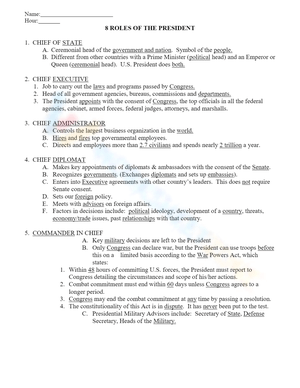
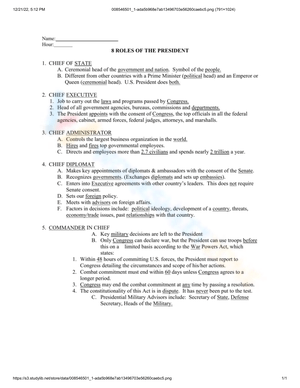
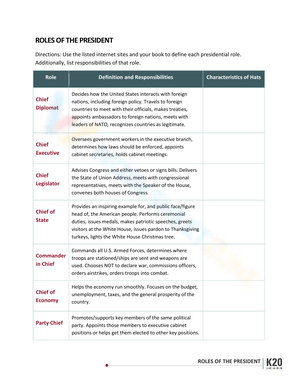
The standard classroom taxonomy includes seven roles: chief executive, commander in chief, chief diplomat, legislative leader, head of state, chief of party, and chief citizen. Sixth graders can memorize those labels quickly. What takes longer — and what separates surface recall from actual understanding — is learning which duties are rooted in Article II of the Constitution and which developed through precedent, party leadership, and accumulated expectation over time.
- Chief executive: enforces federal law and leads the executive branch agencies.
- Commander in chief: serves as the civilian leader of the U.S. military.
- Chief diplomat: directs foreign policy and negotiates with other nations.
- Legislative leader: proposes legislation and works to move priorities through Congress.
- Head of state: represents the nation at official and ceremonial events.
- Chief of party: supports the agenda and candidates of the president's political party.
- Chief citizen: speaks to public concerns and models civic responsibility.
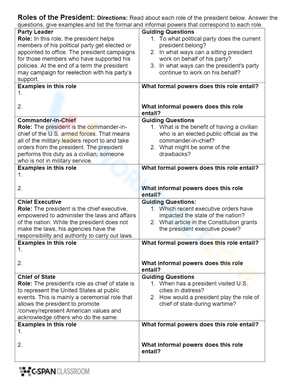
Article II names the core formal powers: enforcing federal law, commanding the military, negotiating treaties with Senate consent, and nominating judges and executive officials. The remaining roles — especially chief of party and chief citizen — are real and consequential, but they emerged through leadership practice and public expectation rather than constitutional text. Teaching students to sort the formal from the traditional is the conceptual work these worksheets are built around.
Mistakes Students Make That These Worksheets Help You Catch
The most consistent error: students treat all seven roles as equally constitutional. A student who correctly identifies "commander in chief" as a formal Article II power will mark "chief of party" the same way, because both terms came from the same class discussion. Chief citizen generates its own confusion — students frequently argue it should be the most important role because it sounds the most democratic, not realizing it is one of the most informal. Worksheets that include a formal-versus-traditional sorting column surface this misconception before it becomes a wrong answer on the unit assessment.
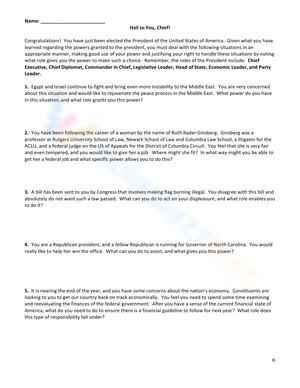
A second pattern appears consistently in scenario activities: students default to "chief executive" as a catch-all. Signing a trade agreement? Chief executive. Attending a state funeral for a foreign leader? Chief executive. Because the executive branch is the broadest category students have encountered, it becomes a default label rather than a reasoned one. Activities that ask students to explain why "chief diplomat" is more specific than "chief executive" in a given scenario — rather than just circling an answer — develop the analytical thinking that identification tasks alone miss.
Building These Worksheets Into Your Weekly Lesson Plans
The roles sequence fits a 50-minute period with time for both instruction and discussion. A three-to-five-minute warm-up asking students what they think the president does on a typical Tuesday morning surfaces prior knowledge quickly — and usually produces a useful mix of accurate impressions and creative inventions. That warm-up sets up the direct instruction: introduce Article II powers first, then explain the informal roles as categories that developed over time through political leadership and public expectation. When building lessons around 6th grade roles of the president worksheets printable, running the vocabulary matching component during direct instruction rather than as independent work pays off — you can pause on chief of party and chief citizen, which rarely appear in students' prior reading, before moving on.
Move into scenario sorting in pairs after the matching activity. Have one student argue for a role and the partner push back with a specific reason. That 12-to-15-minute partner discussion consistently produces stronger written responses, because students have talked through the reasoning before committing it to paper. Close with a checks-and-balances prompt: pick any scenario from the worksheet and identify which branch or constitutional mechanism limits that action. Students who just argued whether a scenario shows chief diplomat or head of state are now thinking about Senate treaty consent — without requiring a separate lesson to get there.
Adjusting the Worksheets for a Range of Learners
For students who need more support, limiting the first worksheet to three roles — chief executive, commander in chief, and chief diplomat — cuts the new vocabulary to a workable load. The remaining four roles enter through a follow-up worksheet once those three are solid. Students at lower reading levels often don't struggle with the concepts themselves; the difficulty is holding seven unfamiliar terms in working memory at once. Narrowing the initial focus and building outward keeps the content accessible without removing any of it.
Students ready for extension work do well with a different kind of question: given a scenario, identify which branch could limit or block that presidential action and name the constitutional process involved — Senate consent for treaties, congressional override of a veto, judicial review of executive action. That task moves well beyond role identification into analysis of how shared power actually operates. The 6th grade roles of the president worksheets printable that include an extension prompt or a follow-up question for faster finishers handle most of a mixed-ability room without requiring a separate enrichment packet.
Standard Alignment
Presidential roles connect directly to C3 Framework standard D2.Civ.4.6-8, which asks students to explain how the three branches of government work together in decision-making. In classroom terms, this standard typically lands mid-unit — after students have studied the Constitution but before the focus shifts to checks and balances specifically. That placement is deliberate: students who understand what each branch does are far better equipped to analyze how the branches limit one another than students who only know the branches exist as a category. These worksheets also address NCSS Theme V (Individuals, Groups, and Institutions) by examining how the executive branch carries out its governing functions. CCSS RH.6-8.1 applies when students use scenario descriptions as textual evidence to support their role identifications rather than guessing from memory.
Frequently Asked Questions
What presidential roles should 6th graders know by the end of this unit?
The seven roles taught in most grade 6 civics units are chief executive, commander in chief, chief diplomat, legislative leader, head of state, chief of party, and chief citizen. Beyond knowing those labels, students should be able to say which roles are grounded in Article II and which developed through tradition. The 6th grade roles of the president worksheets printable in this set build toward that distinction, not just the vocabulary list.
How do I explain the difference between formal constitutional powers and informal roles?
Start with the text of Article II: the president enforces federal law, leads the military, negotiates treaties with Senate approval, and nominates judges and executive officials. Those are the constitutional powers. Then explain that presidents also function as their party's leader, the nation's symbolic representative, and a voice for civic values — roles that matter significantly in practice but don't appear as explicit clauses in Article II. Concrete examples help: a president speaking at a national memorial, endorsing a Senate candidate, or addressing the nation after a tragedy makes the formal-versus-informal distinction land more clearly than definitions alone.
Can these worksheets be used for homework or independent review?
Vocabulary matching and short reading-based questions transfer well to homework after classroom instruction has introduced the terms. Scenario sorting works better in class, where students can discuss borderline cases instead of guessing silently. If you assign scenario activities as homework, add a one-sentence explanation prompt — "Tell me which role fits and why it's more precise than chief executive" — so the worksheet captures reasoning rather than just a circled answer.
Where in a unit on the executive branch do these worksheets fit best?
Introduce them after students have a working understanding of the three branches but before the class examines checks and balances in depth. Students who know what the president actually does — and which of those actions are constitutionally grounded — understand the need for legislative and judicial limits far more concretely than students who only know the executive branch exists as a category.












 Interactive Worksheet Maker
 Quiz Maker
 Word Search Maker
 Crossword Puzzle Maker
 Word Scramble Generator
 Sentence Scramble Generator
 Handwriting Worksheet Generator
 Name Tracing Generator
 Fill In The Blank Generator