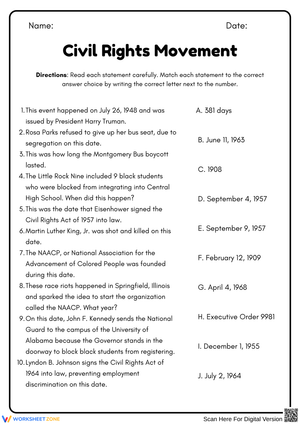
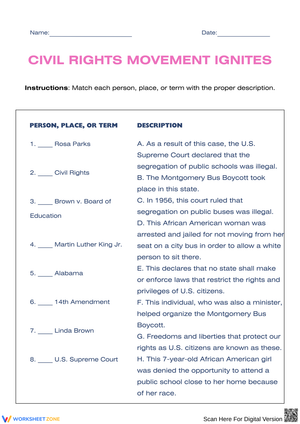
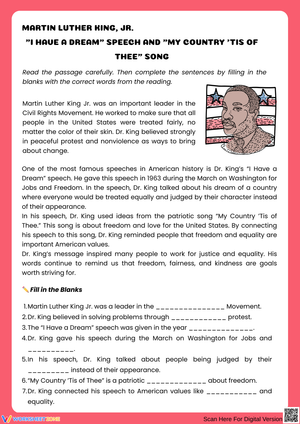
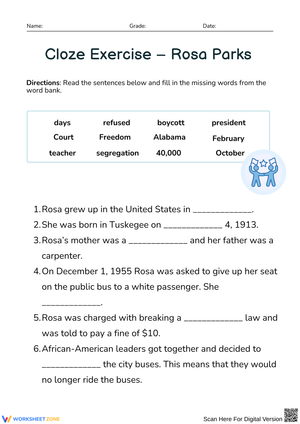
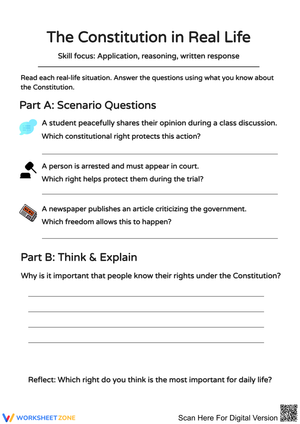
These civics and government pdf worksheets for 6th grade give teachers a set of concept-specific, print-ready resources built around the topics that middle school social studies units return to most — the purpose of government, the three branches, checks and balances, the Constitution, and civic rights and responsibilities. Each worksheet targets a single concept through a mix of short informational passages, vocabulary matching, diagram labeling, multiple-choice questions, and brief written responses. The format keeps practice focused without reducing the content to recall drills.
The Specific Concepts Each Worksheet Addresses
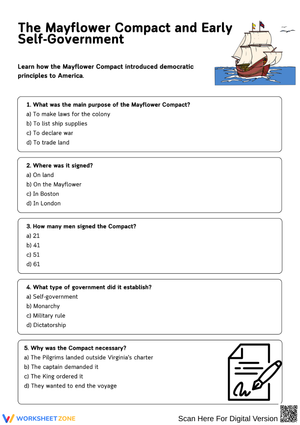
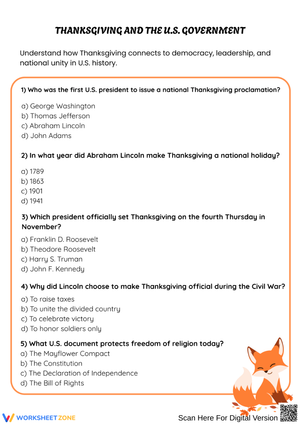
Government content at the sixth-grade level asks students to hold unfamiliar vocabulary alongside genuinely new conceptual systems. Most of these students have heard the word "Constitution" before; few have thought carefully about what distinguishes a right from a responsibility, or why three branches would share power rather than divide it cleanly. Each worksheet opens with a short informational passage that anchors the vocabulary and concept before students are asked to apply either one — giving students a basis to work from instead of requiring prior background knowledge to access the tasks.
- Purpose of government: Students sort examples of public services, laws, and community responsibilities, then write a sentence explaining why organized governments exist in the first place.
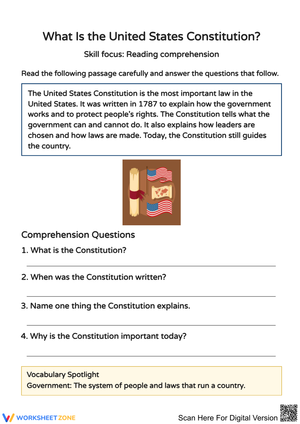
- The Constitution: Students identify the document's role, locate key provisions, and distinguish between the original text and later amendments.
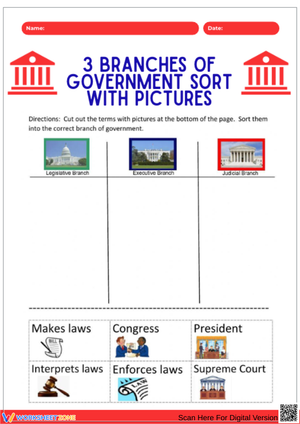
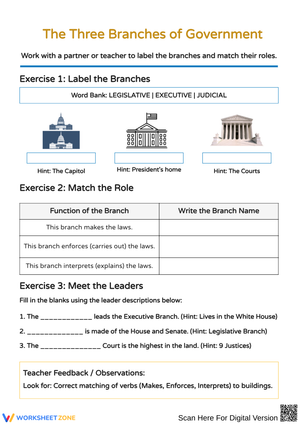
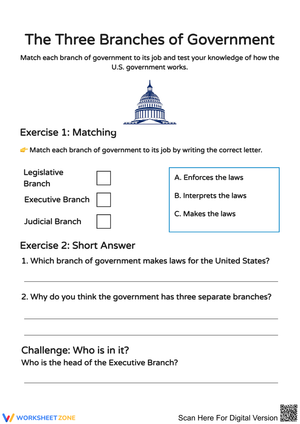
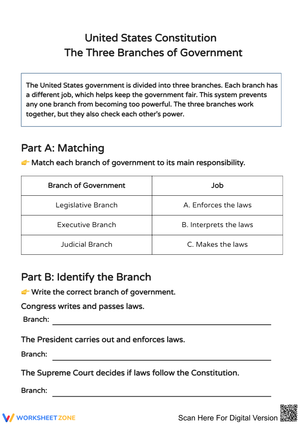
- Three branches of government: Students label branch names and powers, match responsibilities to the correct branch, and compare how decisions move through each one.
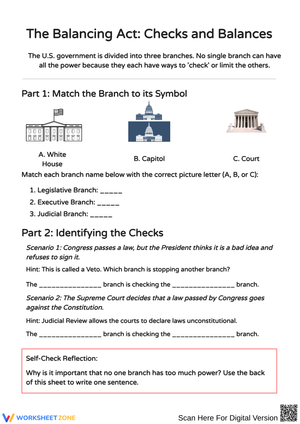
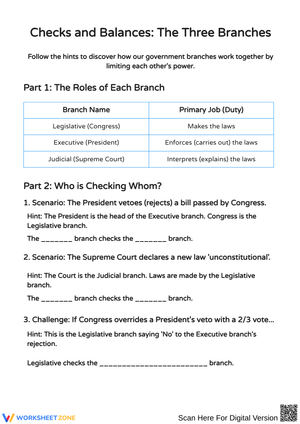
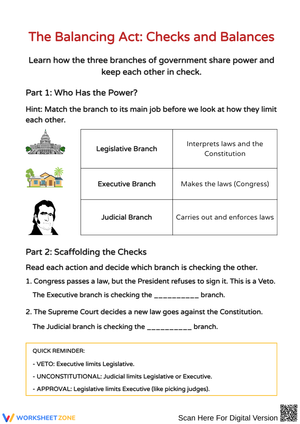
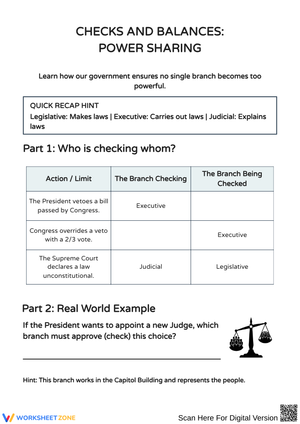
- Checks and balances: Scenario tasks ask students to identify which branch acts, which responds, and what the outcome would be — requiring sequential reasoning rather than isolated recall.
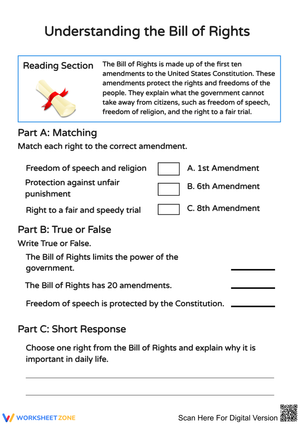
- Rights and responsibilities: Students sort examples into rights they hold versus responsibilities they carry, then justify the placement in a short written explanation.
- Civic participation: Worksheets examine how citizens engage in public life, from voting and staying informed to community organizing and respectful public discussion.
Where Student Thinking Breaks Down in Civics Units
The most persistent error in sixth-grade civics is conflating separation of powers with checks and balances. Students can tell you, after a lesson, that government has three branches. What trips them up is the dynamic piece — that each branch also actively limits the others. In written responses, students regularly write something like "the president makes laws for the country" even after a full lesson on Congress. The scenario tasks in the checks-and-balances worksheet surface that error directly: students must name which branch initiates an action and which branch would respond, forcing them to reason through the sequence rather than reproduce a phrase they heard in class.
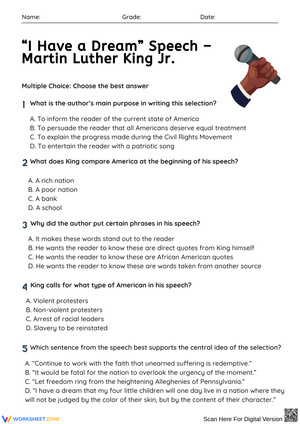
A second breakdown appears in the rights-and-responsibilities section. Students tend to read "rights" as meaning "things I want" and "responsibilities" as meaning "rules I have to follow." The constitutional distinction is genuinely subtle for eleven-year-olds, and a worksheet that only asks students to define the two terms will not resolve the confusion. The sort-and-justify format here asks students to place examples in the correct category and explain their reasoning in writing — which exposes the underlying logic rather than masking it with a correctly labeled answer.
Building These Worksheets Into Your Lesson Flow
Getting the most from civics and government pdf worksheets for 6th grade means treating them as a deliberate sequence rather than interchangeable practice materials. A reliable pattern for a single concept across four days: Day 1, students read the short passage and complete the vocabulary matching; Day 2, they work through the main comprehension and labeling tasks with a partner, talking through answers before writing; Day 3, they tackle the scenario-based questions independently; Day 4, they use the completed worksheets as self-review before a quiz. That structure applies spaced retrieval naturally — students return to the same concept in a different format each day, which is more durable than a single extended practice session on one afternoon.
One technique worth building into the worksheet routine: before students write any answer about rights, branch powers, or government functions, give them thirty to sixty seconds to say their thinking aloud to a partner using a sentence frame. That brief oral rehearsal consistently produces cleaner written responses, especially for students who understand the concept but stall when organizing it on paper. It costs nothing in terms of prep — it is a shift in how the worksheet moment is framed, not a separate activity.
For substitute days, each worksheet carries self-contained directions that require no social studies background to distribute. For classes already using iCivics simulations or primary source materials from DocsTeach, these worksheets slot naturally after a short reading or activity — the document introduces the concept; the worksheet organizes the resulting understanding into written practice.
Tiering the Worksheets for Classrooms With Wide Readiness Gaps
Sixth-grade classrooms typically span three or more reading levels, and civics vocabulary hits students at the lower end of that range harder than nearly any other social studies content. Words like "amendment," "federal," and "veto" carry almost no context in everyday speech for most eleven-year-olds. For students who need more support, a brief whole-class or small-group preview of the bolded vocabulary terms before releasing students to read independently keeps the content task from becoming a vocabulary obstacle course. The matching formats on these worksheets are deliberately accessible — students working with terms for the second or third time can complete the tasks productively even when the first read-through of the passage was partial.
For students who move quickly through the core tasks, the scenario-based questions on checks and balances and civic participation carry enough complexity to extend thinking without a separate enrichment sheet. A straightforward extension: ask those students to write a second scenario that reverses the direction of the check — which branch would respond if a different branch initiated the action? That transfer task requires genuine understanding, not pattern recognition.
For multilingual learners, the short passage format limits reading load, and the structured task types — matching, labeling, sorting — reduce the demand on extended English writing until students have built familiarity with the content vocabulary. Allowing oral discussion with a partner before writing also helps here, and it does not require a separate modified worksheet to make it work.
Standard Alignment
These worksheets align with the College, Career, and Civic Life (C3) Framework, particularly D2.Civ.1.6-8 (explaining the roles of political, civil, and economic organizations in shaping people's lives), D2.Civ.4.6-8 (distinguishing the powers and responsibilities of citizens, political parties, interest groups, and the media), and D2.Civ.6.6-8 (identifying the purposes of government and the limits placed on it). Most state-level grade 6 social studies standards map closely to these C3 anchors — branches of government, constitutional principles, and civic participation appear as benchmark expectations in the large majority of state frameworks by the end of sixth grade.
In practical classroom terms, the three-branches and checks-and-balances worksheets address the content most commonly tested at this level. Teachers pacing a civics unit across three to four weeks can use the set to anchor vocabulary in the first week, move into structural concepts — branches, Constitution, checks and balances — in the second and third weeks, and close with rights, responsibilities, and participation before the unit review.
Frequently Asked Questions
Can these worksheets function as homework without any classroom introduction beforehand?
Each worksheet opens with a short reading passage that gives students enough context to work through most tasks independently. That said, the vocabulary-heavy worksheets — particularly those covering the Constitution and checks and balances — produce better results as homework after at least a brief in-class introduction. Cold-assigning those without prior exposure tends to produce guessing on vocabulary items rather than genuine retrieval, which undermines the point of the practice.
What order works best when sequencing these across a civics unit?
Starting with the purpose-of-government worksheet establishes the conceptual "why" before moving into structure. From there, the Constitution worksheet gives students a frame for the rules governing the branches. The three-branches and checks-and-balances worksheets follow in that order — understanding how branches are defined makes the checks-and-balances scenarios significantly more intelligible. Rights-and-responsibilities and civic participation work well at the end of the unit, when students have enough vocabulary to reason about civic roles with precision. The full set of civics and government pdf worksheets for 6th grade is built with this progression in mind, though each worksheet also holds up as standalone practice for a single concept.
Are these appropriate for students reading well below grade level?
The passages are written at an accessible middle-school level, and the task formats — matching, labeling, sorting, multiple-choice — limit the demand on extended writing for students who need it. For students reading significantly below grade level, pairing the worksheet with a read-aloud or a brief small-group preview of the passage keeps them working on the content rather than struggling at the text. The civics and government pdf worksheets for 6th grade in this set are not low-readability rewrites, but their structure makes access easier to engineer through grouping and introduction decisions rather than requiring a fully separate set of materials.












 Interactive Worksheet Maker
 Quiz Maker
 Word Search Maker
 Crossword Puzzle Maker
 Word Scramble Generator
 Sentence Scramble Generator
 Handwriting Worksheet Generator
 Name Tracing Generator
 Fill In The Blank Generator