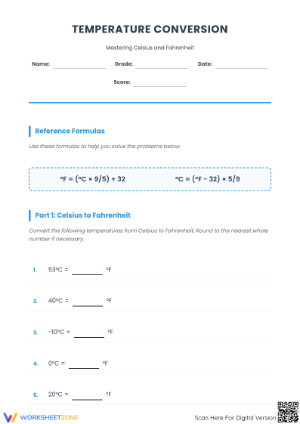
6th Grade Temperature Conversion Printable Worksheets
6th grade temperature conversion printable worksheets give teachers a structured way to build the procedural fluency this skill demands — not just formula recall, but the step-by-step discipline that keeps conversions accurate when numbers get messy. Each worksheet addresses one conversion direction, mixes computation with real-world context, and builds from benchmark values toward multi-step application. An answer key comes with every worksheet so sorting errors by type — formula selection, arithmetic, labeling — takes minutes rather than a full period.
The Skills Each Worksheet Targets
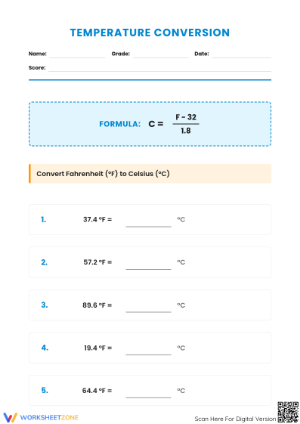
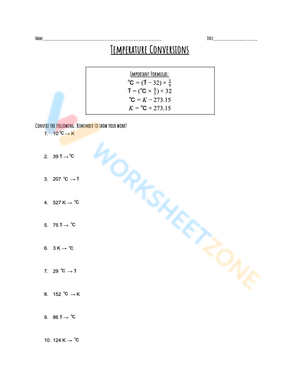
The two formulas students need are C = (F - 32) × 5/9 and F = (C × 9/5) + 32. The core challenge is choosing correctly between them based on the starting unit in the problem — which sounds obvious but trips students up more than the arithmetic does. Each worksheet reinforces the habit of identifying and labeling the starting scale before selecting a formula.
Beyond formula selection, the set covers a range of problem types:
- Direct conversions using whole-number Celsius and Fahrenheit values
- Conversions that require managing order of operations alongside fraction multiplication
- Missing-value problems where one or two steps are provided and students complete the rest
- Word problems set in weather, cooking, and travel contexts
- Temperature tables where students fill in the converted column and assess whether each result is reasonable
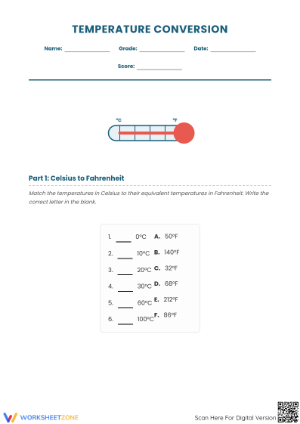
- Benchmark recognition tasks — students mark where 32°F, 98.6°F, and 212°F fall on a Celsius number line
The benchmark tasks earn their place. When students know that 0°C and 32°F describe the same condition — and that 100°C and 212°F mark boiling — they have reference points that catch errors before those errors become final answers. The 6th grade temperature conversion printable worksheets build these benchmarks into every difficulty level, not just the introductory problems, so students keep treating them as a self-check as the conversions get harder.
Mistakes Students Make That These Worksheets Help You Catch
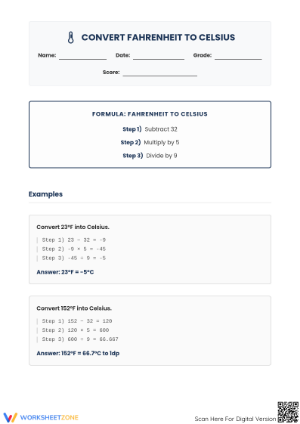
The most consistent error in sixth-grade conversion work is ignoring the parentheses in the Fahrenheit-to-Celsius formula. The correct sequence requires subtracting 32 before multiplying by 5/9. Students who reverse that order might convert 68°F and arrive at something above 100°C — a result that should flag immediately as wrong, but often doesn't because the habit of checking against benchmarks hasn't formed yet. The more challenging worksheets in the set include a modeled example that shows each operation on its own line, so students can see what the step-by-step process is supposed to look like before they attempt it independently.
Premature rounding is a close second. When a conversion produces a repeating decimal, students sometimes round after the first operation and continue calculating with that shortened value. The accumulated error can shift the final answer by one to two degrees — enough to matter in a science context. Each worksheet prompts students to carry the full expression through and round only at the end, with a reminder near the answer line.
Formula confusion looks different from order-of-operations confusion and needs a different response. A student who selects the wrong formula will often arrive at a wildly implausible result — converting a comfortable room temperature and ending up with something above boiling — but won't necessarily notice unless they've internalized what reasonable outputs look like. Asking students to write the starting unit in a labeled box before they choose a formula catches a large share of these errors early. Several worksheets include that box as part of the problem layout.
Unit labels are the last consistent gap. A student who arrives at the correct numerical answer and writes "25" instead of "25°C" has an incomplete response. Answer lines on each worksheet include a degree-symbol prompt that nudges students to complete the label every time.
How to Work These Worksheets Into Your Weekly Lesson Plan
As a warm-up in the five to eight minutes before direct instruction, a single problem — one benchmark conversion paired with a reasonableness check — sets up retrieval context without taking time away from teaching. During guided practice, model the full substitution process on one problem while students follow along, then release them to the first section of a worksheet as you circulate and look for formula errors before they compound.
The mixed-format worksheets work well for homework because the step-by-step format creates a written record of student thinking. When a student shows their work, you can tell at a glance whether the error came from substituting into the wrong formula, from skipping the subtraction of 32, or from a straightforward arithmetic slip. Those are three distinct reteaching needs, and the step-by-step layout makes them distinguishable in about thirty seconds per paper.
Station rotations are another strong fit. One station can focus on direct computation using just the formulas. A second can involve temperature tables and weather charts. A third can ask students to write their own word problem — cooking, travel, or science lab — and swap with a partner to solve. That last station demands a level of formula comprehension that straight computation practice doesn't require: you have to understand the formula well enough to construct a solvable question from it.
For exit tickets in the last four minutes of class, pull one direct conversion and one reasonableness item: "A student converted 20°C and got 293°F. Without solving, explain how you know that answer cannot be right." Responses to that second prompt reveal immediately whether the benchmark framework has taken hold.
Adjusting These Worksheets for a Range of Learners
Students who are still unsteady on fraction multiplication benefit from starting with worksheets that use only integer-friendly values — 0°C, 100°C, 32°F, 212°F — where the arithmetic doesn't compete with the procedural learning. A reference box at the top of the page listing both formulas and the two primary benchmarks gives those students enough support to work independently without pulling the whole class back into re-explanation.
Once students demonstrate consistent accuracy with benchmark temperatures, remove the reference box and introduce non-benchmark inputs that require multiplying by 5/9 or 9/5 with less familiar numbers. That shift moves the cognitive load from following a procedure to managing arithmetic alongside it — a meaningfully harder task that reveals whether students truly understand the process or were relying on the reference.
For extension, the weather-chart and travel-comparison worksheets offer genuine challenge. Converting a five-day forecast for two cities and writing a comparison about which city shows greater temperature variation pushes the work into analysis. These students can also verify their answers by converting back to the original scale — a built-in inverse check that reinforces algebraic reasoning without requiring a separate activity.
Standard Alignment
Temperature conversion connects directly to CCSS.MATH.CONTENT.6.EE.B.7, which asks students to solve real-world problems by writing and solving equations of the form px = q and x + p = q. Substituting a known temperature into the conversion formula and solving for the unknown is a direct application — students write the equation, substitute, and solve step by step. The work also reinforces CCSS.MATH.CONTENT.6.NS.B fluency with rational number operations, particularly fraction multiplication, which is exactly what multiplying by 9/5 or 5/9 requires.
In most sixth-grade sequences, temperature conversion fits best after students have studied order of operations and fraction multiplication. Teachers who introduce this skill before those prerequisites are secure tend to see students default to additive reasoning — subtracting or adding 32 only, skipping multiplication entirely — which signals the fraction fluency isn't ready to support the formula. Placing these worksheets after those foundational lessons turns conversion practice into applied work rather than new instruction.
Frequently Asked Questions
How many problems are on each worksheet?
It varies by type. Computation-focused worksheets typically include twelve to sixteen problems. Mixed-format worksheets that combine formula work, word problems, and reasonableness checks run closer to eight to twelve items because each problem type takes more time and thought to complete. Exit-ticket versions include two to four problems and are sized to fit in four to five minutes of class time.
Do students need to have the formulas memorized before using these?
Not at first. Several worksheets print both formulas at the top of the page so students can focus on the process — substituting correctly, maintaining order of operations, labeling the result — rather than on retrieval from memory. As students build familiarity through repeated practice, move them to worksheets that omit the formula header. The 6th grade temperature conversion printable worksheets are organized so that transition can happen deliberately as readiness grows, rather than all at once.
Do these work in science class as well as math?
They work in both. The word problems draw on lab, weather, and cooking contexts that appear in sixth-grade science, and the benchmark temperatures — freezing, boiling, body temperature, room temperature — are directly relevant to physical science measurement units. Science teachers who want to reinforce the math connection during a heat or matter unit find these worksheets fit without adaptation.
How should the answer keys be used?
Most effectively for sorting errors during review, not just checking right or wrong. When a student's final answer is incorrect, the shown steps reveal whether the substitution was wrong, the arithmetic failed, or the formula choice was the problem. The 6th grade temperature conversion printable worksheets show enough step structure that the answer key lets you triage errors in about thirty seconds per paper — a meaningful time saver during intervention planning.
Clear All