6th Grade Assessing Credibility of Sources Worksheets
These 6th grade assessing credibility of sources worksheets give teachers a repeatable, low-prep way to address one of the most consequential research habits in middle school: deciding whether a source actually deserves to be used. Grade 6 is typically the first year students are expected to select and cite sources with real independence, which makes explicit, structured practice non-negotiable before they walk into their first research project.
The Specific Evaluation Skills Targeted
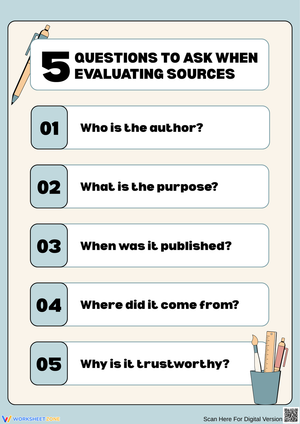
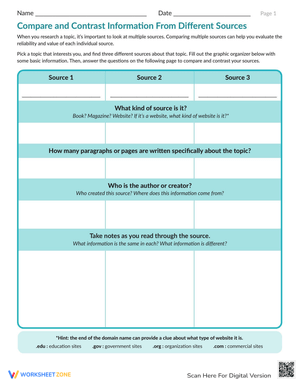
Each worksheet focuses on the same core questions applied across different source formats — article excerpts, website snapshots, blurbs, and comparison charts. The repetition is deliberate. Students at this level need to internalize the evaluation routine across multiple examples before it becomes automatic during independent research.
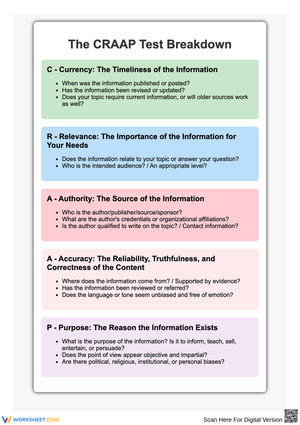
- Author and publisher identification — Students locate who created the source and consider whether that background is relevant to the topic at hand.
- Purpose — They distinguish between sources created to inform, persuade, sell, or entertain, and explain why that distinction affects trustworthiness.
- Evidence quality — Students mark whether claims are backed by data, citations, expert quotes, or examples — or whether they rely on unsupported assertion.
- Currency — They note publication and update dates and decide, for the specific topic, whether the age of the information matters.
- Bias signals — Students flag loaded language, selective framing, or persuasive pressure that undermines a source's objectivity.
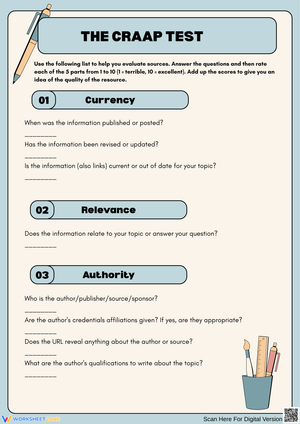
Short-answer questions appear throughout each worksheet so students put their reasoning in writing rather than just checking boxes. A response like "This source is stronger because it names a university researcher and references a published study" tells you far more about a student's actual understanding than any multiple-choice answer could.
Mistakes Students Make That These Worksheets Help You Catch
The most consistent error at grade 6 is treating visual polish as a credibility signal. Students will mark a sleek, professionally designed website as reliable and overlook a plain government or academic page because the layout looks unimpressive. Until they've practiced looking past design, surface appearance almost always wins over substance in their evaluations.
Domain endings are a close second. Many students arrive having heard that .org or .edu sites are trustworthy, and they apply that as an absolute rule without checking the author, the date, or whether the organization carries real expertise on the topic. A student-created .edu page or an advocacy group's .org site makes the counter-example concrete. One of the most productive classroom moments in a credibility lesson is watching a student realize that domain endings are a starting clue, not a verdict.
Bias is also consistently undercalled. Students tend to flag it only when language is openly hostile or extreme. A source that carefully selects supporting data while omitting contradictory evidence, or one that uses emotionally resonant phrasing without stating a position outright, gets marked "balanced" by most 6th graders on a first pass. Building in a few side-by-side comparisons where both sources look neutral but one is clearly more one-sided forces students to read more carefully at the sentence level — which is exactly where bias lives.
Building These Worksheets Into Your Research Unit
The cleanest entry point is whole-class modeling with a projected source. Take one website screenshot or article excerpt and walk through the evaluation questions publicly before students attempt one independently. That 10-minute model prevents the frozen-on-question-one effect that happens when students haven't seen what a full source evaluation actually looks like from start to finish.
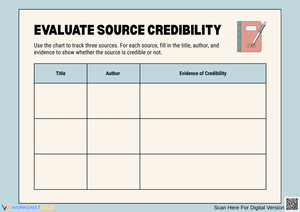
Mid-unit, partner work with a comparison chart shifts the dynamic productively. Give pairs two sources on the same topic and ask them to determine which one they'd cite in a research paper and why. The conversation that follows — "this one has an author, yours doesn't" or "mine was published last year and yours is from 2014" — shows students that source judgment is reasoned, not arbitrary. 6th grade assessing credibility of sources worksheets that include comparison tasks are worth front-loading in the unit; the shared vocabulary students build during pair work carries directly into independent practice and research writing.
For the last five minutes of a research block, individual exit tickets are efficient. A single question at the bottom of a worksheet — "Name one specific reason you would not cite this source in a paper" — takes three minutes to answer and gives you clear formative data on where individual students still need attention. Station rotations, where each station focuses on a different credibility problem — outdated information at one, biased language at another, missing author credentials at a third — work best once students are confident enough with the routine to self-direct through each task without needing repeated re-explanation.
Standard Alignment
These worksheets address CCSS W.6.8, which requires students to "gather relevant information from multiple print and digital sources; assess the credibility of each source." In practice, that standard gets the most direct classroom attention during research writing units, but the habits it demands overlap meaningfully with RI.6.6 — determining an author's point of view and explaining how it shapes content and style. Teachers who address source credibility and author perspective within the same instructional unit, rather than treating them as separate lessons weeks apart, tend to find both standards stick more firmly because students recognize the same close-reading habits applying across different tasks.
Adjusting the Set for Mixed Readiness in the Same Room
Students who need additional support benefit from reduced text load and sentence structures to start from. When a source excerpt runs four to six sentences rather than two dense paragraphs, the evaluation task stays manageable without the added weight of heavy decoding. Frames like This source may not be reliable because... or One sign that this source is trustworthy is... give students language to begin with before they have the confidence to generate it themselves. Pairing those frames with a pre-writing annotation step — underline or circle any credibility clues before answering questions — makes the evidence visible on the page before students have to write about it.
For students ready for more challenge, the most effective adjustment is source ambiguity. A well-written advocacy piece with strong evidence still carries bias. A peer-reviewed article from 2009 may be authoritative but outdated for a current-events topic. These edge cases — not sources that are obviously good or obviously bad — generate the kind of careful reasoning that shows real growth. Asking students to rank three sources from most to least credible and justify each placement in writing pushes source evaluation into genuine argument. 6th grade assessing credibility of sources worksheets work best for advanced students when the examples resist easy categorization and force a real decision rather than a quick sort.
Frequently Asked Questions
Can these worksheets be used before a research project, or are they better suited to mid-unit review?
Both timing choices work depending on your goal. Before a project, the worksheets build the vocabulary and evaluation habits students need before they encounter real sources. Mid-unit, they work as structured review that catches misconceptions before students embed errors into their notes or citation lists. Many teachers use a few worksheets as pre-instruction and return to others after students have started gathering sources for a writing assignment — using the second pass to address exactly what went wrong the first time around.
Do students need internet access to complete these worksheets?
No. Source examples appear as printed excerpts, blurbs, and website snapshots — not live URLs. That's a practical advantage in classrooms where device access is limited or where live browsing creates management problems. Students evaluate what's on the worksheet itself, which also keeps the lesson tightly focused on analysis rather than navigation.
What if my students have already been taught a credibility framework like CRAAP or SIFT?
Students who already know a credibility acronym will find the underlying questions familiar. The real value here is format variety and written justification practice — moving students past "I checked the boxes" into an explanation of their actual reasoning. Any 6th grade assessing credibility of sources worksheets worth regular use should ask students to articulate why, not just record a verdict on a checklist.
Are these worksheets appropriate for homework, or do they work better in class?
Short source reviews — one excerpt or source card with three to five evaluation questions — hold up well as homework assignments. Comparison tasks and ranking activities tend to be more productive in class, where you can hear students' reasoning and redirect misconceptions before they solidify. If a comparison worksheet goes home, build in a brief debrief the following morning rather than marking it and moving straight to the next lesson; that five-minute whole-class conversation often surfaces the same error patterns for several students at once.
Clear All