Greek and Latin Roots Practice That Fits the Grade 6 ELA Block
These greek and latin roots worksheets for 6th grade focus on high-utility roots — the ones that keep appearing in ELA, science, and social studies rather than living only inside one subject's vocabulary list. Each worksheet builds toward transfer: students move from recognizing a root in isolation to using that pattern to reason through an unfamiliar word in context. The set prints cleanly and is built to fit inside the parts of a school day where vocabulary practice actually lands — bell ringers, small-group reteach, and sub plans.
What Students Practice in Each Worksheet
The tasks in this set are specific and varied rather than repetitive. Students work through combinations of:
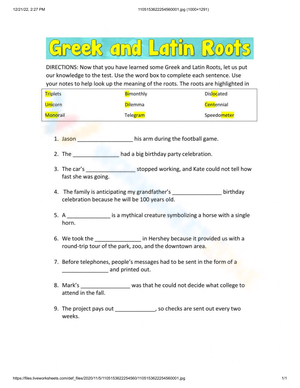
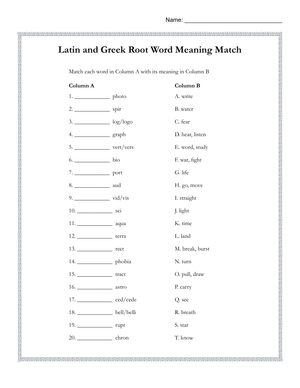
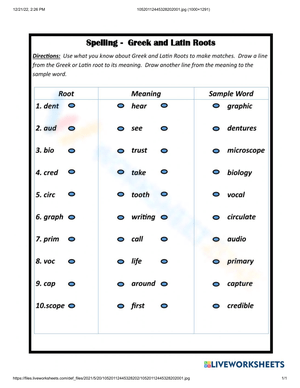
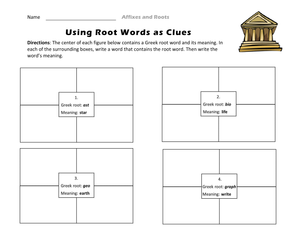
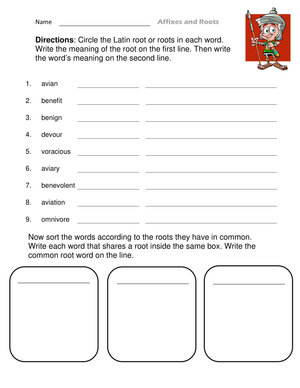
- Matching roots to their meanings alongside two or three example words
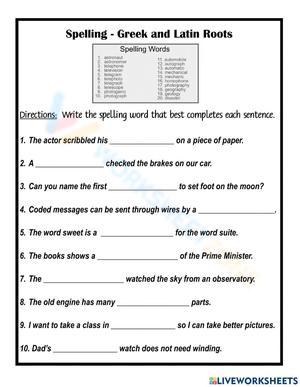
- Reading a sentence and using context to confirm what a root-based word means in that specific setting
- Sorting word families by shared root — grouping transport, portable, and export together to see the port pattern at work
- Building new words from a given root and a list of prefixes or suffixes
- Writing a brief explanation of how a root helped decode a term they had not seen before
That last task is the one that gives teachers the clearest signal. A student who writes "I knew spectator was someone who watches because spect means to look — same as in inspect" is demonstrating transfer. A student who just circles the answer is still in recognition mode, and that distinction matters for instructional decisions.
Root Study Beyond the ELA Block
One reason root practice earns regular rotation is that the payoff extends across subjects. In science, sixth graders encounter thermometer, biology, and photosynthesis. In social studies, they run into democracy, geography, and chronology. In literary discussions, they meet monologue, predict, and interrupt. Students who are trained to spot meaningful parts inside those words have a working strategy before they ask for help — or give up and skip the word entirely.
A productive classroom pattern is to teach six to eight roots over a two-week cycle, then revisit them the following week inside content-area vocabulary. Teachers who use the greek and latin roots worksheets for 6th grade in this set as a bridge between direct instruction and text-based application report stronger retention than when practice stays confined to one standalone vocabulary lesson. The key is that roots need to reappear — in reading responses, in notebook entries, in the brief written explanation at the bottom of a worksheet — rather than showing up once and disappearing.
Where Students Get Stuck and What the Worksheets Reveal
The most instructive error is not a wrong answer on a matching task. It is the gap between knowing a root definition and using the word correctly. Students who have just learned that dict means "to say or speak" will sort dictate, diction, and predict together with confidence. The trouble surfaces with contradict. They can identify the root, and they can define the word as "to speak against." But when they encounter "her actions contradicted her words" inside a paragraph, they still hesitate — because root-level knowledge has not yet connected to real-world usage. Worksheets that include sentence-level tasks make that gap visible early, before students carry it into a reading assessment.
A second pattern worth anticipating: overapplication. A student who has internalized that port means "carry" will sometimes mark portal as "something carried" rather than recognizing it as a related but semantically distinct Latin term. That is not a reason to avoid root study — it is a prompt for a two-minute class discussion about how roots shift across centuries and contexts. The error is more instructionally useful than a guessed correct answer.
Working These Worksheets Into Your Weekly Routine
In most grade 6 classrooms, five to eight minutes at the start of class is the right window for root practice. One row of matching followed by one sentence-analysis item keeps the task focused and leaves enough time for the rest of the block. Students who finish early can move to the word-building item rather than waiting. That routine is repeatable across a unit without becoming mechanical.
Small groups are another strong context. When a reading group is struggling with a content-area term — parsing geothermal before a science reading or chronological before a social studies passage — a short worksheet gives students a structured entry point before they return to the text. The oral step that deepens this: have students underline the root, say its meaning aloud, then explain how that meaning applies to the whole word. That thirty-second exchange produces more durable learning than the written task alone and gives teachers a quick formative check without collecting anything.
PDF format earns its place in sub plans. A worksheet that includes the root, a definition, two example words, and three application sentences gives a substitute teacher enough structure to run the task without a mini-lesson. Having five or six worksheets printed and ready in a folder is one of the more practical things a teacher can do at the start of a roots unit.
Standard Alignment
CCSS.ELA-LITERACY.L.6.4b asks students to use common Greek and Latin affixes and roots as clues to the meaning of a word. That standard sits inside the Language strand's vocabulary-acquisition expectations at grade 6, where word-analysis strategies are meant to serve reading comprehension across subjects — not live only inside a standalone vocabulary block. Teachers who use these worksheets in the minutes before a content-area reading are applying the standard exactly as intended: as a transferable strategy, not an isolated skill.
Adapting Root Practice Across Ability Levels
For students who are still building basic decoding habits, shorter worksheets with fewer roots and more worked examples keep the task accessible. A student who sees rupt = break, followed by erupt, interrupt, and rupture as models before encountering any questions has a better shot at reasoning through an unfamiliar item than a student dropped into a blank-and-match format cold. Reducing the number of roots on a given worksheet from eight to four — while keeping the same task types — is usually enough to make the practice productive rather than frustrating.
On-level sixth graders do well with mixed practice. A worksheet that combines recognition, sentence-level context, and a short written explanation gives teachers better evidence of understanding than any single task format. For students ready to go further, open-ended prompts work well: ask them to locate a root from the day's lesson inside a paragraph from their current science or social studies text, copy the sentence, and explain the connection. That two-sentence extension does not require a separate worksheet — it can sit at the bottom of any existing one as an enrichment add-on.
Frequently Asked Questions
What makes a root worth teaching at the 6th grade level?
Roots earn instructional time based on how often they reappear in academic vocabulary. Roots like struct (build), spect (look), dict (say), port (carry), and graph (write) show up enough times across subject-area reading in a single school year that students have multiple chances to see the pattern reinforced. A root that appears in only one or two common words is harder to justify spending class time on when the period is already short.
How do these worksheets fit into a vocabulary routine that already uses word walls or vocabulary notebooks?
They work alongside those tools without replacing them. A word wall might display geography and geothermal after a science unit. A worksheet that asks students to find the geo root and explain its meaning connects that word-wall entry to a transferable word-analysis strategy. The worksheet handles the application work; the word wall or notebook handles the visual and reference anchoring.
Can these be used as a formative check rather than just practice?
Yes, and that is one of their stronger uses. The sentence-analysis and written-explanation tasks in the greek and latin roots worksheets for 6th grade give teachers written evidence of reasoning, not just right-or-wrong answers. A student who explains "I know geography has to do with the earth because geo is in geothermal too" has shown you something a multiple-choice item would not catch. That kind of documentation matters in small-group and intervention settings where teachers need to track progress over time.
When in a unit is the best time to assign root worksheets?
One day after direct instruction, not the same day. Students who practice a root immediately after first hearing it tend to rely on short-term recall rather than building a durable connection. Waiting until the following class — even just overnight — adds enough spacing that the practice becomes retrieval rather than repetition. Spaced retrieval is one of the more reliably effective memory strategies in classroom vocabulary work, and it costs nothing to implement with a printable worksheet. Teachers who use the greek and latin roots worksheets for 6th grade as a review check two or three days into a roots cycle generally see stronger assessment results than those who assign practice immediately after the introductory lesson.
Clear All