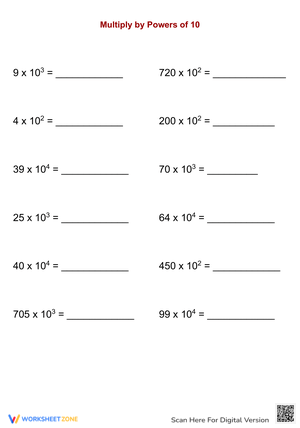
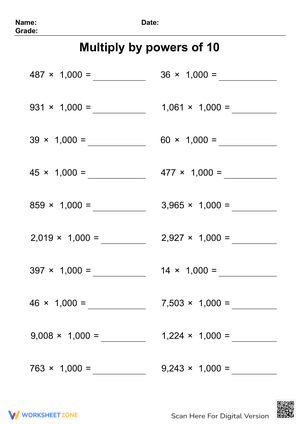
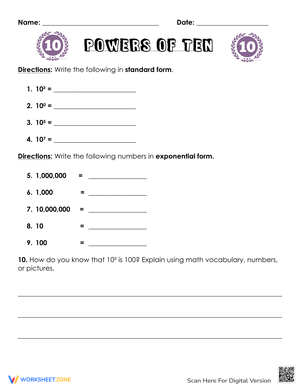
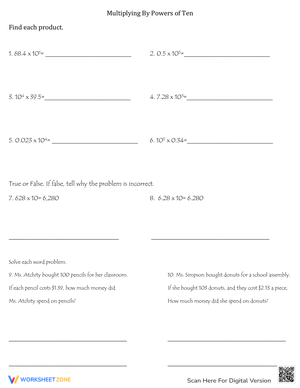
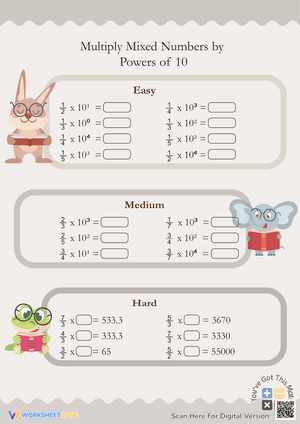
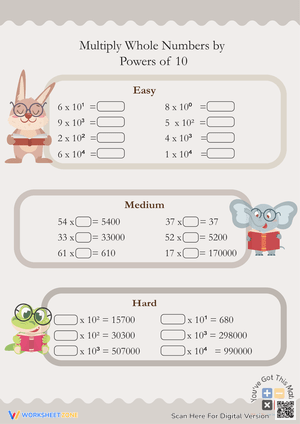
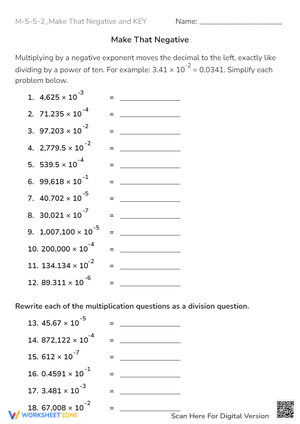
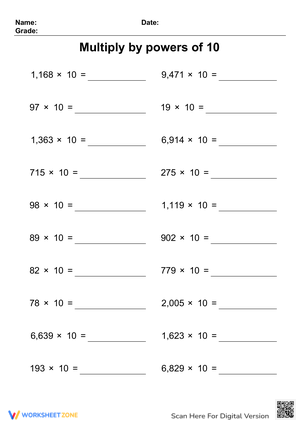
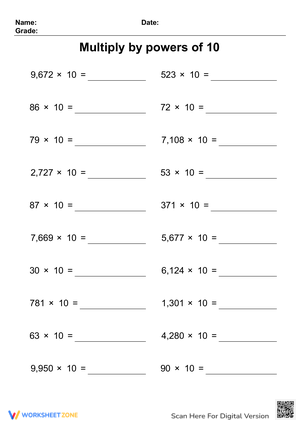
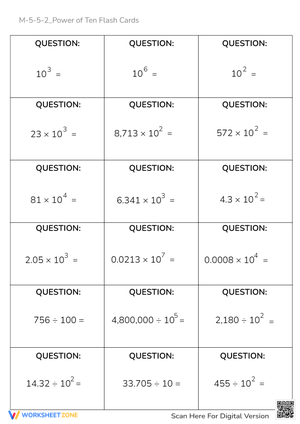
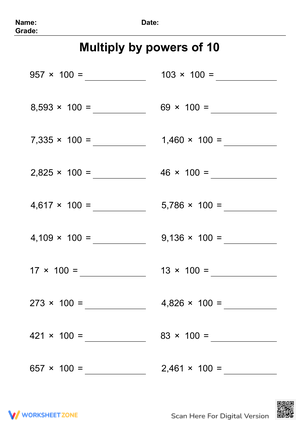
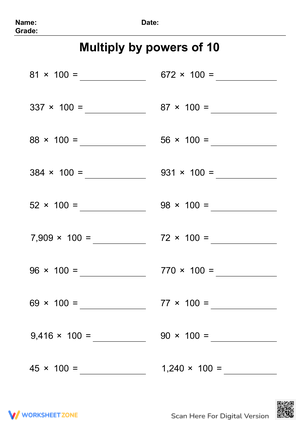
These 5th grade multiplying by powers of 10 worksheets give teachers a focused set of practice resources for a skill that catches many students off guard — the moment whole-number multiplication extends to decimals and the comfortable "add a zero" shortcut stops working. Each worksheet targets a specific layer of the concept, from whole-number products to decimal factors to exponent notation, so students build real understanding rather than a procedural trick they'll eventually need to unlearn.
What the Set Covers
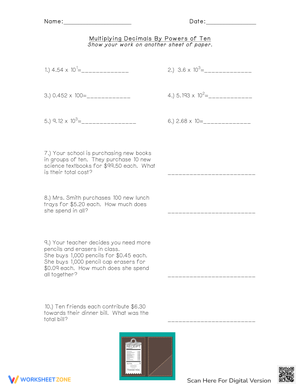
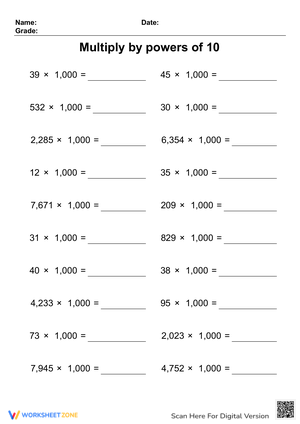
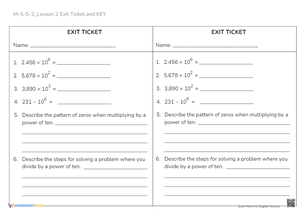
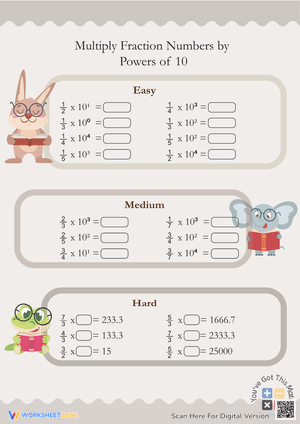
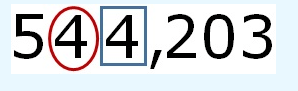
The resources move through three layers of the skill. The first group of worksheets works with whole numbers only: multiplying 34, 340, and 3,400 each by 10, 100, and 1,000 lets students see that the digit shift is consistent regardless of how many digits the original number carries. Students annotate their work, labeling which place value each digit moves into after the multiplication. The second layer introduces decimal factors — 0.6, 0.04, 4.72 — and asks students to name the resulting place value changes. The third layer adds exponent notation, connecting 10^3 to 1,000 and asking students to translate between representations before computing. Because 5th grade is genuinely the first time most students encounter exponents, the set gives the notation room to settle before mixing it into more demanding computation problems.
Across the set, students complete four types of tasks:
- Computing products and identifying which place value position each digit shifts into
- Translating between standard form, word form, and exponent form (1,000 / one thousand / 10^3)
- Multiplying decimal numbers by 10, 100, and 1,000 and writing the resulting place value positions
- Completing partially worked problems where the starting digit positions are labeled and students identify the missing product
Mistakes Students Make That These Worksheets Help You Catch
The single most predictable error is the "add a zero" misconception. Students who correctly compute 7 × 10 = 70 often believe the rule is about appending a zero digit rather than shifting digits to higher place values. The problem surfaces immediately with decimals: a student who multiplies 0.7 × 10 by "adding a zero" writes 0.70, which equals 0.7 — the computation produces no change, and some students accept that result without noticing anything is wrong. Each worksheet in the decimal section mixes whole-number and decimal problems on purpose, forcing students to confront this gap rather than waiting until a unit assessment to discover it.
A second pattern worth watching: students who shift digits correctly for whole numbers will sometimes reverse direction with decimals, moving digits right rather than left on the place value chart — essentially performing division. This shows up when a student solves 0.05 × 100 and writes 0.0005. The most effective correction is returning to an annotated place value chart and tracing where the digit 5 actually lives before and after the multiplication, rather than re-explaining the rule in the abstract.
Standard Alignment
The set addresses CCSS.MATH.CONTENT.5.NBT.A.2, which requires students to explain patterns in the number of zeros of the product when multiplying by powers of 10, explain the placement of the decimal point when multiplying a decimal by a power of 10, and use whole-number exponents to denote powers of 10. Fifth grade is the entry point for this standard — it does not appear in earlier grade-level expectations. It sits in the Number and Operations in Base Ten domain because it extends place value understanding into a new representational context rather than introducing a separate operation. The 5th grade multiplying by powers of 10 worksheets address all three components of 5.NBT.A.2, including the written explanation tasks the standard explicitly names alongside the computation itself.
How to Build These Worksheets Into Your Lesson Plans
Many teachers use one worksheet as a whole-group launch during direct instruction — projecting the problems and working through the first two or three together before releasing students to finish independently. The annotated place value sections are especially useful here because they give you a visible record of each student's reasoning that you can scan quickly at the end of class. A second common fit is the warm-up slot at the start of math: one worksheet, students work silently for eight minutes, then you review two or three problems together before moving into the lesson. That routine holds up well for the three or four days immediately after the initial whole-group introduction, when students need written practice alongside classroom discussion to stabilize the concept.
Because the 5th grade multiplying by powers of 10 worksheets are print-ready PDFs, they also work well in digital classrooms — uploaded as a fillable assignment or sent home for additional practice after a lesson. Teachers running math rotations often assign one worksheet to the independent station so students get written practice while the teacher works with a small group at a different table.
Adjusting for Students at Different Points in Their Understanding
Students who are still uncertain about the hundredths and thousandths positions benefit from pairing the decimal worksheets with a physical place value chart they can write on and erase. For these students, limiting each session to the whole-number rows of a mixed worksheet before progressing to decimal rows gives them a working pattern to reference when the harder problems arrive. The whole-number section is not too simple to bother with — the pattern recognition built there is exactly what transfers to the decimal work, and skipping it tends to leave struggling students without an anchor for the new material.
For students who move through the computation quickly and accurately, the written-explanation prompts in the set provide real challenge. Producing a mathematically sound sentence about why 0.04 × 100 = 4 is meaningfully harder than getting the correct answer, and it reveals whether a student actually understands the underlying concept or is pattern-matching. These students can also extend the pattern beyond 10^3 — predicting what 0.04 × 10^5 would equal and then verifying — without needing additional materials.
Frequently Asked Questions
Does the set include division by powers of 10?
No — the worksheets focus on multiplication. Division by powers of 10 involves shifting digits in the opposite direction, and mixing both operations in the same set tends to increase confusion about which way the digits move. Once students are secure with multiplication, division fits naturally as a follow-up unit.
Will these worksheets work for 6th grade remediation?
The 5th grade multiplying by powers of 10 worksheets align to 5th grade standards, but the content transfers cleanly to remediation at higher grade levels — particularly before units on scientific notation or metric conversions. Sixth and seventh graders who struggled with this concept in 5th grade find the structured task format useful for catching up without being talked down to.
How long does each worksheet typically take?
Most students finish one worksheet in 10 to 15 minutes, depending on whether it includes written explanation rows. The explanation prompts add time but are worth including — they surface conceptual gaps that pure computation rows miss. If you are using a worksheet as a brief warm-up, choose one that focuses on computation and save the explanation tasks for a slower lesson block where you have time to discuss student responses.
How do I know when students are ready to move from whole numbers to decimals?
A reliable indicator is accuracy plus explanation. If a student can correctly compute five whole-number products and explain in one sentence why the digits moved, that student is ready for the decimal section. A student who computes correctly but explains by saying "you just add zeros" is not ready — the explanation reveals that the conceptual understanding needed for decimal work is not yet in place, even if the answers look right.














 Interactive Worksheet Maker
 Quiz Maker
 Word Search Maker
 Crossword Puzzle Maker
 Word Scramble Generator
 Sentence Scramble Generator
 Handwriting Worksheet Generator
 Name Tracing Generator
 Fill In The Blank Generator




 BACK TOSCHOOL