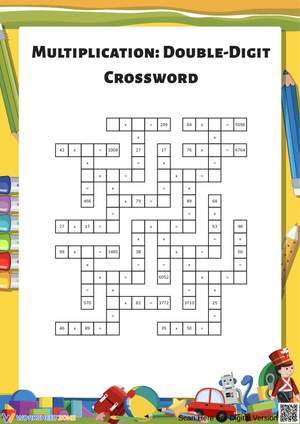
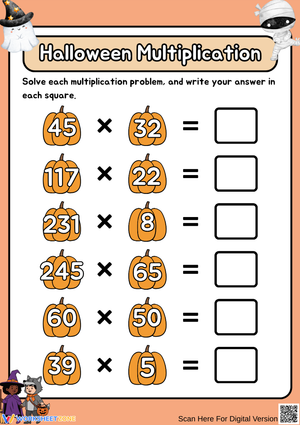
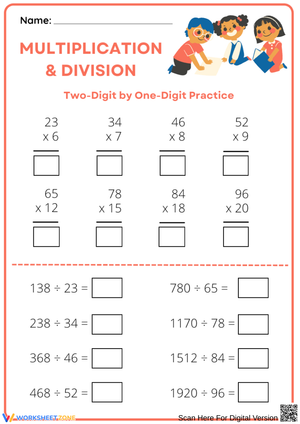
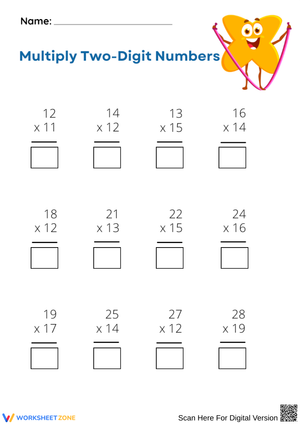
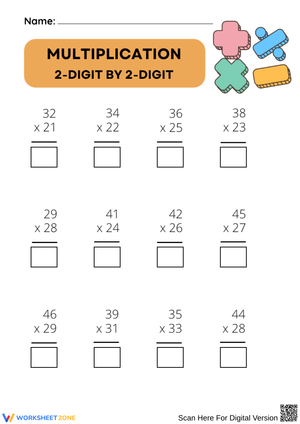
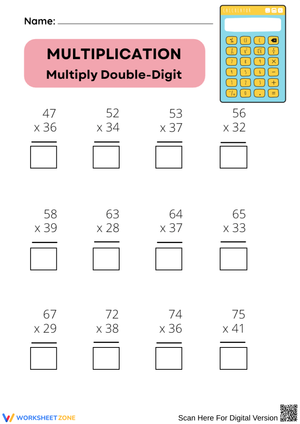
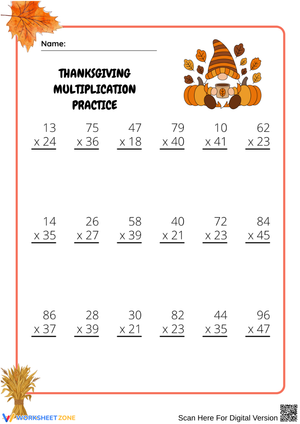
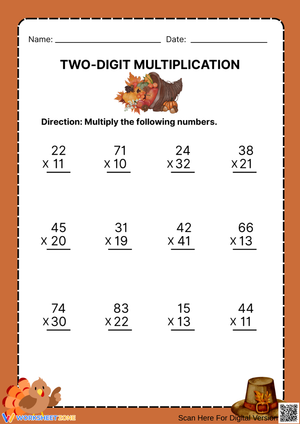
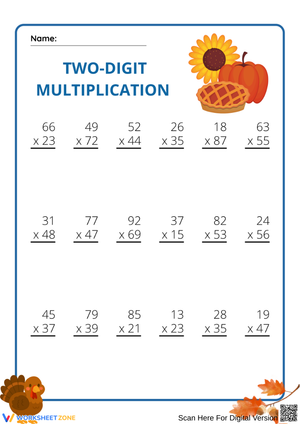
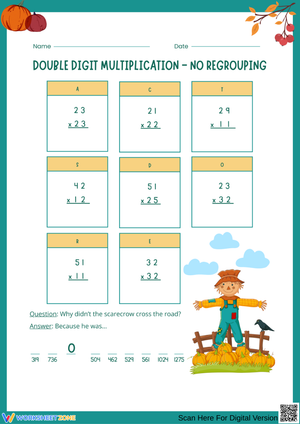
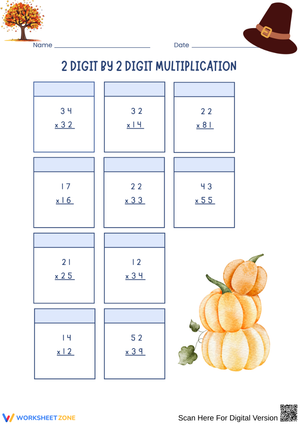
These 5th grade 2 digit 2 by 2 printable worksheets give teachers a focused, immediately usable practice set for one of the most demanding computation skills in the grade 5 math progression. Each worksheet targets the move from place-value reasoning to written computation — the stretch most fifth graders are navigating when they meet factors like 34 × 27 for the first time. Teachers get something they can sort by lesson goal, copy for centers, and pull again mid-unit without rebuilding anything from scratch.
The Specific Skills These Worksheets Target
Each worksheet in the set addresses 2-digit by 2-digit multiplication at a different stage of student readiness. Early worksheets use area models and partial products — formats that make the tens and ones decomposition visible before students commit to vertical computation. Later worksheets move toward the standard algorithm with carefully chosen factor pairs designed to test regrouping inside the partial products, not just in the final addition step.
- Decomposing two-digit factors into tens and ones to build partial products by hand
- Connecting the sections of an area model to the corresponding lines in the standard algorithm
- Regrouping accurately across both partial products before combining them
- Estimating products by rounding both factors to verify whether a computed answer is reasonable
- Applying the standard algorithm inside word problem contexts where students must first identify the correct operation
The progression matters because fluency at this level is not just about speed. A student who can explain why the second partial product in 36 × 48 begins one place to the left has a far stronger foundation for 3-digit by 2-digit work than a student who memorized the steps without understanding the place value logic behind each move.
Common Student Errors Worth Watching For and Correcting
The most frequent mistake at this stage is not a multiplication fact error — it is a place value alignment problem. Students multiply the tens digit of the bottom factor correctly but record that partial product starting in the ones column instead of shifting one place left. The answer looks close, and students rarely self-catch it because the arithmetic felt correct as they worked. Spotting that misalignment in the first two or three problems of a worksheet tells a teacher more than any final score does.
A second pattern surfaces with factors like 24 × 60. Students who handle 24 × 16 accurately will often stall on 24 × 60 because they do not recognize that multiplying by 60 follows the same structure as multiplying by 6 — just with a place value shift built in. They treat the zero as something to "do something with" rather than a signal that the product already moves left by one position. These worksheets surface that confusion before it compounds into larger multi-digit work.
Regrouping errors also appear in a specific spot: the final addition step where the two partial products are combined. Students who managed the multiplication correctly sometimes rush the addition and carry incorrectly, producing an answer that is off by exactly 10 or 100. That tells teachers the algorithm is partially internalized but the student is losing track of the full problem under cognitive load — a different instructional problem than a fact gap, and worth addressing separately.
How to Build These Worksheets Into Your Lesson Plans
The same worksheet does not have to serve the same purpose every time it appears in a unit. Early on, one worksheet works as guided practice right after a whole-class area model lesson — students complete it alongside the teacher's worked example on the board. By mid-unit, the same format works as independent seatwork while the teacher pulls a small group to the back table. Near the end of a unit, a mixed-format worksheet functions as a spiral review item that helps students consolidate the algorithm before moving to larger factors.
Short sessions work particularly well for this skill. Five problems at the start of the math block — while students are settling in and the teacher is finishing attendance — establish a daily repetition rhythm without eating into direct instruction time. These 5th grade 2 digit 2 by 2 printable worksheets are formatted to support exactly that kind of use: no extra materials, no setup, no prolonged explanation once students know the format. Teachers who use them as bell ringers report spending those first minutes watching student work rather than fielding procedural questions.
For substitute plans or intervention binders, a small stack sorted from concept-based to algorithm-focused gives a non-specialist something structured to distribute without guessing which problems suit which students. The format stays stable; the difficulty does the differentiating.
Standard Alignment
These worksheets address Common Core State Standards for Mathematics standard 5.NBT.B.5, which expects students to fluently multiply multi-digit whole numbers using the standard algorithm. In classroom terms, this standard is typically taught in the fall or early winter of grade 5, after students have consolidated place value understanding from the 4.NBT cluster and before the curriculum extends to multi-digit division. A 2-digit by 2-digit problem set is the most practical on-ramp to that standard — complex enough to require genuine algorithm management but contained enough for a student to complete a full problem without losing track of the structure.
Teachers in states that have adopted modified standards rather than Common Core directly will find the content still aligns, because multi-digit multiplication with the standard algorithm is a near-universal grade 5 expectation across state frameworks. Most curriculum maps use the two-digit by two-digit benchmark specifically to assess whether students are ready to move toward larger factor sizes.
Differentiating These Worksheets Across Student Readiness Levels
For students still working through place value concepts, the area model worksheets in this set provide a structured entry point that does not require full algorithmic control. Teachers can highlight the tens-row and ones-row of the area model in two different colors before handing the worksheet to a student who is struggling — that visual separation does work that verbal explanation alone often cannot accomplish. No additional materials are required to make that adjustment.
Students who have already reached fluency with the standard algorithm benefit most from the word problem and estimation worksheets, which ask them to decide when multiplication applies, check their answers using rounded factors, and explain any discrepancy if their estimate and computed answer differ significantly. That keeps the work genuinely demanding without jumping to a new standard before consolidation is complete.
For English language learners, the computation-only worksheets remove the language barrier entirely, letting students demonstrate procedural understanding without the added load of parsing written problem contexts. Once those students show accuracy on the algorithm worksheets, the word problem sets can be introduced with teacher-added vocabulary support rather than swapping in a different resource altogether.
Frequently Asked Questions
Are these worksheets aligned to a specific grade 5 standard?
Yes. The set addresses 5.NBT.B.5, the Common Core expectation for fluent multi-digit multiplication using the standard algorithm. Two-digit by two-digit problems are the standard entry point for that standard in most grade 5 curriculum maps, and the worksheets are sequenced to move students from conceptual understanding through procedural fluency within that specific target.
Do the worksheets include answer keys?
Answer keys are included with the set. That matters most during center rotations, homework checks, and substitute-led sessions. Teachers who use these for quick formative checks find that having the key ready lets them sort papers by error type — place value misalignment versus fact error versus regrouping mistake — rather than just marking problems incorrect and moving on without identifying what actually went wrong.
Can these be used for students working below grade level?
Students still building multiplication fact fluency or working on single-digit by two-digit problems may find the full two-by-two format overwhelming at first. The concept-based worksheets in this set — particularly the area model and partial products formats — give those students a supported entry point that does not require full algorithmic control. That makes these 5th grade 2 digit 2 by 2 printable worksheets a workable fit for intervention groups, not just on-grade instruction.
How many worksheets are included in the set?
The set includes multiple worksheets organized by format and difficulty, spanning area model practice, partial products, standard algorithm fluency, and word problem application. Teachers can assign them in sequence across a unit or pull individual worksheets to match a specific lesson objective without committing to the full sequence.
Are these appropriate for homework?
The algorithm-focused and mixed-practice worksheets work well as homework once students can move through the standard algorithm independently. Word problem worksheets are better kept for class, where the teacher can help students identify which operation applies and address vocabulary questions in the moment. Sending home a worksheet before a student has procedural control tends to produce rushed, error-filled work that reinforces mistakes rather than building accuracy. These 5th grade 2 digit 2 by 2 printable worksheets are most effective as homework assignments in the middle and later phases of the unit, after students have demonstrated they can work through the algorithm without guided support.














 Interactive Worksheet Maker
 Quiz Maker
 Word Search Maker
 Crossword Puzzle Maker
 Word Scramble Generator
 Sentence Scramble Generator
 Handwriting Worksheet Generator
 Name Tracing Generator
 Fill In The Blank Generator




 BACK TOSCHOOL