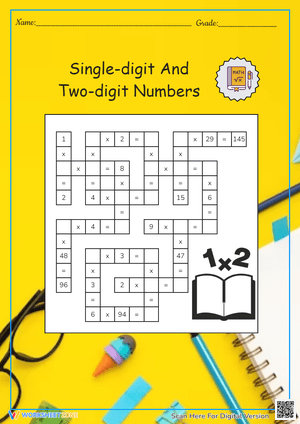
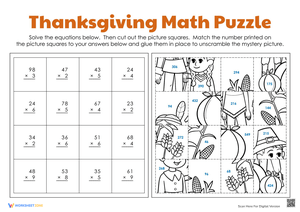
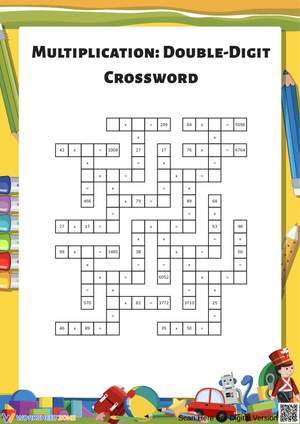
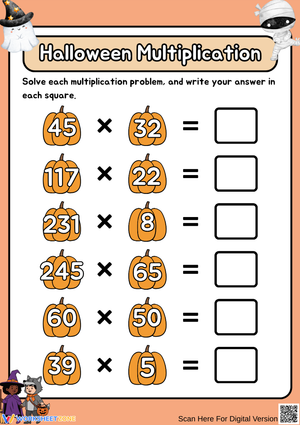
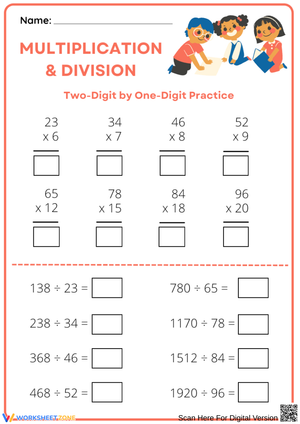
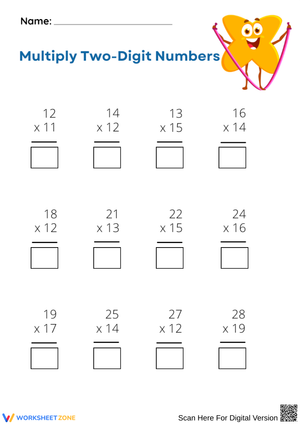
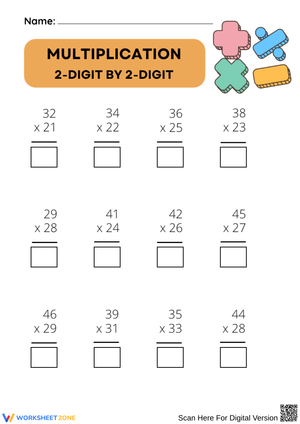
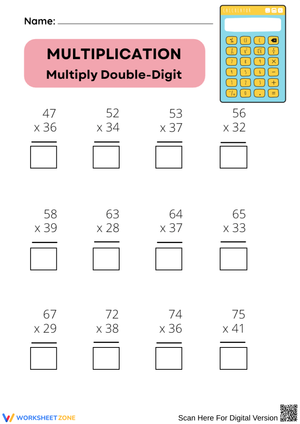
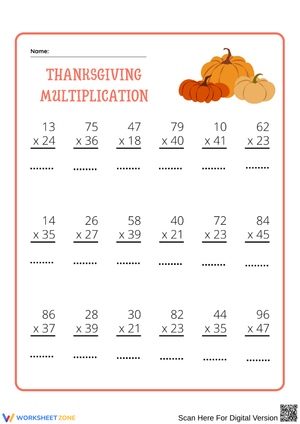
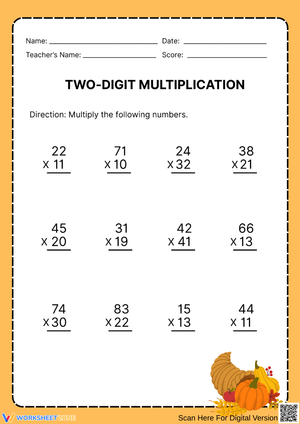
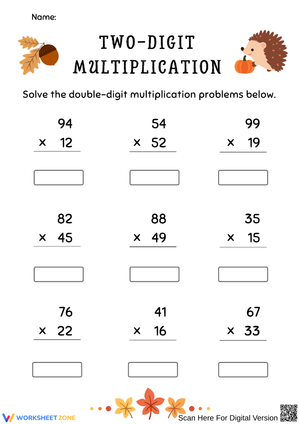
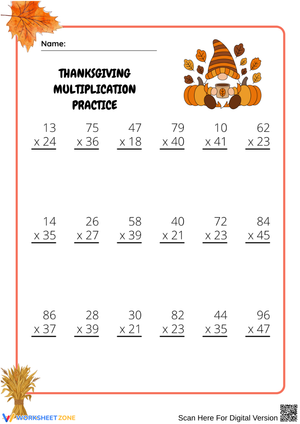
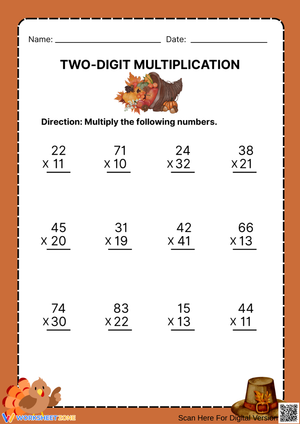
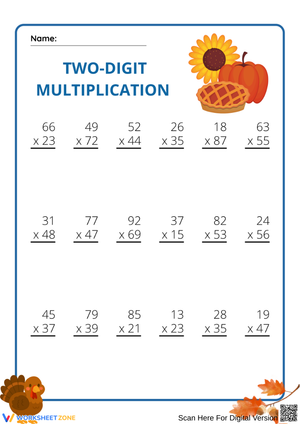
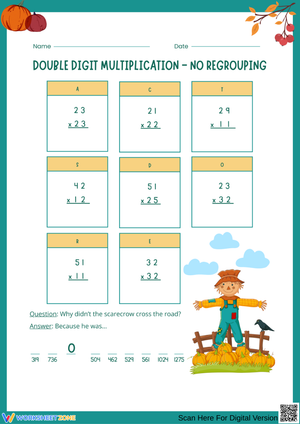
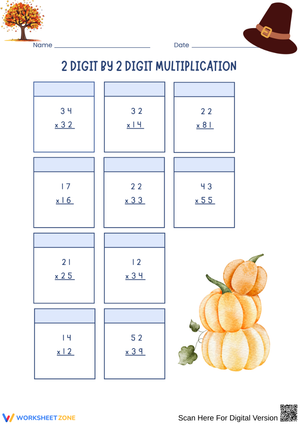
These 5th grade 2 digit multiplication pdf worksheets give teachers a focused set of printables that move students from partial-product reasoning toward standard-algorithm fluency — without requiring device access or any special setup. The set fits easily into core lessons, small-group reteach blocks, centers, or homework, and it covers the computational foundation students need before they extend to longer factors.
The Specific Skills Each Worksheet Targets
The resources are organized around the full arc of 2-digit by 2-digit multiplication. Early worksheets build estimation habits — students round both factors to the nearest ten and predict a reasonable product before solving. That step matters because it gives teachers a window into whether a student understands the size of the product, not just the procedure for reaching it.
From there, the set moves through area-model work, where students decompose both factors into tens and ones and calculate four partial products. Later worksheets shift to the standard algorithm, asking students to set up, compute, and check two-row problems with correct place-value alignment. A small number of items on each worksheet ask students to compare their algorithm answer to their estimate and flag the result as reasonable or not — a built-in self-checking habit that catches careless errors before they get practiced repeatedly.
- Estimation: Rounding both factors and recording a ballpark product before solving
- Area models: Decomposing factors into tens and ones, completing four partial products, then summing
- Partial products method: Writing all expanded products before combining into a final answer
- Standard algorithm: Two-row computation with digit alignment and the correct place-value shift in the second row
- Reasonableness checking: Comparing computed answers to estimates and identifying results that don't make sense
Common Student Errors Teachers Should Anticipate and Address
The single most reliable error in 2-digit by 2-digit multiplication is the missing place-value shift in the standard algorithm's second row. When students multiply 34 × 27, they correctly compute 34 × 7 = 238. On the next row, many write 68 starting in the ones column — treating the 2 in 27 as a standalone 2 rather than as 20. The final sum is off by a full factor of ten, and students often miss it because 68 looks plausible in isolation. Without an estimate to compare against, there's nothing to trigger a second look.
A separate pattern appears with area models: students set up all four boxes correctly — 30 × 20, 30 × 7, 4 × 20, 4 × 7 — but drop the smallest partial product (4 × 7 = 28) when they add. Because the error is small relative to the total product, it's easy to miss unless teachers specifically ask students to show each addend in their work.
There's also a fluency issue that surfaces mid-procedure. Students who are shaky on facts like 7 × 8 or 6 × 9 slow down significantly while computing partial products, lose their place in the algorithm, and then make alignment errors unrelated to place-value understanding. When these worksheets reveal that pattern consistently, the better response is to address fact fluency directly rather than drill the 2-digit procedure again — the problem is upstream of the strategy.
Fitting These Worksheets Into Your Week
For core instruction, the most effective sequence is to model two problems publicly — one with partial products, one with the standard algorithm — and then assign a single worksheet for guided practice while students are still in their seats. That keeps the transition tight and lets teachers circulate and catch setup errors before students practice them ten times over. Eight to ten items is enough for that block without pushing into discussion time.
Centers work best with shorter worksheets — four to six items — where students can finish independently, check against a posted answer key, and then rework any missed problem using a different method. The rework step is easy to enforce with a printed worksheet because students can write the second attempt alongside the first. That side-by-side comparison is often where the conceptual understanding actually clicks.
For exit tickets, five problems near the end of a lesson tell a teacher almost everything needed to plan the next day. Two estimation items, two standard-algorithm items, and one error-analysis question — where students identify what went wrong in someone else's work — cover concept, procedure, and analysis in under ten minutes. These 5th grade 2 digit multiplication pdf worksheets also hold up well in sub plans: the format doesn't require explanation beyond what's on the worksheet itself, and the substitute can collect them at the end of class so the classroom teacher has real student work to review.
Standard Alignment
Common Core State Standards for Mathematics: 5.NBT.B.5 requires Grade 5 students to fluently multiply multi-digit whole numbers using the standard algorithm. Two-digit by two-digit practice is the most direct entry point for that standard — complex enough to require real strategy, constrained enough to make errors visible and correctable. Teachers who want students fluent with 3-digit and 4-digit multiplication by year's end typically build that fluency by anchoring it here first, then extending factor lengths once the place-value logic is stable. The standard doesn't require students to use only the algorithm; it requires fluency with it. That's why a set that also includes area models and partial products isn't off-standard — it's the instructional path that makes algorithm fluency durable rather than fragile.
Adjusting the Set for a Range of Learners
Students who are still uncertain about place value need a different entry point, not faster repetition of the same worksheet. Assign those students resources that keep the area-model structure explicit — labeled rows for tens and ones, clearly bounded boxes for each partial product, and factor pairs chosen for cleaner arithmetic (21 × 13 rather than 37 × 48). That level of visible structure reduces the demand on working memory and lets students focus on the multiplication itself. Once students can work through the area model reliably, moving them to partial products is a small step rather than a large one.
On-level students benefit from a mix: straightforward computation, an estimation prompt, and one error-analysis item per worksheet. That combination builds both speed and critical thinking without requiring a separate assignment or separate directions.
For students ready to push further, ask them to solve the same problem three ways — area model, partial products, and standard algorithm — and write one sentence explaining which method they'd choose for a harder problem. These 5th grade 2 digit multiplication pdf worksheets support that kind of open-ended reasoning when the set includes varied item types rather than computation drill alone.
One practical note: differentiation doesn't always mean different worksheets. Assigning the same worksheet to the whole class but directing one group to use area models and another to use the standard algorithm — then comparing both approaches in a brief debrief — is often more instructionally powerful than silently sorting students onto separate tasks. The shared content gives every student something to talk about.
Frequently Asked Questions
What prerequisite skills should students have before starting?
Solid one-digit fact fluency is the most critical. Students who stop mid-problem to work out 8 × 6 lose their place in the algorithm and start making alignment errors that look like place-value confusion but aren't. Beyond facts, students need to understand tens and ones inside two-digit numbers and be able to round both factors to produce a reasonable estimate. When those three conditions are met, the worksheets reveal strategy gaps rather than foundational skill gaps — and that's where instruction can actually move.
Do these worksheets cover area models, or only the standard algorithm?
A strong set addresses both, plus partial products. Most Grade 5 classrooms include students at different points in the strategy sequence, and having worksheets that span area models through the standard algorithm means teachers don't need separate resources for reteach groups and on-level groups. The area-model worksheets aren't remedial — they deepen the place-value reasoning that makes the standard algorithm make sense rather than feel like a memorized trick.
How many problems per worksheet is appropriate?
It depends on the setting. Eight to ten problems works for guided practice during a lesson — enough repetition to reveal a pattern, not so many that the period ends before the teacher can debrief. For centers or independent work, four to six items with room to show full work is more useful; students can actually finish and think about what they did. Worksheets with 30 or 40 computation items measure stamina more than understanding, and they rarely generate the kind of student work that informs next-day instruction.
Are these useful for standardized test preparation?
Indirectly, yes. Grade 5 assessments include multi-digit multiplication, and 5th grade 2 digit multiplication pdf worksheets build the computational fluency and estimation habits those assessments require. They work best as formative tools used consistently during instruction — not as test-prep drills pulled out the week before an exam. Teachers who use them throughout the learning sequence typically see stronger results than those who rely on them only at the end of a unit.














 Interactive Worksheet Maker
 Quiz Maker
 Word Search Maker
 Crossword Puzzle Maker
 Word Scramble Generator
 Sentence Scramble Generator
 Handwriting Worksheet Generator
 Name Tracing Generator
 Fill In The Blank Generator




 BACK TOSCHOOL