These topic sentence worksheets for 5th grade give teachers a set of ready-to-print exercises aimed at one of the most persistent writing challenges at this level: getting students to write an opening sentence that actually controls a paragraph instead of just floating at the top of it. Each worksheet targets a specific skill in isolation, which matters because students who struggle to identify a topic sentence in someone else's writing usually struggle differently than students who can identify one but cannot write their own.
The Specific Skills Targeted
The set moves through five skill areas, each handled by a separate worksheet so teachers can assign exactly what a given group needs.
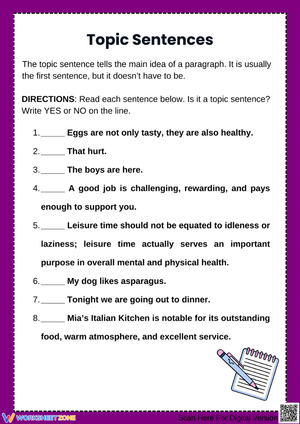
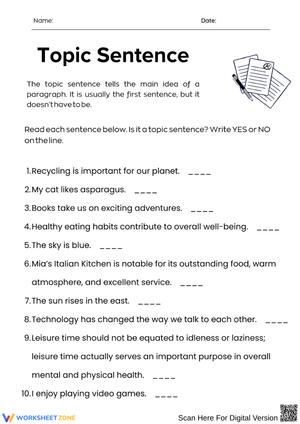
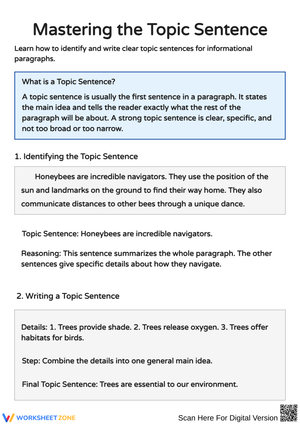
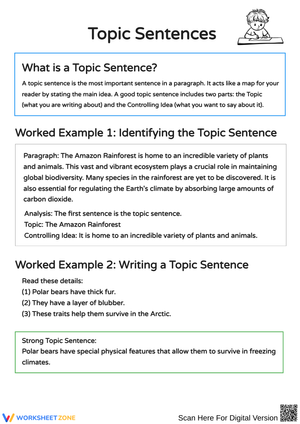
- Identifying topic sentences in mentor paragraphs: Students read a short paragraph and underline the sentence that establishes the controlling idea — not the most interesting sentence, not the first sentence by default, but the one that tells a reader what the entire paragraph will be about.
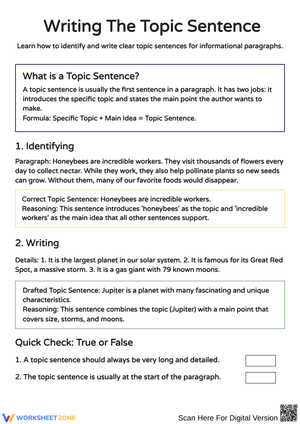
- Matching supporting details to topic sentences: Students receive a list of detail sentences and select the topic sentence from a set of choices that best governs all of them. This builds analytical reading alongside writing awareness.
- Revising weak topic sentences: Students rewrite sentences that are either too broad ("Animals are interesting") or too narrow ("Dogs can run fast") into focused, workable opening sentences.
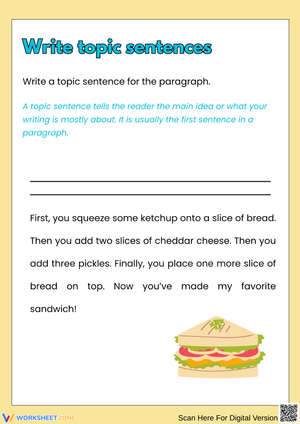
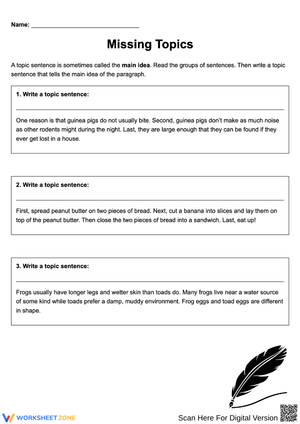
- Writing original topic sentences from a prompt: Students receive a picture, a list of facts, or a writing prompt and generate their own controlling sentence before drafting the rest of a paragraph.
- Genre-specific practice: Separate exercises show students that an informative topic sentence introduces a subject to be explained, while an opinion topic sentence stakes a position to be defended — and that those two jobs require different sentence structures.
Common Misconceptions to Watch For and Correct
The two errors that appear most reliably in 5th grade are sentences that sweep too broadly and sentences that state a single fact instead of a controlling idea. Those are related but not the same problem. Too-broad sentences — "There are many things to know about the rainforest" — give a writer nowhere to go because the paragraph could go anywhere. Fact-only sentences — "The Amazon rainforest covers 2.7 million square miles" — give a writer nowhere to go because the sentence is already complete; there's nothing left to argue, explain, or develop.
A subtler error shows up during revision work: students confuse improving a sentence's vocabulary with fixing its logic. A student might change "Dogs make good pets" to "Dogs make excellent and loyal pets." That's stronger wording, but the sentence still fails as a topic sentence because neither "good" nor "excellent and loyal" signals what specific aspect of dog ownership the paragraph will cover. What actually works is something closer to "Dogs are easier to train than most people expect" — a sentence that commits the paragraph to a particular claim worth supporting with evidence. Watching for this distinction during independent practice is where these worksheets earn their place in a lesson sequence.
Lesson-Planning Ideas to Get the Most From These Worksheets
The most effective sequence puts the identification worksheet first — before any writing instruction, even before the mini-lesson. Showing students a paragraph and asking them to locate the controlling idea surfaces what they already believe about how paragraphs work, which gives a teacher something concrete to correct or build on rather than starting from an assumed baseline. The writing worksheets land after the mini-lesson, and the revision worksheet tends to work best in pairs before students attempt solo generation tasks.
A reverse-engineering approach works particularly well with these topic sentence worksheets for 5th grade: remove the topic sentence from a paragraph, hand students only the supporting details, and ask them to reconstruct what the opening sentence must have said. Students who can decode a paragraph's logic this way are ready to write independently. Students who write a detail sentence as their answer — rather than a controlling idea — still need more time with the identification worksheet. That distinction shows up fast and it's diagnostic.
The genre-specific worksheet fits naturally at the transition point when teachers shift from informative to opinion writing, usually around the third or fourth unit of the year. It prevents students from carrying the flat "this paragraph will tell you about" phrasing that works adequately in informative writing into opinion pieces where it reads as weak and uncommitted.
Standard Alignment
The worksheets address CCSS.ELA-LITERACY.W.5.2.A, which asks students to "introduce a topic clearly, provide a general observation and focus, and group related information logically." In classroom terms, this is the standard that separates a paragraph that wanders from one that holds together. The genre-specific worksheet also addresses CCSS.ELA-LITERACY.W.5.1.A, the opinion-writing standard that requires students to "introduce a topic or text clearly, state an opinion, and create an organizational structure." Teachers working through both informative and opinion writing units across the year can use the topic sentence worksheets for 5th grade at the opening of each unit to reset student attention toward what a strong opening sentence needs to accomplish in each genre.
Adapting the Worksheets for a Range of Learners
Students who are still working on paragraph comprehension at a foundational level do better starting with the identification and matching worksheets rather than jumping to revision or generation tasks. Asking a struggling writer to produce an original topic sentence without a structured entry point tends to produce one of the fact-only errors described above. Giving that student a matching worksheet first — choosing the best option from four choices and then explaining the reasoning aloud to a partner — builds the mental model before the blank page arrives.
For students who have the concept and need more challenge, the revision worksheet can be extended: instead of rewriting one weak sentence, students write two alternatives and argue which is stronger and why. The generation worksheet also holds up under more demanding conditions — asking a student to write a topic sentence for a paragraph on a topic they know very little about forces them to construct a genuinely controlling sentence rather than defaulting to a recalled fact.
Frequently Asked Questions
Does the topic sentence have to be the first sentence in a paragraph?
At the 5th grade level, yes — and that's worth stating plainly to students even though technically a topic sentence can appear mid-paragraph in professional writing. Students building paragraph structure for the first time benefit from an unambiguous rule. The exception (topic sentence appearing after a hook or a transition) is worth introducing in 6th grade once the base pattern is secure enough that bending it doesn't produce confusion.
How do I help students who confuse a hook with a topic sentence?
Show both in a single paragraph and assign two separate jobs: circle the sentence that makes you want to keep reading, and underline the sentence that tells you exactly what this paragraph is about. In many student paragraphs, those will be the same sentence. In well-crafted mentor texts, they sometimes won't be. Naming the two functions separately — attention-getting versus idea-announcing — usually untangles the confusion faster than re-explaining what a topic sentence is in the abstract.
Can I use these worksheets as a formative check rather than just for practice?
The generation worksheet works well as a quick formative check. Give students a list of three supporting detail sentences and ask them to write the topic sentence that governs all three. If a student writes a fourth detail sentence instead of a controlling idea, that's diagnostic information that changes the next day's small-group instruction. The topic sentence worksheets for 5th grade set includes enough variety that teachers can reserve one worksheet per skill area for assessment purposes while using the others for guided and independent practice.
What's the difference between a topic sentence and a thesis statement, and does it need to be taught at 5th grade?
A topic sentence controls a single paragraph. A thesis statement controls an entire essay and is supported by topic sentences across multiple body paragraphs. Fifth grade is the right time to introduce this distinction explicitly because CCSS W.5.2 moves students into multi-paragraph writing, and students who don't understand the hierarchical relationship between the two often write body paragraphs that restate the thesis rather than develop it. A brief direct-instruction moment — "the thesis is the boss of the essay; the topic sentence is the boss of one paragraph" — handled alongside the genre-specific worksheet is usually enough to make the distinction stick at this level.












 Interactive Worksheet Maker
 Quiz Maker
 Word Search Maker
 Crossword Puzzle Maker
 Word Scramble Generator
 Sentence Scramble Generator
 Handwriting Worksheet Generator
 Name Tracing Generator
 Fill In The Blank Generator