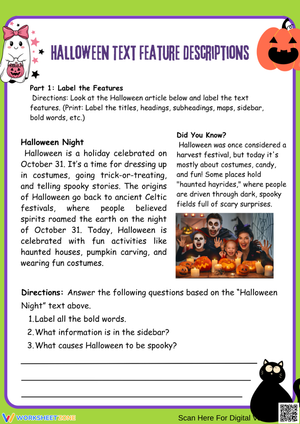
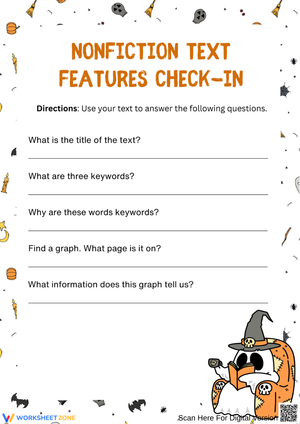
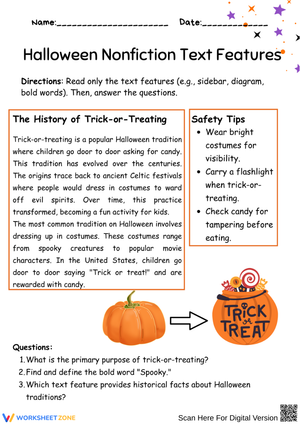
5th grade nonfiction text features pdf worksheets give teachers a ready-to-use set of informational reading resources that push students well past naming features toward explaining what those features actually do for a reader. By fifth grade, most students can point to a heading or caption without much effort; the harder work is connecting each feature to a reading purpose — and that is the shift this set targets.
The Skills Each Worksheet Asks Students to Use
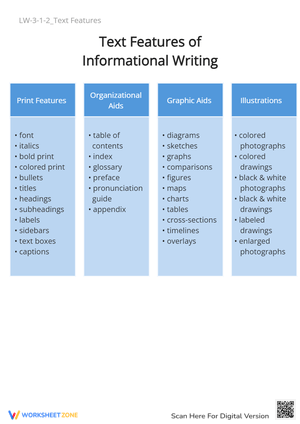
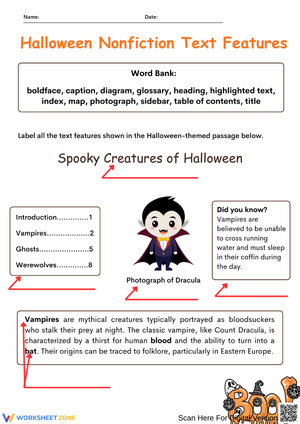
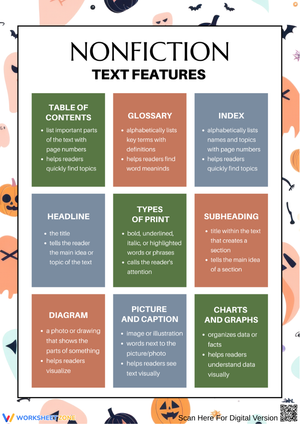
Each worksheet in the collection places students inside a realistic passage context rather than an isolated definition match. The features covered span what fifth graders regularly encounter in science and social studies reading:
- Headings and subheadings — previewing structure and predicting the content of each section
- Captions — explaining what the caption adds beyond what the photograph or image alone shows
- Diagrams with labeled parts — interpreting a visual system rather than just reading individual labels
- Maps — answering location and region questions using the feature itself as the source
- Charts and tables — pulling specific data and explaining why the table format is useful
- Timelines — connecting sequence to meaning, not just recognizing chronological order
- Sidebars and text boxes — distinguishing supplementary detail from the main text's central idea
The consistent two-step task across the set asks students first to identify the feature and then to explain its purpose in that specific passage. That explanation step is where fifth graders either show comprehension or reveal that they are still treating features as vocabulary terms to recognize rather than tools to use actively. Questions like "What does this diagram show that the paragraph alone does not?" require a fundamentally different kind of thinking than "What is this text feature called?"
Student Mistakes Worth Anticipating Before the Lesson
The most persistent error at this grade level is not misidentification — it is what might be called strategic blindness. A student who labels a caption correctly will often skip the information inside it when answering a comprehension question, defaulting to the nearest paragraph instead. This shows up clearly when a question about a photograph is answered entirely from the body text, even when the caption directly states the answer. The worksheet prompts close this gap by requiring students to cite the feature itself as the source of their response, not just acknowledge that it exists.
A second common issue involves multi-part diagrams. Students tend to read only the label closest to a question's vocabulary word rather than interpreting the diagram as a whole. A prompt like "What does this diagram explain about how the water cycle works?" exposes that gap immediately; a prompt that simply asks "What is Part A labeled?" does not. The explanatory questions throughout the set exist precisely because shallow identification tasks miss this pattern entirely.
Where These Worksheets Fit in Your Weekly Routine
These resources fit several points in a fifth-grade literacy schedule without requiring significant setup. At the start of a nonfiction unit, use one worksheet as a pre-assessment — not for a grade, but to surface what students already do with features versus what they are still only naming. During the unit, assign each worksheet by feature type and pull small groups around the features causing confusion while other students work independently.
The 5th grade nonfiction text features pdf worksheets in this set are short enough to function as five-minute warm-ups before a science or social studies reading block. That repeated, low-stakes exposure builds the preview-and-check habit more reliably than a single dedicated lesson. After several cycles, students begin scanning headings and reading captions before they answer — which is the real goal.
For intervention, narrow the task deliberately. Select one worksheet focused on a single feature type and spend most of the session on think-alouds: explain out loud why a map answers a location question faster than rereading the full paragraph. That metacognitive narration is what struggling readers need most, and a focused worksheet gives the structure to deliver it without improvising from scratch.
Standard Alignment
These worksheets connect most directly to RI.5.7, which asks fifth graders to draw on information from multiple print or digital sources and locate answers efficiently. That standard frames text feature use as a comprehension task, not a vocabulary exercise. Using 5th grade nonfiction text features pdf worksheets in this context keeps the standard visible without reducing the work to test-format drill.
The set also supports RI.5.5, which asks students to compare and contrast overall structure across texts. When students explain how a timeline sequences events differently than a body paragraph does, or how a table allows data comparison that prose cannot replicate, they are building the structural awareness RI.5.5 requires. Together, these two standards make text feature work a comprehension task with a clear grade-level target — not a vocabulary add-on.
Tailoring the Work for Students at Different Skill Levels
For students still building reading fluency, reduce the reading load by selecting worksheets with shorter passages and a single dominant feature rather than an article with five different text elements appearing at once. The explanation task — "why does this feature help the reader?" — can be handled orally with a partner before any writing happens. That keeps the cognitive demand on the text feature reasoning rather than splitting focus across decoding and composition simultaneously.
For students who move through the work quickly and accurately, extend the task by asking evaluative questions: Would a chart work better here than a timeline? What information does this diagram leave out? That kind of critical reading pushes toward the analytical thinking middle school will require and produces richer classroom discussion than assigning a second, longer worksheet to the same student.
Frequently Asked Questions
What nonfiction text features should fifth graders know?
At minimum: headings, subheadings, captions, diagrams, maps, charts, tables, timelines, and sidebars. More important than the list is whether students can explain what each feature contributes to their understanding — that functional knowledge is the actual fifth-grade expectation, and it is what these worksheets practice.
Can these worksheets be used in science or social studies, not just ELA?
That is one of the strongest uses for the set. Informational text appears across content areas, and the features students encounter in a science article about ecosystems or a social studies reading on regional geography are the same ones that show up in ELA nonfiction. Rotating 5th grade nonfiction text features pdf worksheets into content-area reading reinforces the skill in the contexts where students actually encounter it — which is what makes the habit transfer reliably.
How do these worksheets work in intervention without becoming busywork?
The key is narrowing the task and treating written responses as evidence of reasoning rather than performance to evaluate. Select a worksheet focused on one feature type, work through it alongside the student with think-alouds, and use the prompts to surface how students explain their choices. The focused format keeps the session productive without overwhelming a student who is still building comfort with longer informational texts.
Are these appropriate for test preparation?
Yes, though the test-prep value comes from building reading behaviors — previewing headings, reading captions before answering questions, checking a chart when the question asks for specific data — rather than from memorizing feature names. Students who develop those habits through regular practice handle informational test passages more efficiently when time pressure is real.












 Interactive Worksheet Maker
 Quiz Maker
 Word Search Maker
 Crossword Puzzle Maker
 Word Scramble Generator
 Sentence Scramble Generator
 Handwriting Worksheet Generator
 Name Tracing Generator
 Fill In The Blank Generator