Printable 5th Grade Worksheets for Summarizing Nonfiction Texts
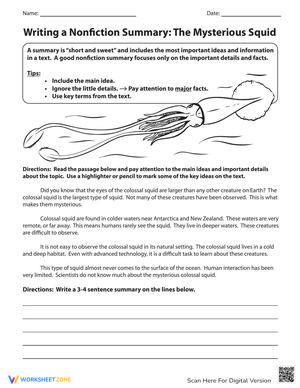
These 5th grade summarizing nonfiction texts printable worksheets give teachers a repeatable format for one of the harder comprehension skills to assess at this level — figuring out whether students actually understood the text or simply remembered it long enough to copy a few sentences. Each worksheet pairs a short informational passage with structured note-taking space and a concise summary task, keeping the cognitive work visible so teachers know exactly where a student broke down.
What Students Practice Across the Set
The work moves through a clear sequence in each worksheet. Students first annotate the passage to identify its main ideas — not a single topic label, but the specific claims or explanations the author develops across sections. They then select supporting details that genuinely explain those ideas rather than just appearing nearby in the text. The final task is a short written summary in their own words, held to a sentence limit so students practice compression rather than elaboration.
That sequence matters because RI.5.2 asks students to handle two or more main ideas within one text — a step up from what students practiced in fourth grade. Nonfiction passages on topics like the water cycle, immigration, or animal adaptation often develop two distinct ideas across separate sections, and students who handle the first one routinely miss or blur the second. These worksheets give students dedicated space to track both ideas before they begin drafting, which changes the summary task from guesswork to evidence sorting.
Frequent Student Errors Worth Watching For
The most consistent error at this grade isn't copying, even though that's the one teachers name most often. It's retelling — students who restate the passage in order, section by section, producing something that reads like a miniature version of the original rather than a distilled explanation of its ideas. A student who summarizes an article about the water cycle by writing "First water evaporates, then it forms clouds, then it falls as rain, then it runs back into rivers" has reproduced the text's structure, not identified its central idea. The passage had an argument; the student produced a list.
A second consistent error appears specifically in multi-section passages: students who accurately identify the first main idea and then treat everything else as supporting detail for that one idea, even when the author shifts to a second distinct explanation halfway through. They produce a summary that's partially correct but incomplete in a way that's hard for them to see without a graphic organizer showing them two separate idea slots side by side.
A third error — rarer but worth anticipating — is the student who writes a strong summary sentence and then closes with "I thought this was interesting because..." That move signals the student hasn't fully separated informational summary from written response, which is a genre distinction worth addressing directly alongside the summarizing work.
Standard Alignment
These worksheets align to CCSS.ELA-LITERACY.RI.5.2, which requires fifth graders to determine two or more main ideas of a text, explain how key details support each one, and summarize the text. That three-part expectation is precisely why the graphic organizer step in each worksheet matters. If teachers assign only a final summary paragraph, there's no evidence of whether a student found both main ideas, chose relevant details, or collapsed the two ideas into a single vague statement. Making the thinking visible before the summary is written turns the worksheet into usable formative data rather than a finished product to grade.
In a classroom planning sequence, RI.5.2 typically arrives alongside text structure work — teachers at this level are usually pairing main-idea instruction with cause-and-effect or compare-contrast text features. These worksheets fit that pairing because many of the passages use those structures, and students who can name the text structure often find it easier to locate where one main idea ends and the next begins.
Building These Worksheets Into a Weekly Reading Routine
In a reading workshop model, these work best when the teacher models the first main-idea box during the mini-lesson and then releases students to complete the rest independently. That structure — teacher models one, students handle the next — gives teachers a natural circulation moment to check whether students are selecting ideas or just copying facts before anyone has written a full summary.
- Monday warm-up after morning meeting: A short passage with one clear main idea and two supporting details eases students back into close reading without overwhelming them before the full lesson starts.
- Reading center rotation: Each worksheet repeats the same format from week to week, so students in centers work independently after the first two practice sessions without needing re-explained directions.
- Small-group intervention: Preteach two or three domain-specific words, read the passage aloud together, and have students point to the sentences they'd put in the main-idea box. The worksheet becomes a written record of that conversation.
- Sub plans: Choose a worksheet with a high-interest science or social studies topic and clear paragraph breaks. Students who know the routine complete it without live modeling.
- Formative assessment: Collect summaries and sort them into three groups — students who named both main ideas, students who named one, and students who retold instead of summarized. That sort takes about eight minutes and tells you exactly what the next small-group session needs to address.
These worksheets produce more instructionally useful data when used across multiple weeks with different passages than when assigned once as a unit check. Repeated use across science and social studies topics shows whether a student's summarizing skill is transferring or whether strong performance on one worksheet was tied to familiar content knowledge.
Adjusting the Worksheets for a Range of Learners
For students who freeze when facing a multi-paragraph passage, the most effective adjustment is paragraph chunking — highlight or physically cut the passage so students work with one section at a time, filling in the corresponding idea box before moving forward. This doesn't lower the RI.5.2 demand; it reduces working-memory load so students can focus on the comprehension move rather than managing the whole text at once.
Sentence frames work similarly well without softening the task. A frame like The author mainly explains that... followed by One detail that supports this is... keeps students writing genuine summaries rather than personal reactions. Students who no longer need the frame can be pushed further: which of their two supporting details is stronger evidence, and why? That question targets the same standard but asks for a layer of evaluative thinking on top of the summary work.
These 5th grade summarizing nonfiction texts printable worksheets also transfer across content areas, which matters for differentiation. A student who struggles with the literacy demand but has strong background knowledge in science may perform better on a passage about animal ecosystems than on a text about immigration history. Using the set across different content domains gives teachers a clearer picture of whether the difficulty lives in reading level, vocabulary, or the summarizing skill itself.
Frequently Asked Questions
What makes a 5th grade nonfiction summary different from a 4th grade one?
The main difference is the "two or more main ideas" requirement in RI.5.2. Fourth grade asks students to identify the main idea of a text and explain how it's supported. Fifth grade raises that to multiple main ideas — students must read across sections and decide which ideas are central versus which are examples or elaborations of a larger point. That shift changes summarizing from a single-idea task to a text-wide synthesis task, and it's the reason these worksheets include space for tracking more than one idea before any writing begins.
How do these worksheets address students who copy directly from the text?
The graphic organizer step interrupts the copy habit because students record notes in labeled boxes before writing the full summary. Teachers can set a rule — no complete sentences in the boxes, four words or fewer per note — which forces students to process the language rather than transcribe it. When students move from notes to the summary paragraph, they're working from their own abbreviated language rather than from the original text still visible in front of them.
Do these worksheets work in science and social studies blocks, or just in ELA?
The format transfers across subject areas without modification. A 5th grade summarizing nonfiction texts printable worksheets set that includes passages on science topics — ecosystems, weather systems, human body systems — works just as well in a science block as in a reading block. Social studies passages on historical events, government structures, or geography fit the same format. Teachers in departmentalized settings often split the set across subjects so students get summarizing practice with different content vocabularies throughout the week.
How quickly can teachers assess the completed summaries?
Efficiently, because the task is narrow. Teachers check for three things: are both main ideas present, are the supporting details relevant rather than random, and does the response stay in informational rather than personal language? Sorting a class set of 25 into those categories takes less time than grading an open-ended response and produces results that translate directly into instructional decisions. These 5th grade summarizing nonfiction texts printable worksheets produce cleaner formative data than longer tasks do precisely because the format keeps student work focused and comparable across the whole class.
Clear All