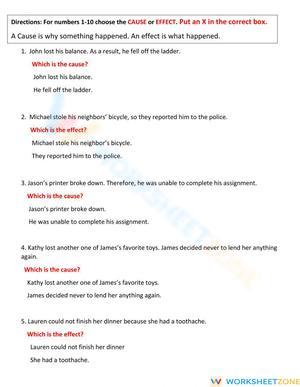
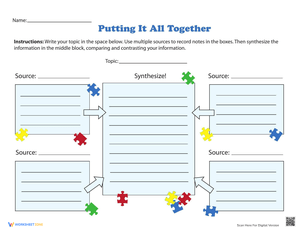
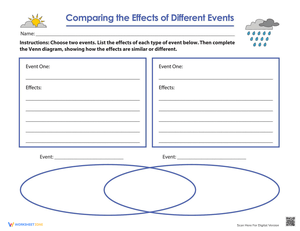
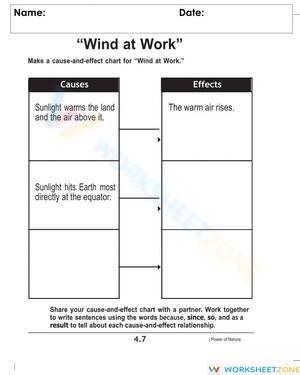
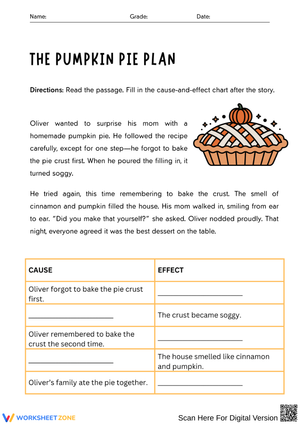
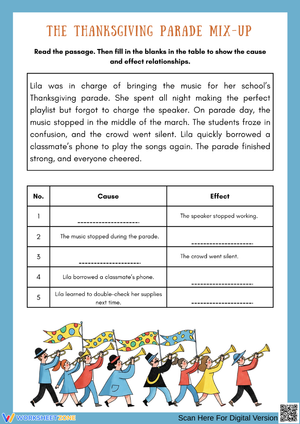
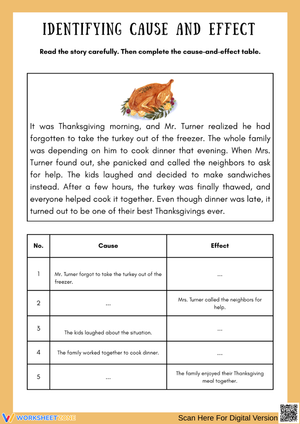
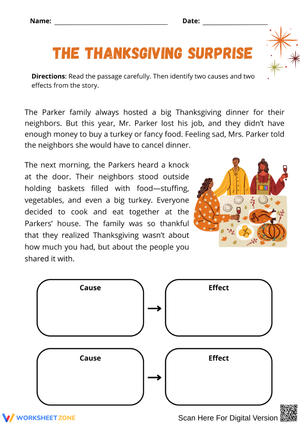
These 5th grade cause and effect in nonfiction printable worksheets target one of the more demanding comprehension moves upper elementary readers face: tracing how an author explains reasons and results in informational text, not just noting what happened next. Students in Grade 5 are reading science passages about ecosystems, social studies texts about historical decisions, and biographies that explain the conditions behind a person's choices. Each worksheet pairs a short nonfiction passage with questions that require students to identify the cause, name the effect, and cite the specific sentence or detail that supports the relationship.
What Students Practice Across the Set
Nonfiction cause-and-effect work is harder than the story version of the same skill. In a narrative, the sequence usually makes the relationship obvious. In informational text, a passage might explain why a species declines across three separate paragraphs, or describe the chain of events behind a historical decision without once using the word "because." The tasks in these 5th grade cause and effect in nonfiction printable worksheets train students to read for structure — not just to collect facts — and to explain how one condition, action, or event produced a specific result.
Across the set, students:
- match a stated cause to its effect using details pulled directly from the passage
- identify more than one effect that stems from a single cause
- locate signal words — because, since, as a result, due to, therefore — and explain what relationship each marks
- distinguish between background context and the actual cause the author is emphasizing
- cite or closely paraphrase the sentence that best supports the identified relationship
That last item — pointing to the evidence — separates real comprehension from guessing. Without being asked to locate a specific line, many fifth graders confirm cause-and-effect relationships using background knowledge rather than what the passage actually says.
Where Students Break Down on Nonfiction Cause-and-Effect
The most common error at this level is not confusion about what "cause" means — it is confusing a background detail with the actual cause the author identifies. A student reading a passage about the Dust Bowl might write "farmers moved west" as the cause when the text explicitly names drought and unprotected topsoil as the trigger. The background information was absorbed; the structural relationship was not read.
A second pattern: students over-rely on signal words. A student who finds "therefore" in a passage will sometimes copy the surrounding sentence without checking whether it actually describes a cause-and-effect relationship or just a sequence. These worksheets address that directly by including items where a signal word is present but the relationship still requires careful reading to explain, alongside items where no signal word appears and students must infer the connection from adjacent sentences.
Worth watching in student work: students who name the effect accurately but state the cause too broadly — writing "the weather changed" when the passage describes three consecutive years of drought combined with loose, unprotected soil. That vagueness almost always means the student read for the general idea rather than the precise causal detail the author provided. When you see that pattern, the gap is in close reading, not in understanding the concept of causation.
Fitting These Worksheets Into a Realistic Reading Block
The most productive use of each worksheet is as a follow-up to a ten-minute text structure mini-lesson, not as a standalone assignment handed out cold. Introduce the passage together, name the topic, and ask students which event or condition seems to trigger the result. That first pass keeps instruction anchored in teacher modeling before students work independently.
A simple weekly rotation builds accuracy without overloading the literacy block, and 5th grade cause and effect in nonfiction printable worksheets fit naturally into every slot in that cycle:
- Monday: whole-group introduction, one projected paragraph, one relationship identified together
- Tuesday: partner work on one worksheet using passages with clear signal words
- Wednesday: independent practice on a second worksheet with more implied relationships
- Thursday: small-group reteach for students who confused background details with actual causes
- Friday: one fresh worksheet completed individually — three to five minutes, used as a formative check
After Friday's check, sort the completed worksheets by response pattern rather than by score. Which students can name the cause but not support it with evidence? Which students describe the effect accurately but trace back to the wrong trigger? That three-minute sort maps out exactly what Monday's mini-lesson needs to address.
Standard Alignment
These 5th grade cause and effect in nonfiction printable worksheets align to CCSS.ELA-LITERACY.RI.5.3, which asks students to explain the relationships or interactions between two or more individuals, events, ideas, or concepts in a text, including how they affect one another. In classroom terms, that standard is tested when a student reads a science or social studies passage and must explain why a particular outcome occurred — not just describe it, but trace it back to the conditions or decisions that produced it. A wrong answer is almost never a random guess; it is usually a structure error, which the evidence-citing requirement on each worksheet makes visible.
Reading Rockets identifies cause and effect as one of the core nonfiction text structures that strong readers use to organize meaning as they read. That research supports treating cause-and-effect work as a recurring focus across several weeks rather than a single-lesson coverage point. One lesson introduces the structure; repeated practice with varied passages builds the flexibility students need when the same skill appears in an unfamiliar text on an assessment.
Adapting Each Worksheet for Readers at Different Levels
For students who need additional support entering the text, add one step before any questions are answered: ask them to underline every signal word in the passage first. That slows the reading down and gives students a concrete foothold before they have to name a relationship. From there, direct them to answer only the items where a signal word is visible, and save inference-based items for a follow-up session once that first pattern feels solid.
Students working above grade level benefit from a discussion layer added after they complete each worksheet, rather than a different version of the same task. Ask them to determine whether the cause-and-effect relationship is direct — one event produces one result — or part of a chain, where A causes B and B leads to C. That distinction does not appear on the worksheet itself, but it pushes students to think about how the whole passage is organized rather than how one paragraph works. Some students will be ready to compare how two different nonfiction passages handle the same type of causal relationship — exactly the kind of cross-text analysis that appears on Grade 5 assessments and that signals genuine structural understanding rather than pattern-matching.
Frequently Asked Questions
Can these worksheets be used with both science and social studies nonfiction passages?
Yes. Cause-and-effect relationships appear across both content areas — ecosystems, weather events, historical decisions, economic shifts. Because students are reading for text structure rather than topic-specific knowledge, the skill transfers without modification. The same worksheet works equally well during a science reading block one week and a social studies block the next.
Is it appropriate to send these worksheets home as homework?
Only after students have practiced the skill in class. Sending a cause-and-effect nonfiction worksheet home before any classroom instruction on text structure leads to answers driven by background knowledge rather than evidence from the passage. Two or three in-class sessions first — then the homework version produces more accurate results and far fewer unsupported guesses.
What should teachers do when students consistently flip the cause and the effect?
That reversal is common and usually signals that a student is reading for sequence rather than relationship. A practical fix: before answering, ask the student to write one sentence beginning with "The reason this happened was…" and a separate sentence beginning with "Because of this…" Forcing those two sentence starters makes the distinction between the two roles concrete and quickly reveals whether the student knows which is which.
How do these worksheets fit alongside a reading program that already addresses text structure?
As targeted reinforcement. Most core programs introduce nonfiction text structures but move through each one in a lesson or two. These worksheets give cause and effect the repeated, focused practice that builds lasting accuracy — something a program's built-in lessons rarely have the time to provide on their own.












 Interactive Worksheet Maker
 Quiz Maker
 Word Search Maker
 Crossword Puzzle Maker
 Word Scramble Generator
 Sentence Scramble Generator
 Handwriting Worksheet Generator
 Name Tracing Generator
 Fill In The Blank Generator