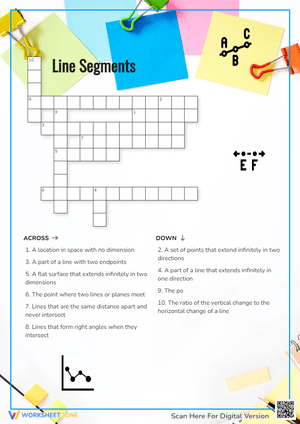
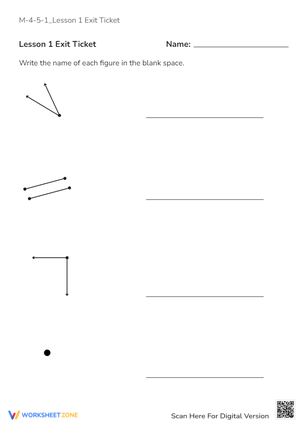
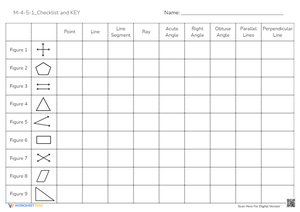
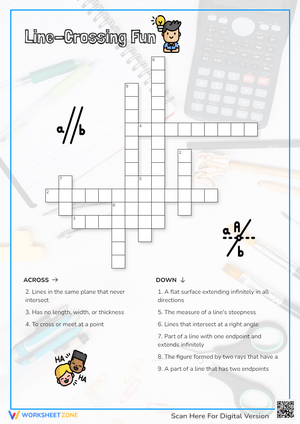
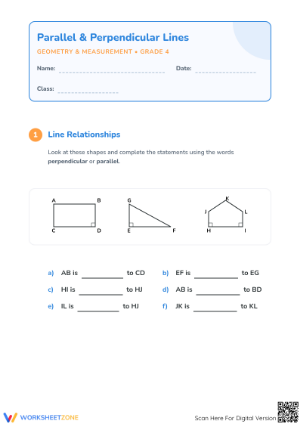
These 4th grade parallel and perpendicular lines pdf worksheets give teachers printable geometry practice that slides into a standard math block without demanding extra prep time or materials. Students work directly with drawn line relationships — identifying, labeling, sorting, and explaining — and the visual nature of the tasks means attention stays on the geometry rather than on decoding instructions.
What Each Worksheet Has Students Do
Parallel and perpendicular lines enter 4th grade as more than vocabulary terms. They give students precise language for describing how the sides of shapes relate to each other, and that language carries forward into every geometry unit that follows. Each worksheet builds toward applying the concepts, not just restating their definitions.
- Identify parallel or perpendicular line pairs in diagrams that include varied orientations — not only horizontal and vertical examples
- Sort line pair images into categories, including pairs that are intersecting but not perpendicular
- Draw examples of each relationship with a straightedge, then label them correctly
- Locate parallel and perpendicular sides inside rectangles, squares, and right triangles
- Write short explanations naming the geometric reason — for example, These lines are perpendicular because they intersect and form a right angle
Including non-examples matters more than it might seem. Students who only see correct examples learn to recognize a visual pattern rather than a mathematical relationship. When a worksheet asks students to mark which pairs in a mixed set are parallel — and several pairs that almost look parallel are actually converging — those items reveal exactly who still needs instruction.
Student Errors Worth Knowing Before You Hand Out the Worksheet
Two errors appear in nearly every class working on this topic. The first is positional bias: students treat "parallel" as meaning "horizontal." Draw two lines running diagonally across the page, equidistant at every point, and a meaningful portion of the class will skip the item or mark it wrong because it doesn't look like the definition example they were shown. Choosing 4th grade parallel and perpendicular lines pdf worksheets that vary line orientation from the start addresses this before it becomes entrenched — but only if the teacher also names it explicitly. Pointing at a set of slanted parallel lines and asking "are these the same distance apart everywhere?" is often enough to trigger the correction.
The second error is treating intersection as sufficient for perpendicularity. Students see two lines cross and write "perpendicular" without checking for the right angle. The most direct correction is a side-by-side comparison before the worksheet begins: one pair crossing at roughly 60 degrees, one crossing at 90. Students who see that contrast rarely make the automatic labeling error again. A written explanation requirement on the worksheet — "explain how you know" — surfaces this mistake on paper so teachers can address it quickly rather than discovering it only at the unit assessment.
Lesson-Planning Strategies for Getting the Most From This Set
The most efficient use of 4th grade parallel and perpendicular lines pdf worksheets is as the transition between teacher modeling and independent practice — not as the whole lesson. Spend the first eight to ten minutes of a math block showing line pairs, naming the relationship, and pressing students to justify the label aloud. Then distribute the worksheet while the vocabulary is still active in the room. That small overlap between class discussion and written practice produces stronger first attempts than a cold handoff at the start of a period.
During math centers, these worksheets pair well with a notecard cut at a right angle, which students can hold against drawn lines to physically check for perpendicularity before writing their answer. That one-second verification slows the automatic-labeling error and builds the habit of checking rather than guessing. For small-group intervention, the same worksheet can function as a discussion tool — pausing after every two or three items to ask students what they see before they mark anything. For Friday review or Monday warm-up the following week, the visual format reactivates the concept quickly without requiring a full re-teach.
Standard Alignment
CCSS 4.G.A.1 requires students to draw and identify points, lines, line segments, rays, angles, and perpendicular and parallel lines. The standard sits in 4th grade specifically because students at this level have enough spatial reasoning to compare line relationships and enough vocabulary development to describe them in writing. Earlier geometry stays at the level of naming shapes. This standard marks the shift toward analyzing how parts of a figure relate to each other — opposite sides, adjacent sides, angles formed at intersections — and that relational thinking is what each worksheet practices directly.
How to Adjust These Worksheets for Different Readiness Levels
The range across the set of 4th grade parallel and perpendicular lines pdf worksheets makes tiered assignment straightforward. Students who need more support do better starting with a worksheet that focuses on one relationship at a time. "Mark all the parallel pairs" is a simpler task than "sort these into parallel, perpendicular, and neither," and completing one type correctly builds the confidence to take on comparison tasks next. Large, uncluttered diagrams with generous space for circling and labeling are also easier to annotate without frustration.
Students ready for more challenge benefit from worksheets that ask them to draw examples from real-world prompts — "sketch what the edge of a bookshelf and the edge of a wall look like from above" — or to identify every parallel and perpendicular relationship inside a more complex polygon. Color-coding works well across levels: students mark parallel pairs in one color and perpendicular pairs in another, which lets teachers scan a class set in under a minute and spot exactly where the pattern breaks down. A few students each year are also ready to discuss what it would mean for two lines to look parallel but not be — a conceptual thread that runs through geometry well into middle school.
Frequently Asked Questions
What is the difference between parallel and perpendicular lines at the 4th-grade level?
Parallel lines remain the same distance apart at every point and never intersect. Perpendicular lines intersect at exactly one point, and that intersection forms a right angle. Fourth graders build the clearest understanding of both concepts when they study them in contrast to each other — on the same worksheet and inside the same shape — rather than in separate units.
Can these worksheets work for homework or math centers?
Yes. The visual format requires no additional materials for take-home use, and the tasks are focused enough for students to work through independently. For centers, adding one physical tool — a right-angle corner cut from cardstock — gives students a concrete way to verify perpendicular relationships before they write their answer.
Which shapes work best for teaching both concepts at the same time?
Rectangles and squares show both relationships inside a single figure. The opposite sides are parallel; the adjacent sides meet at right angles, making them perpendicular. Labeling those relationships directly on a drawn rectangle is one of the most productive tasks in the set because it connects abstract vocabulary to a figure students already know well.
Do answer keys make these worksheets easier to manage in the classroom?
Answer keys reduce checking time during the lesson, which means feedback reaches students while they still remember what they were thinking when they marked an answer. For station work or substitute plans, keys also allow students to self-check without waiting for teacher review — a practical structure that keeps the task purposeful rather than open-ended.













 Interactive Worksheet Maker
 Quiz Maker
 Word Search Maker
 Crossword Puzzle Maker
 Word Scramble Generator
 Sentence Scramble Generator
 Handwriting Worksheet Generator
 Name Tracing Generator
 Fill In The Blank Generator