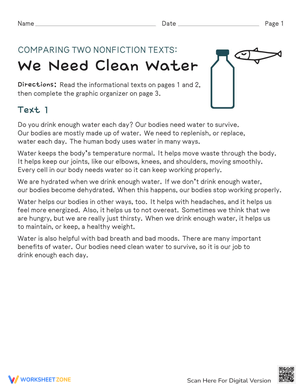
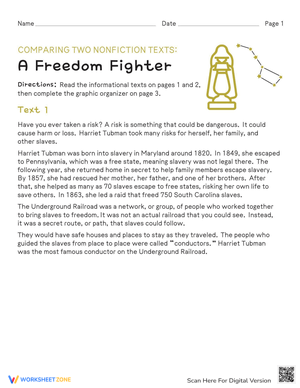
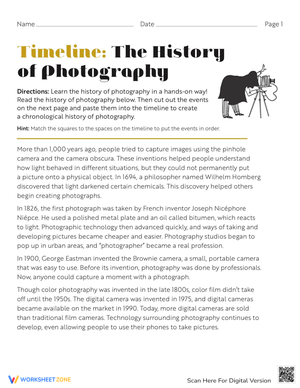
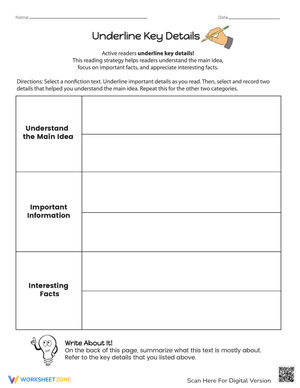
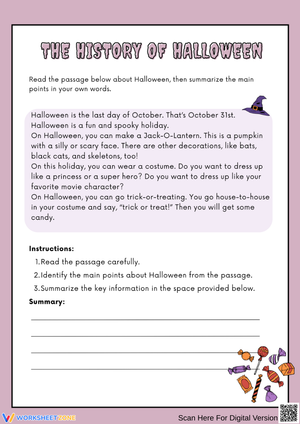
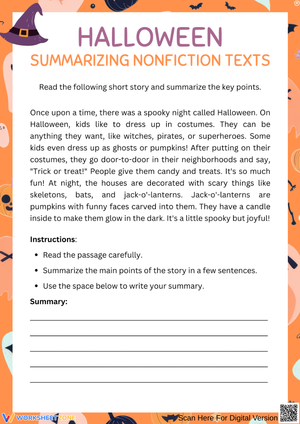
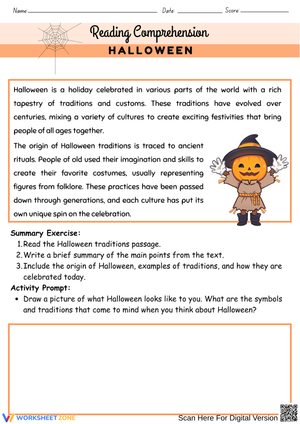
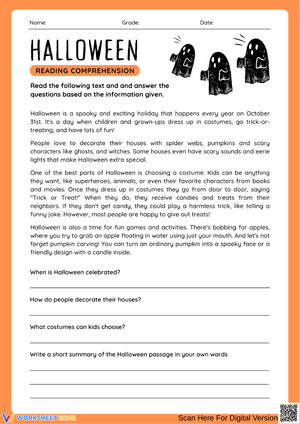
These summarizing nonfiction texts worksheets for 4th grade give teachers a reliable structure for one of Grade 4's harder transitions — moving students from collecting facts toward deciding what actually matters in an informational passage. Each worksheet pairs a short nonfiction text with a stepped organizer covering topic, main idea, key details, and a written summary, so the process stays consistent long before students can carry it out on their own.
What Each Worksheet Asks Students to Do
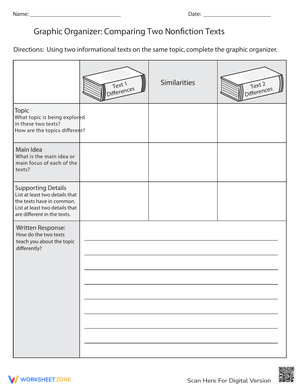
The skill sequence runs in four steps, each one narrowing toward the final summary:
- Topic: students name the subject of the passage in a word or short phrase
- Main idea: students write, in their own words, the central point the author is making about that topic
- Key details: students select two or three facts or explanations that directly support the main idea — not simply any interesting facts from the passage
- Summary: students combine the above in two to four sentences without copying text directly from the passage
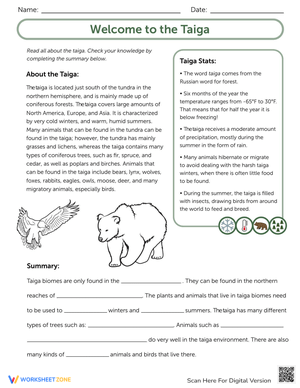
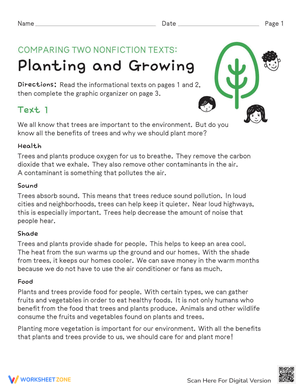
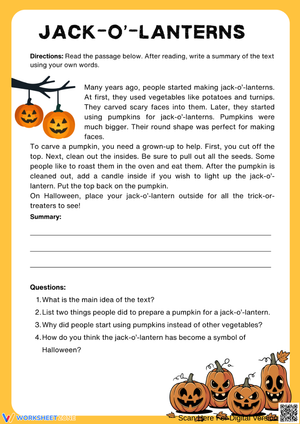
The summarizing nonfiction texts worksheets for 4th grade in this set each include a passage, this four-step organizer, and a summary box with a sentence-count guide. Some worksheets include text features — headings, bold terms — so students practice using those features to locate central ideas rather than treating them as separate content. Others use plain-text passages to keep focus entirely on the body text without visual distractions from the page layout.
Where Students Get Stuck — and What to Look For
The most consistent problem in student work is the transcript summary: a student lifts the opening sentence from the passage, adds two facts from the middle, and closes with the passage's final sentence. The result sounds fluent but tells teachers almost nothing about what the student understood. A related pattern is detail overload — listing six or seven facts when only two are central to the main idea. Both tendencies share the same root cause: students are collecting rather than ranking. These worksheets address this directly by asking students to name the main idea before they touch the details section, so the main idea becomes the filter rather than an afterthought.
A subtler error appears with passages that include text features. Fourth graders often treat sidebar content as carrying equal weight to the body paragraphs, then fold sidebar facts into their summaries even when the sidebar was supplementary. Students who do this are not wrong to read sidebars carefully — the confusion is that they haven't yet learned to rank information from different parts of the page. Each worksheet in this set that includes a sidebar follows up with a direct question: does this information support the main idea, or does it add extra detail? That question makes the judgment explicit before students reach the summary box.
Getting the Most Out of These Worksheets in Your Reading Block
The most productive entry point is a teacher think-aloud using a projected worksheet. Walk through each step aloud: read the passage once without a pencil, read it again while marking, decide on the topic in one word, locate and restate the main idea without copying, choose three details and cross out the rest, then draft the summary. That 12-to-15-minute sequence shows students the actual decision-making, not just the finished product. Watching a teacher reconsider a detail mid-think-aloud — crossing it out, replacing it, explaining why — is more instructive than any printed directions box at the top of the page.
For centers or partner work, keep the format identical every time. When the organizer doesn't change, cognitive effort stays on comprehension rather than on figuring out a new set of instructions. For homework, choose the shorter-passage worksheets from the set: the four steps are clear enough for families to follow without explanation, and students can complete the task in one sitting without needing support partway through.
The organizer also serves well as a quick diagnostic. A student who writes a solid main idea but whose summary still reads like a list of facts has a different gap from a student who leaves the main idea line blank or just restates the topic. Each pattern points to a different next instructional step, and the organizer format surfaces both clearly in the same piece of student work.
Standard Alignment
CCSS ELA-Literacy RI.4.2 asks students to determine the main idea of an informational text, explain how key details support it, and summarize the text. The standard sits at the center of Grade 4 informational reading because it marks the transition from basic fact location — consolidated in Grade 3 — to analysis: understanding what the author is most trying to communicate, not merely what the text contains. The summarizing nonfiction texts worksheets for 4th grade in this set are built around that exact shift. Students don't just locate the main idea; the organizer asks them to demonstrate the relationship between that idea and the details that carry it forward.
Adjusting the Set for Different Student Levels
For students who freeze at the main idea line, two adjustments work consistently: shorten the passage to one or two paragraphs, and add a sentence frame such as "The author mainly wants readers to understand that…" Both moves keep cognitive demand on comprehension rather than on writing production. Most students who leave the main idea blank already know the answer — they simply don't know how to commit it to a sentence. The sentence frame removes that barrier without removing the thinking.
Students who move through the task quickly and write clean summaries benefit from a follow-up question at the bottom of the worksheet: "Which detail was hardest to cut, and why?" That question surfaces metacognitive reasoning about how evidence functions in informational text and pushes the work toward RI.4.8 territory without requiring a separate task entirely. For multilingual learners, a vocabulary box in the margin defining terms like evidence, central idea, and supports as they appear in that specific passage keeps attention on reading comprehension rather than word-level decoding.
Frequently Asked Questions
How long should a Grade 4 nonfiction summary be?
Two to four sentences covers the task well for most fourth graders. The summary should name the topic, state the main idea, and include one or two key supporting details — not retell every fact in the passage. Setting a sentence ceiling directly on the worksheet helps students approach summary writing as selection rather than transcription, and that small design constraint tends to produce noticeably shorter, cleaner student responses than open-ended prompts do.
Can these worksheets be used for informal assessment?
Yes, and the stepped organizer makes diagnosis faster than a short-answer quiz would. A student who writes a strong main idea but fills the summary with a list of details has a different skill gap from one whose main idea line just restates the topic. Both patterns are visible in the same piece of student work without requiring a separate assessment event. For a formal grade, pair the written summary with a brief rubric covering main idea accuracy, detail relevance, and original wording.
What's the difference between a nonfiction summary and a retell?
A retell follows the sequence of the text — first this, then that. A summary identifies the author's central point and selects only the details that support it, regardless of where they appear in the passage. In student work, retells tend to run long and include transitional phrases like "and then" or "also," which are signs that the student is moving through the text chronologically rather than synthesizing it. The four-step organizer in each worksheet pushes students toward synthesis by requiring the main idea to be established before any details are selected.
Do the worksheets include answer keys?
Each worksheet includes a model main idea statement and a sample summary. Because nonfiction summarizing involves genuine judgment — students who choose slightly different supporting details are not necessarily wrong — the models are framed as strong examples rather than single correct answers. That framing makes them usable for peer review and whole-class discussion, not just teacher checking. The summarizing nonfiction texts worksheets for 4th grade in this set organize those models so they can be projected during class without requiring additional copies to be printed and distributed.












 Interactive Worksheet Maker
 Quiz Maker
 Word Search Maker
 Crossword Puzzle Maker
 Word Scramble Generator
 Sentence Scramble Generator
 Handwriting Worksheet Generator
 Name Tracing Generator
 Fill In The Blank Generator