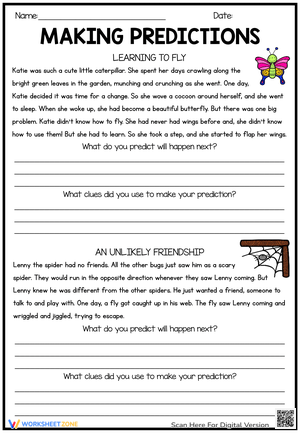
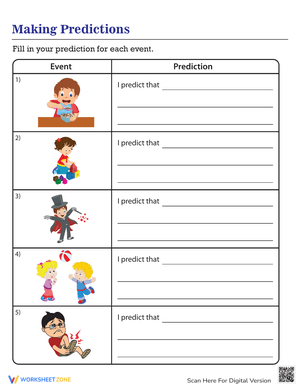
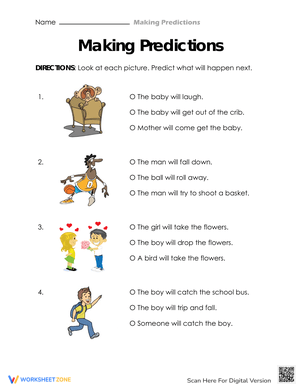
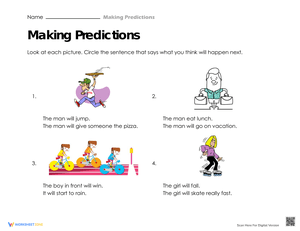
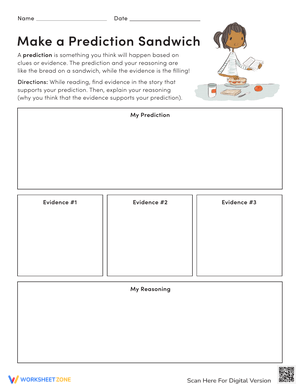
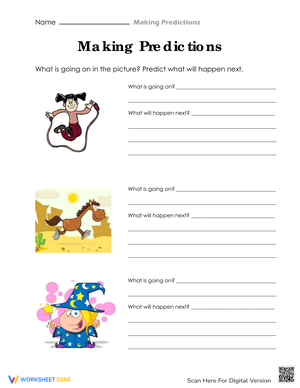
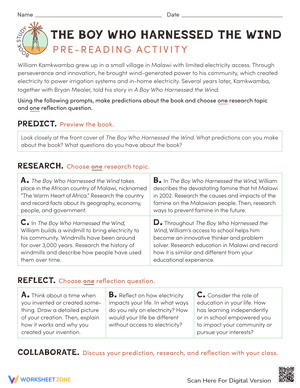
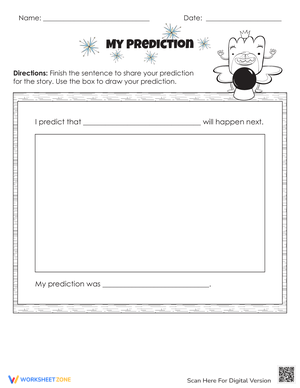
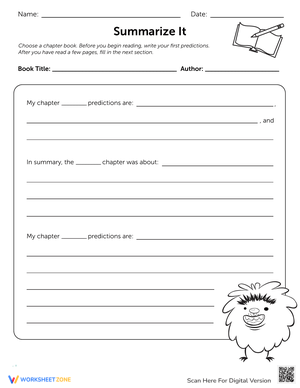
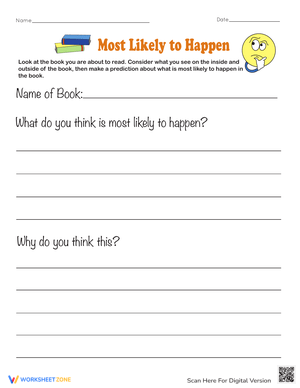
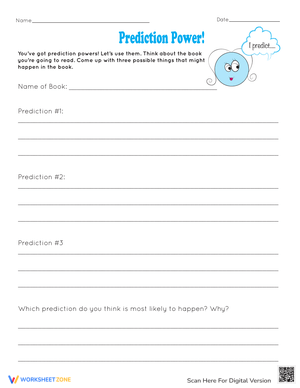
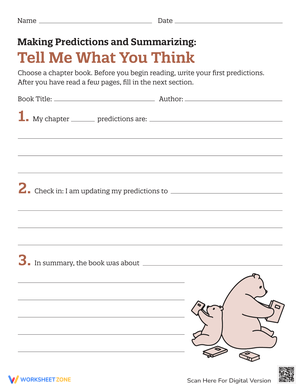
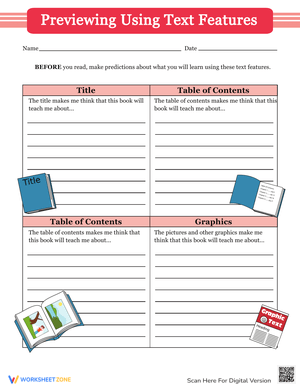
These 4th grade making predictions in nonfiction worksheets give students structured practice reading informational text the way experienced readers do — pausing before a section, reading the structural signals an author built in, and writing a reasoned expectation before the content either confirms or corrects it. The set focuses on the two moves teachers find hardest to separate in instruction: reading text features as evidence and activating prior knowledge without letting it override what the text actually presents.
The Specific Skills These Worksheets Target
Nonfiction prediction is a fundamentally different cognitive task from fiction prediction, and fourth grade is exactly where that distinction needs to become explicit. In fiction, students predict based on character behavior, narrative tension, and emotional cues. In an informational text, there is no plot. Students have to predict based on what they can see: the heading that announces a category, the caption beneath a labeled diagram, the bold term signaling an upcoming definition. Each worksheet asks students to examine a text feature, write what they expect the section to teach, read the passage, and then mark whether their prediction held, needed revision, or missed the mark — and explain why.
Across the set, students practice:
- Reading headings and subheadings as organizational signals, not decorative titles
- Using captions and diagrams to anticipate technical vocabulary before encountering it in body text
- Connecting prior knowledge to specific text evidence without substituting personal background for what the author actually writes
- Revising predictions mid-text when new information contradicts the initial expectation
- Citing the specific text feature or sentence that grounded each prediction — not just naming the prediction itself
Why Text Features Do the Heavy Lifting Here
One reason prediction in nonfiction trips up fourth graders is that the evidence lives in places students have been trained to skip. They move fast through informational text — blowing past a subheading like "How Water Cycles Through a Watershed" to get to the first sentence of the body paragraph. What they miss is that the subheading is the thesis of everything that follows. These worksheets slow that process down deliberately. Students must write their prediction before reading the body text, which means they have to actually engage with the feature first.
This sequencing also surfaces who is reading the structural signals at all. A student who writes "I think it will be about water" after seeing the subheading above hasn't internalized the feature any more than a student who skipped it entirely. A student who writes "I think it will explain the path water takes and name specific stages in that path" has read the heading as a content promise. That distinction shows up clearly in the written responses, and it gives teachers something concrete to work from in follow-up conversation.
Errors Worth Watching For Before They Become Habits
The most persistent error is over-reliance on schema. A student who already knows something about volcanoes reads a subheading like "Underwater Eruptions" and writes a prediction built entirely on what they know about eruptions on land — lava flow, ash clouds, immediate surface destruction. The text is actually about hydrothermal vents and deep-sea ecosystems. The student's prediction wasn't wrong because they lacked knowledge; it was wrong because they stopped reading the text and started reading their own memory. Holding prior knowledge loosely — treating it as a starting point, not a conclusion — is the hardest part of this skill to teach, and these worksheets force the issue by requiring students to name the specific text feature that informed each prediction, not just their background knowledge.
A second error that appears regularly: students treat every bold word as a simple definition cue. They write "I predict this word will be defined" and call the prediction done. The stronger move is to predict how that term connects to the section's main idea. If the bold word is photosynthesis inside a passage about forest layers, the prediction should address the role photosynthesis is likely to play in a discussion of canopy versus forest floor — not just note that a definition is coming. These worksheets push toward that fuller expectation by asking students to connect their prediction to the section heading, not just to the isolated bold term.
Building These Worksheets Into Your Reading Block
These worksheets work best at the front end of a reading lesson, before students have touched the assigned passage. That placement matters more than it sounds. When teachers distribute the passage and worksheet together and tell students to fill in the prediction column as they read, the prediction becomes retrofitted — students read first, then write what the text said rather than what they expected it to say. Handing out the worksheet first, pointing students to the text features, and giving five minutes to complete the prediction column before reading keeps the thinking honest.
In a gradual-release lesson, a 4th grade making predictions in nonfiction worksheets fits naturally in the guided practice phase. Teachers model one prediction with a think-aloud — "I see the heading 'The Role of Decomposers' and I know decomposers break down dead material, so I'm predicting this section explains how they return nutrients to soil, not just that they exist" — then pairs work through the next feature together before students complete the remaining items independently. The written responses double as a quick formative check: scanning the room during independent work shows immediately which students are grounding predictions in text evidence and which are freewriting from memory.
For literacy centers, one worksheet per rotation works well when paired with a short informational text already in the classroom — a science magazine article, a social studies passage excerpt, or a nonfiction trade book section. Students can work through these without direct supervision once the task format has been modeled once or twice as a whole group.
Standard Alignment
These worksheets address CCSS.ELA-LITERACY.RI.4.1, which requires fourth graders to refer to details and examples in a text when explaining what it says explicitly and when drawing inferences. Making a prediction before reading is the front end of inferencing — students form a hypothesis using evidence they can observe. Returning to that prediction after reading and explaining whether it held is the back end: students cite the specific text evidence that confirmed or revised their thinking. Both moves are required by RI.4.1, and each worksheet asks students to complete both within the same task.
The set also connects to CCSS.ELA-LITERACY.RI.4.5, which targets students' ability to describe the overall structure of events, ideas, and information in a text. Predicting from headings and subheadings is a direct application of that standard — a student can't predict what a structural element signals unless they understand why it exists in the first place.
Adjusting the Set for Different Levels of Readers
For students who struggle with informational text, the first adjustment is narrowing the prediction task. Rather than asking them to predict the full content of a section from its heading, point them to a single caption beneath a photograph and ask them to predict one fact the body text will confirm. That smaller scope reduces cognitive load without removing the prediction step entirely. Once students can do that reliably, widen the task back to full subheadings and multi-part predictions.
For students ready for more challenge, the most productive extension is asking them to predict the relationship between two subheadings before reading either section. If one heading reads "The Dust Bowl Begins" and the next reads "Families Head West," a strong reader can predict not just the content of each section but how the second depends on the first — prediction as structural reasoning, not just anticipation of isolated facts. You can also ask these students to use the 4th grade making predictions in nonfiction worksheets as a self-assessment tool after completing it: they identify which text feature type gave them the most reliable signal across the worksheet and explain why in a short written reflection.
Frequently Asked Questions
Do students need prior reading instruction before using these worksheets independently?
Basic familiarity with text features helps — students should be able to identify a heading, caption, and bold word before working on their own. If that groundwork isn't in place yet, the first worksheet in the set works well as a whole-group lesson where you introduce each feature type alongside the prediction task. After one modeled session, most fourth graders can work through subsequent worksheets without direct support.
How is predicting in nonfiction different from the prediction work students did in third grade?
Third-grade prediction is almost entirely fiction-based — students predict character choices and plot turns using narrative logic and emotional inference. Fourth grade is where informational text becomes a significant part of the reading load, and the habits students built in fiction don't transfer automatically. A student who is excellent at predicting what a character will do next has no ready-made framework for predicting what a diagram demonstrates. These worksheets build that new framework directly.
Can these be used as a graded assignment?
They function better as formative tools than summative grades. Prediction responses are inherently variable — a strong prediction that turns out to be wrong can demonstrate sharper textual reasoning than a vague prediction that happens to be correct. What you're looking for is whether students cite a specific text feature and whether their expectation is logically consistent with that feature. A rubric built around evidence and reasoning rather than prediction accuracy makes assessment both fairer and more instructionally useful.
How much practice do students need before prediction becomes an automatic reading habit?
Most fourth graders need consistent exposure across four to six weeks before prediction from text features becomes a reading reflex rather than a worksheet exercise. Isolated use — one worksheet before a unit test — won't produce lasting change. The skill transfers when students start doing it automatically while opening a science textbook or social studies chapter, without a 4th grade making predictions in nonfiction worksheets sitting in front of them. Getting to that point is the real goal of the instruction.












 Interactive Worksheet Maker
 Quiz Maker
 Word Search Maker
 Crossword Puzzle Maker
 Word Scramble Generator
 Sentence Scramble Generator
 Handwriting Worksheet Generator
 Name Tracing Generator
 Fill In The Blank Generator