Decomposing Shapes printable worksheets for 2nd Grade
Decomposing shapes printable worksheets for 2nd grade give teachers a direct path from passive shape-naming toward genuine spatial reasoning — the ability to look at a hexagon, mentally split it into trapezoids, or see a rectangle and immediately recognize where equal thirds would fall. The set here covers both polygon decomposition and equal-share partitioning of circles and rectangles, the two major geometry threads at this grade level. Each worksheet drops cleanly into morning warm-ups, guided math stations, or whole-group instruction without requiring extra preparation.
What Students Practice Across the Set
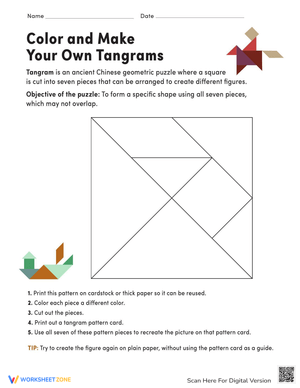
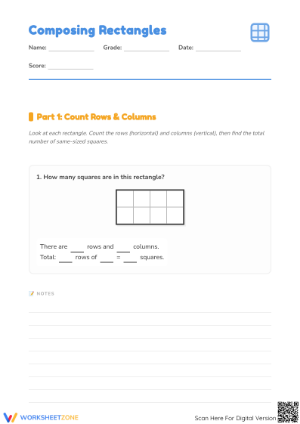
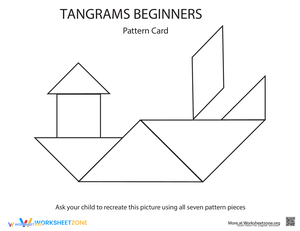
Students work across several distinct but related skills. On the decomposition side, they break larger polygons — hexagons, trapezoids, large rectangles — into specified smaller shapes by drawing internal lines, then name each resulting piece. On the partitioning side, they divide circles and rectangles into two, three, and four equal shares and practice the vocabulary that goes with each: halves, thirds, fourths, a third of, a half of. A separate group of tasks asks students to work in both directions — start with a whole shape and divide it, then start with pieces and reconstruct the whole. That reversal matters. Students who can split a rectangle in half don't automatically understand how the two pieces recombine, and this set treats both directions as distinct skills worth practicing.
One worksheet in the set shows the same square partitioned two different ways — into two rectangles in one problem, and into two triangles on the next — then asks whether both examples show halves. That task is built specifically to surface the misconception that equal shares must look identical, before the idea hardens into a persistent error.
Building These Worksheets Into Your Geometry Unit
The most effective sequence places decomposing shapes printable worksheets for 2nd grade after a brief concrete phase, not before it. Paper folding works well as that opener: students fold a rectangle in half both horizontally and vertically, trace each fold line, and immediately see that two different-looking folds produce the same share. That physical experience makes the worksheet task feel like recording something they already understand rather than decoding a cold abstraction.
Cut-and-paste worksheets in the set belong mid-unit, once students have the vocabulary but before they've fully internalized equal-area reasoning. Use them during small-group rotations while the rest of the class works at stations. Watching a student cut two pieces from a partitioned shape and stack them to verify equal size tells you far more about their understanding than a circled multiple-choice answer. A student who stacks is reasoning about area. A student who eyeballs and moves on is probably applying visual symmetry and guessing.
The exit-ticket use case belongs to the worksheets that show a pre-partitioned shape and ask students to mark which versions are divided into equal shares. These run under five minutes and sort students clearly enough to plan the next day's instruction the same evening.
Mistakes Students Make That These Worksheets Help You Catch
The most consistent error isn't misidentifying shape names — it's drawing division lines that look approximately equal without verifying area. A student will partition a rectangle into three vertical strips where the middle one is noticeably wider than the outer two, then label all three "thirds." The error is invisible to them because they're satisfying the visual appearance of the task without understanding the mathematical requirement. On grid-backed worksheets in the set, the inequality becomes countable: students see the middle strip holds more squares than the outer ones, and that forces the correction in a way verbal feedback rarely does.
Circle thirds are a separate problem. Most students draw correct halves on circles without trouble, but when asked to draw thirds, they typically produce three lines radiating from the center at uneven angles. To an 8-year-old, three lines meeting in the middle feel like thirds because they've divided a point three ways — not the area. The fastest correction isn't verbal explanation: have students cut out the partitioned circle and stack the pieces. Two non-equal "thirds" held in each hand resolves the confusion more efficiently than any diagram on the board.
There's also a vocabulary gap between "fourth" and "quarter" that catches students on assessments. These express the same equal share with different words, but students who have only seen one term in practice can appear not to know the concept at all. Several worksheets in the set use both terms within the same problem to prevent that gap from forming.
Standard Alignment
The central standard is CCSS.MATH.CONTENT.2.G.A.3, which requires students to partition circles and rectangles into two, three, or four equal shares, describe those shares using the terms halves, thirds, fourths, and quarter, and recognize that equal shares of identical wholes do not need to have the same shape. In classroom terms, this standard typically arrives in the third or fourth quarter of 2nd grade — after basic shape identification carried over from first grade and directly before the fraction instruction in 3rd grade that depends on this visual foundation. These decomposing shapes printable worksheets for 2nd grade address the full scope of 2.G.A.3, including the equal-shares-look-different requirement that many teachers underemphasize or treat as enrichment rather than grade-level expectation.
Adjusting the Work for the Full Range of Learners in the Room
Students still building basic shape vocabulary get more traction with grid-backed worksheets than with blank-shape versions. The grid lines handle the measuring so students can focus on counting equal units — a student who can't yet judge visual area can still count six squares in each half of a twelve-unit rectangle. Those worksheets are the right starting point before moving anyone to freehand partitioning.
For students who move quickly through grade-level tasks, the best stretch is finding multiple valid ways to partition the same shape. A rectangle can show fourths as four horizontal strips, four vertical strips, a two-by-two grid, or two halves each cut with a diagonal. Several worksheets in the set include a "show another way" prompt at the end of the problem; those are worth directing early finishers to rather than leaving them as optional bonus items that never get used.
One honest limitation: worksheets that call for freehand diagonal lines frustrate students with fine-motor challenges. Pairing those worksheets with a straightedge, or swapping in dotted-line versions, addresses the issue without changing the mathematical content of the task.
Frequently Asked Questions
What is the difference between decomposing a shape and partitioning it?
In 2nd-grade geometry, these are related but distinct operations. Decomposing a shape means breaking a polygon into smaller named polygons — splitting a hexagon into two trapezoids, or a square into two triangles. Partitioning typically refers to dividing a shape into equal shares and connecting those shares to fraction vocabulary: halves, thirds, fourths. Both operations appear across this set, and students benefit from understanding that decomposing focuses on shape composition while partitioning focuses on equal area.
When in the school year should these worksheets come out?
The 2nd-grade geometry unit typically runs in the third or fourth quarter, often April or May, placing it directly before 3rd-grade fraction work. That timing is deliberate in the standards structure: the equal-shares vocabulary students build here — halves, thirds, fourths, quarter — is the same language they'll need when they encounter numerator and denominator the following year. Using decomposing shapes printable worksheets for 2nd grade as part of a geometry-to-fractions bridge, rather than an isolated unit, gives students a conceptual foothold that carries forward.
Do these worksheets work for students who need review beyond 2nd grade?
Yes. For a 3rd grader who is struggling with the concept of one-third, going back to the visual partitioning tasks in this set provides a concrete anchor. The connection between "one of three equal parts drawn inside a rectangle" and the notation 1/3 is much clearer when the student has recently practiced drawing those parts by hand. The vocabulary and visual models transfer directly into fraction instruction without requiring any reframing of the tasks.
Clear All