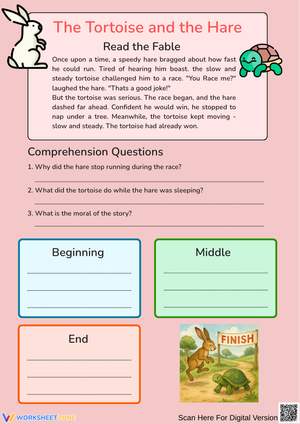
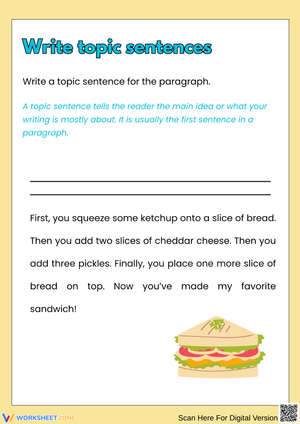
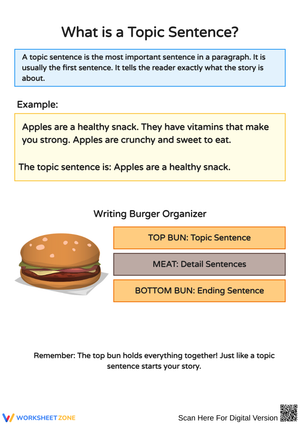
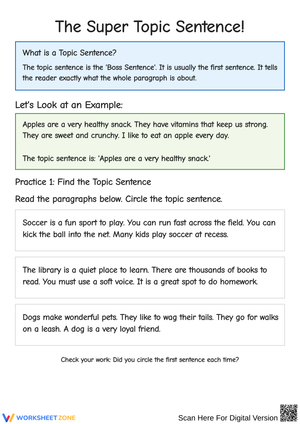
These beginning middle end worksheets for 2nd grade give teachers a print-ready tool for one of the trickiest transitions in early literacy: moving students out of the "and then... and then..." writing pattern and into a story with actual shape. The set covers both retelling from a read text and original composition, so the same stack of copies earns its place during reading response and writing workshop.
The Specific Skills Practiced Across the Set
The worksheets ask students to work in two directions—reading and writing—and both reinforce the same underlying framework.
Reading-focused worksheets ask students to:
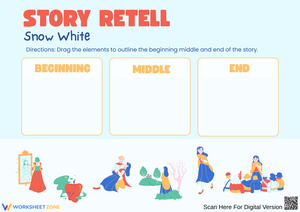
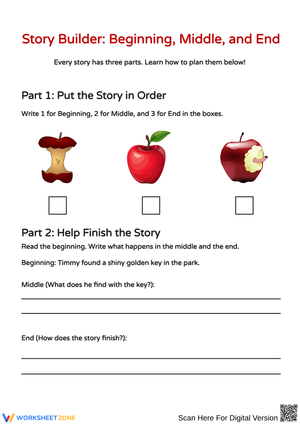
- Identify and describe the beginning, middle, and end of a short passage in their own words
- Record the characters and setting established at the story's opening
- Name the central problem and describe at least two events in the middle that connect to it
- Explain how the character's situation or feelings shift by the final section
Composition worksheets ask students to:
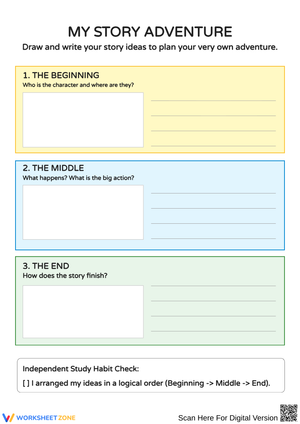
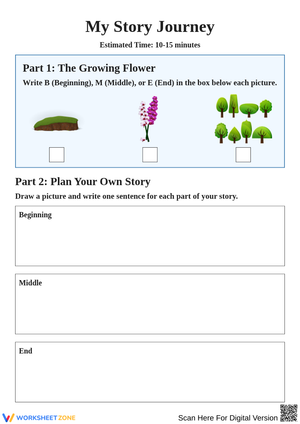
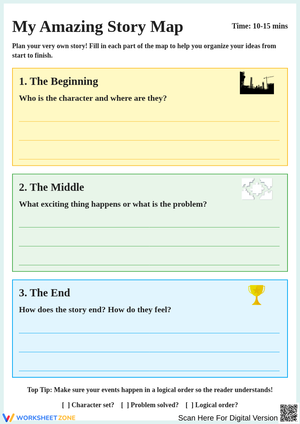
- Plan an original story by filling in a three-part organizer before drafting
- Extend the middle section beyond a single event, using multiple lines to build more than one connected moment
- Write an ending that closes the problem introduced at the start rather than introducing an entirely new idea
Using the retelling worksheets before the composition ones creates a useful sequence: students locate structure in someone else's story before they are asked to build it themselves. That order matters, especially during the first weeks of a narrative unit.
Errors Students Make That These Worksheets Help Surface
Three patterns appear in student work consistently enough that they are almost predictable at this grade level.
The first is the one-event middle. A student writes "Lila looked for her cat" in the middle box, considers the section finished, and moves on. The multi-line middle section on each worksheet is a deliberate signal that more than one moment belongs there. When students leave most of those lines blank, that gap opens a natural conference conversation about building action before the ending arrives.
The second is the disconnected ending. Students will wrap up with something like "and then they all had cake and it was great"—introducing a new element with no tie to the problem set up in the beginning. Worksheets that ask specifically "How was the problem fixed?" redirect students to look back at their beginning before they close the story.
Third—and easy to overlook in a full-class read—is the characterless beginning. Students often launch straight into action: "One day there was a big storm." No one is in the storm. We don't know why it matters. A beginning-section prompt that asks "Who is in your story?" and "Where are they when the story starts?" pushes students to anchor the narrative before the action begins. Without that anchor, the middle and end feel unearned even when the events are creative.
How to Build These Worksheets Into Your Literacy Block
The most reliable entry point is a shared mapping session with a mentor text the class already knows well—a book from earlier in the year works better than something new. Before students ever pick up a pencil on an individual worksheet, map the familiar story together on a large class chart using the same three sections they will later fill in independently. Students contribute the content; the teacher records it. That collective session lightens the working-memory demand on the first independent attempt because students are applying a structure they have already rehearsed aloud, not encountering it cold on a blank page.
From there, beginning middle end worksheets for 2nd grade work well as a five-to-eight minute read-aloud response task during the first two weeks of a narrative unit—short enough to fit before transitions, long enough to build consistent habit. Later in the unit, the composition worksheets slot in as planning tools before students open their writing notebooks. Teachers who anchor small-group work around these on Tuesdays and Thursdays see students arrive at Friday's independent writing block with a noticeably clearer sense of where their stories are going.
One honest limitation: the three-box format benefits students who think in linear sequence naturally, but it can frustrate writers who prefer to draft freely and revise later. For those students, let them draft first, then use the worksheet after the fact as a self-check—labeling the beginning, middle, and end in their own draft to see what is present and what is missing.
Standard Alignment
The set addresses two distinct second-grade CCSS strands. CCSS.ELA-LITERACY.RL.2.5 asks students to describe the overall structure of a story—specifically how the beginning introduces the story and the ending concludes the action—and the retelling worksheets address that standard directly. CCSS.ELA-LITERACY.W.2.3 covers narrative writing: recounting a sequence of events with elaboration, using temporal words to signal order, and providing a sense of closure. The composition worksheets map most directly onto the closure requirement, which is consistently the piece second graders underperform on in on-demand writing samples. Having a completed three-part organizer in hand makes that gap far easier to identify than reading a full draft after the fact.
Adjusting the Set for Different Writers in the Room
For students who need more support—including those still building English writing fluency—the beginning middle end worksheets for 2nd grade work well when introduced with the beginning section already filled in. Removing that first decision lets students focus entirely on sequencing the middle events. A picture-only version, where students sketch rather than write in each section, serves as a bridge before written production begins and keeps the structural thinking active without stalling students at the transcription stage.
Students who move quickly through composition tasks benefit from an expanded middle section that asks for a "turning point" in addition to a sequence of events—language that previews the story-arc vocabulary they will encounter more formally in third grade. Asking these writers to include one sentence about what the character thought or felt when the problem got worse adds meaningful complexity without changing the task structure for the rest of the class.
Frequently Asked Questions
Why do second graders struggle so much more with the middle section than with the beginning or end?
The beginning is easy because students start with what excites them. The end is easy because they want the story finished. The middle asks them to sustain a thought, make decisions about what comes next, and build tension toward a resolution—all of which require more sustained planning than most seven-year-olds have fully developed yet. The extra lines in the middle section are not accidental; they signal visually that more work belongs there and give students permission to keep writing past their first instinct to stop.
Can these worksheets support reading comprehension, or are they only useful for writing instruction?
The retelling worksheets are among the most practical comprehension-check tools available at this grade level. When a student's middle section on a retelling worksheet contains only the resolution—skipping the problem entirely—that is a comprehension gap, not a writing problem. The completed worksheet makes that gap visible in a way that whole-class discussion often obscures, because quieter students can listen without revealing what they actually understood. Individual written retelling catches what group conversation misses.
Does the set work for advanced writers, or does it mainly target students who are behind?
The beginning middle end worksheets for 2nd grade that ask students to record the character's internal reaction at each stage—what does the character feel when the problem first appears, and how does that change by the end?—are genuinely challenging for a fluent second-grade writer. That version pushes toward inferential thinking rather than event-level recall. At the other end of the room, a student still at the labeling stage finds the same three-part framework accessible because identifying is a simpler task than evaluating. The set holds up across that full range without requiring a completely different activity for each group.
How often should these worksheets appear across a writing unit before the format gets stale?
As a pre-writing planning tool, once per narrative assignment is enough—more than that and the organizer starts to feel like required paperwork rather than a thinking aid. As a reading response tool, two or three times a week is a reasonable ceiling before the format loses its usefulness. A Monday warm-up after morning meeting and a Friday close tied to the week's read-aloud is a natural rhythm that keeps the structure present without wearing it out before the unit ends.












 Interactive Worksheet Maker
 Quiz Maker
 Word Search Maker
 Crossword Puzzle Maker
 Word Scramble Generator
 Sentence Scramble Generator
 Handwriting Worksheet Generator
 Name Tracing Generator
 Fill In The Blank Generator