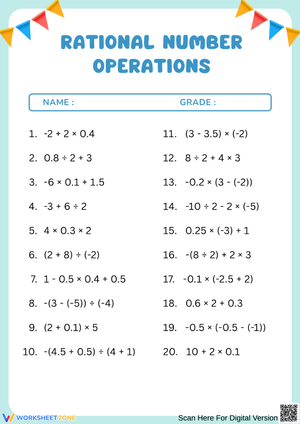
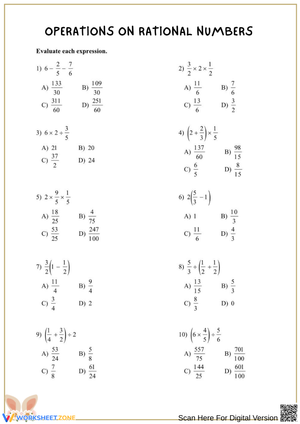
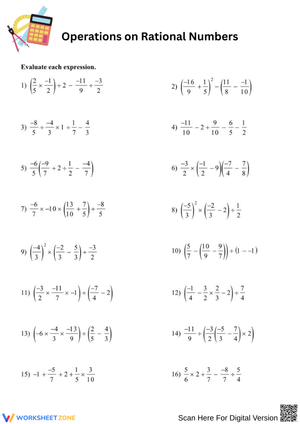
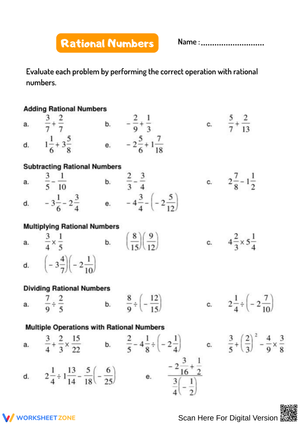
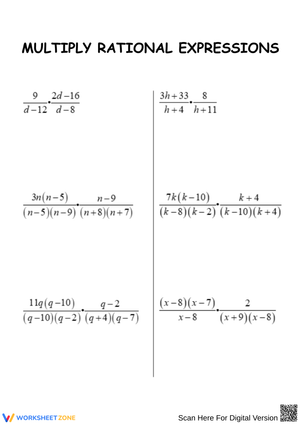
Multiplying and Dividing Rational Expressions Worksheets PDF for Grade 11
These multiplying and dividing rational expressions worksheets pdf for 11th grade address a skill where student confusion almost always traces back to one of three procedural gaps: treating terms as factors during cancellation, skipping the reciprocal step in division, or losing domain restrictions once a common factor disappears. Each worksheet in the set requires students to write factored form, note excluded values, and show simplification as distinct steps — which gives teachers actual process data, not just a final answer to mark.
What Each Worksheet Targets
The set works across the full range of polynomial forms students encounter in Algebra 2: monomials, binomials with a GCF, trinomials, and differences of squares — often combined within a single problem. The skills practiced on each worksheet follow the same core sequence:
- Factor completely before simplifying — both numerator and denominator, pulling the GCF first and then checking for other patterns.
- State domain restrictions from the original denominators before any factors are canceled or expressions are rewritten.
- Apply the reciprocal in division problems — rewriting the second rational expression before any simplification begins.
- Multiply remaining factors across numerator and denominator after cancellation is complete.
- Verify the answer is fully simplified, with no remaining common factors between numerator and denominator.
This sequence looks straightforward until students hit polynomial denominators with two or more terms. That is exactly where the error patterns below start appearing in written student work.
Mistakes Students Make That These Worksheets Help You Catch
The most persistent error at this level is canceling terms rather than factors. A student who correctly factors x² - 9 as (x + 3)(x - 3) will, in a different problem, look at a numerator like (x + 3)(x + 7) and attempt to cancel just the x from (x + 3) with a variable in the denominator. They understand that something cancels — they just haven't internalized that cancellation requires the entire factor, not a piece of a sum. That distinction takes more than one practice session to correct.
Several other errors appear regularly across student work in this unit:
- Dividing straight across instead of first multiplying by the reciprocal of the second expression. Students who memorized "flip and multiply" for arithmetic fractions sometimes abandon that rule once polynomial numerators are present.
- Omitting restrictions after cancellation. A student who cancels (x - 5) will often write a clean simplified answer and forget entirely that x = 5 was excluded in the original expression.
- Stopping at partial factoring — pulling out a GCF but not recognizing that the remaining binomial is a difference of squares, leaving common factors still in place.
- Missing the divisor's numerator as a restriction source. In a division problem, the numerator of the expression being divided by also creates an excluded value, because it moves into the denominator when the reciprocal is applied.
One classroom routine that reduces restriction errors consistently: ask students to box each original denominator — and the numerator of any divisor — before they factor anything. That physical step keeps the restriction information visible and sharply reduces the number of final answers that arrive without excluded values attached.
Fitting These Worksheets Into the Instructional Sequence
The most effective starting point is a multiplication-only worksheet where both expressions are given in pre-factored form. That version removes the factoring step entirely so students can concentrate on what cancels and why — and it gives teachers a fast read on whether the class understands the difference between a factor and a term. That information determines whether direct instruction is needed before any mixed practice begins.
Once multiplication is stable, introduce a division-only worksheet where every problem requires the reciprocal step before simplification. Partner work during the first few problems gives students a reason to name the step aloud — "I need to multiply by the reciprocal of the second expression" — which makes the rule stick more reliably than silent independent work. After that, a combined worksheet covering both operations with unfactored polynomials and multi-step simplification mirrors assessment conditions and gives teachers one more data point before the unit test. For reteach groups, working through four problems in a small-group setting with teacher observation surfaces error patterns that a class assignment alone would not catch.
Standard Alignment
These worksheets align primarily to HSA-APR.D.7, which specifies that students multiply and divide rational expressions as a system analogous to operations with rational numbers. That framing carries instructional weight: the structure of fraction multiplication and division transfers directly to rational expressions — what changes is that polynomial factoring becomes a required prior step, not an optional one. A secondary connection to HSA-SSE.A.2 is present whenever students identify the internal structure of an expression to rewrite it, which happens on nearly every problem. In course-sequencing terms, this topic sits after polynomial factoring is established and before solving rational equations or analyzing rational functions graphically. Teachers using multiplying and dividing rational expressions worksheets pdf for 11th grade in a pre-calculus course find the multi-step problems especially useful as targeted review before rational functions appear in a graphical context.
Differentiating Across Student Readiness Levels
For students who are still shaky on factoring, the most direct adjustment is to pre-factor the expressions on selected problems — providing the factor form and asking only for restriction notation and simplification. This removes one processing demand without changing what the rational expression problem itself requires. Once those students show consistent accuracy with cancellation and restriction notation, reintroduce unfactored expressions gradually: monomials first, then binomials, then trinomials.
For students ready for a genuine challenge, two adjustments go further than simply including harder polynomials. First, add problems where no cancellation is possible, requiring students to confirm — rather than assume — that the expression is already fully simplified. Second, ask students to construct a rational expression that, when multiplied by a given expression, produces a result with specified domain restrictions. Multiplying and dividing rational expressions worksheets pdf for 11th grade that span a visible range of difficulty allow teachers to pull problems for both groups from the same resource set rather than sourcing entirely separate materials for every lesson.
Frequently Asked Questions
What factoring skills do students need before starting this unit?
Students need reliable command of GCF factoring, trinomial factoring with leading coefficients of 1 and coefficients greater than 1, and difference of squares recognition. If any of those are shaky, the rational expression work deteriorates quickly — the majority of student errors on these problems originate at the factoring step, not in the multiplication or division structure itself. A short factoring diagnostic at the start of the unit saves significant reteaching time later.
Should students state domain restrictions on multiplication problems, or only on division?
On both operation types. Restrictions come from the original denominators of every expression in the problem, recorded before any factoring or cancellation occurs. In a division problem, the numerator of the divisor also creates a restriction, because it moves into the denominator position when the reciprocal is applied. A complete answer on any worksheet item includes all excluded values stated from the original, unfactored expression — not from the simplified result.
How many problems per worksheet is realistic for a 50-minute class period?
Six to eight problems with all work shown — factor form, domain restrictions, simplification steps — is a practical ceiling for independent practice in a standard period. Fewer problems done with full process documentation are more instructionally valuable than a longer set where students skip steps to reach a final answer. If the goal is formative data on process rather than answer accuracy, even four fully worked problems give enough information to plan the next lesson.
Can these worksheets be used with students returning to the topic after a gap?
They work well in that context when sequenced starting from pre-factored multiplication problems and moving progressively into unfactored forms. Students returning to this content after a break typically retain the basic multiplication structure but need explicit reactivation of the reciprocal rule and the habit of noting domain restrictions — both of which these worksheets reinforce through their required step format. Multiplying and dividing rational expressions worksheets pdf for 11th grade used in this review sequence work best spread across two or three sessions rather than compressed into one.
Clear All