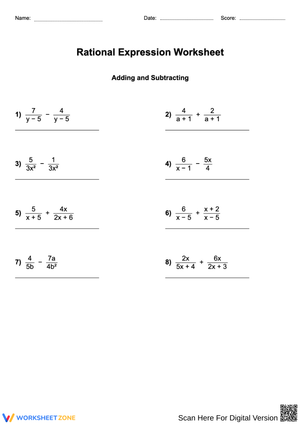
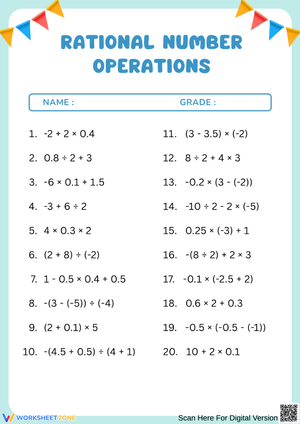
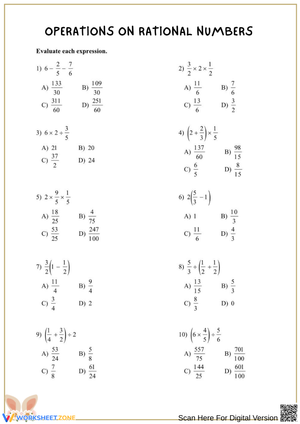
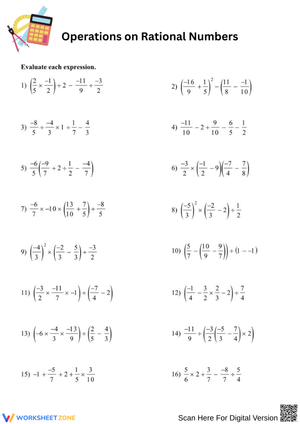
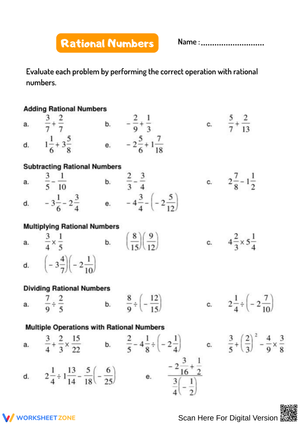
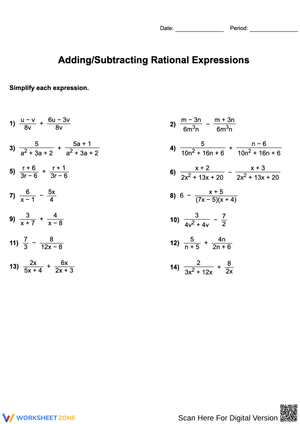
These adding subtracting rational expressions worksheets for 11th grade give algebra teachers a sequenced set of practice materials built around a skill chain students must execute in order: factor each denominator completely, construct the LCD from those factors, multiply each fraction by the missing factor, combine numerators, simplify, and state the excluded values. A breakdown at any single step stops the problem cold, and the worksheets are organized to develop each link before asking students to run the full process.
What These Worksheets Ask Students to Do
Factoring is treated as an explicit skill here, not a background assumption. Students factor trinomials, pull out greatest common factors, and identify differences of squares before any combined rational expression problem appears. A student who writes (x² − 9) as (x − 9) instead of (x + 3)(x − 3) cannot build a correct LCD — every downstream step breaks down. Making factoring visible on the practice set surfaces that failure before it compounds into a larger wrong answer with no clear entry point for correction.
LCD construction receives particular attention for the case where denominators share a factor. Students who learned fraction arithmetic with integers tend to multiply all denominators together regardless of shared factors, which produces an unnecessarily complex LCD and invites errors later. These worksheets include problems that specifically require students to identify the shared factor, take the highest power of each unique factor, and build a leaner LCD — not a product of everything present. Domain restriction identification runs throughout the set, placed before simplification on every worksheet because canceling a shared factor can hide an original restriction. The only way to preserve the accurate domain is to read the excluded values off the unsimplified denominators before canceling anything.
Student Errors Worth Watching Before They Compound
The most reliable error in subtraction problems is failing to distribute the negative sign across the entire second numerator. Students write a − (b + c), subtract b correctly, and leave c positive. In actual student work, that looks like setting up (4x + 1) − (2x + 7) and arriving at 2x + 8 instead of 2x − 6 — the 7 did not get negated. These worksheets address this directly by requiring students to write the second numerator in full parentheses as a discrete step before combining anything, which creates a paper trail that both the student and the teacher can check during review.
The other persistent problem is illegal cancellation: students cancel terms across addition signs instead of canceling factors. After watching a teacher cancel (x + 3) from a rational expression product, students attempt the same move on a numerator like (x + 3)(x − 1) + 5, treating the 5 as ignorable. A circled final answer can be completely wrong for this reason while the rest of the work looks plausible. The worksheets include problems where numerator simplification requires combining like terms before any cancellation is possible, specifically to interrupt that shortcut before it becomes automatic.
Where These Worksheets Land in a Typical Algebra 2 Lesson
The most effective entry point is error analysis. Before students attempt their own problems, hand them a worked rational expression problem with one deliberate mistake embedded in the subtraction step — ask them to find and correct it. That warm-up runs about eight minutes and focuses student attention on exactly where errors accumulate. Students who work through it make fewer sign errors in independent practice afterward because they have already articulated why the mistake is wrong. Worth noting: this activity falls flat on the first day of the unit. Students need at least one prior exposure to rational expression operations before they can meaningfully evaluate what went wrong in someone else's work.
For independent practice, these adding subtracting rational expressions worksheets for 11th grade sequence naturally after direct instruction on LCD construction. The like-denominator worksheets work well as an exit task on the first practice day, giving immediate formative data on whether students can combine numerators and simplify before unlike denominators enter the picture. Polynomial-denominator worksheets belong in the middle of the unit — placing them at the end, when time pressure is highest, tends to produce rushed factoring and cascading errors. On group work days, assigning one complex problem per group on a shared whiteboard makes factoring disagreements visible: students who cannot agree on the LCD have to articulate their reasoning aloud, which surfaces errors that would otherwise stay buried in silent individual work.
Tailoring the Practice for Different Student Readiness Levels
Students who are still unsteady on factoring need the preliminary factoring exercises as deliberate, graded practice — not a quick warm-up before the main event. Keep those students on monomial-denominator worksheets while more confident students work with polynomial denominators. The conceptual work is identical; the algebraic complexity is lower, and it gives struggling students a genuine success experience before the harder structures appear. Pushing them into polynomial denominators before factoring is solid almost always produces a student who memorizes a vague sequence of steps without understanding what any of them are for.
For students who move through the standard problems quickly, the most productive extension is working backward: give them a target LCD and ask them to construct two rational expressions that would require it. That task demands a different kind of understanding than solving forward and reliably identifies students who have learned a procedure without grasping what they are building. The error analysis format mentioned above also scales up here — rather than finding one mistake, ask advanced students to annotate an entire worked solution, labeling each step and explaining why it is or is not valid. That forces precise mathematical language in a way that standard problem sets rarely do.
Standard Alignment
These worksheets align with HSA-APR.D.7, which requires students to add, subtract, multiply, and divide rational expressions, understanding that rational expressions form a system analogous to the rational numbers. In classroom terms, this standard lands in Algebra 2 as the first point where students encounter an algebraic object with its own domain — not just a fraction to reduce and move on from. The adding subtracting rational expressions worksheets for 11th grade in this set cover the addition and subtraction operations specifically, which are the operations most likely to produce domain errors when students stay focused on the arithmetic and lose track of the excluded values they identified at the start.
Frequently Asked Questions
How do these worksheets sequence across a rational expressions unit?
Start with like-denominator worksheets, which isolate numerator combination and simplification without requiring LCD construction. Move to unlike monomial denominators next, then to polynomial denominators in two stages — first those where the denominators share no common factors, then those where a shared factor requires deliberate identification before the LCD can be built. Domain restriction practice appears throughout all stages rather than as a standalone final topic.
Why identify excluded values before simplifying rather than after?
Canceling a shared factor removes it from the final expression. If that factor was the only place a restricted value appeared, the simplified expression looks defined at a point where the original was not. Reading excluded values from the original, unsimplified denominators — before any cancellation — preserves the accurate domain of the expression the student started with. Waiting until after simplification occasionally produces a domain statement that is simply incomplete.
Do the worksheets include problems where the LCD is just the product of both denominators?
Yes. These adding subtracting rational expressions worksheets for 11th grade include both situations: problems where denominators share no common factors, making the LCD their direct product, and problems where a shared factor requires more deliberate construction. Students need to encounter and distinguish between both — defaulting to simple multiplication in every case produces an unnecessarily complex LCD whenever the denominators do share a factor, which then makes the numerator combination harder than it has to be.
What should a teacher do when a student's answer is algebraically equivalent to the key but written differently?
This happens regularly — numerators can be expanded or left factored in several forms that are all mathematically correct. The most useful response is teaching students to verify equivalence by substituting a test value into both forms. That habit builds algebraic reasoning well beyond the mechanics of combining fractions, and the answer key for this set flags the most common equivalent forms so teachers can address comparisons during review without reworking the full problem from scratch.












 Interactive Worksheet Maker
 Quiz Maker
 Word Search Maker
 Crossword Puzzle Maker
 Word Scramble Generator
 Sentence Scramble Generator
 Handwriting Worksheet Generator
 Name Tracing Generator
 Fill In The Blank Generator